Меню
The main objective of international relations is the regulation and proposals for the development of international trade and economic relations with neighboring countries, enforcement of our agreements and arrangements with neighboring countries, regulation and development of proposals for the development of international trade and economic relations with foreign countries, coordination and development of proposals for the development of international trade and economic relations of the Republic of Kazakhstan in the framework of international and regional integration, as well as assistance in ensuring the implementation of agreements and agreements reached with integration associations.
On September 6, 2021, Minister of Trade and Integration of the Republic of Kazakhstan Bakhyt Sultanov held talks with Erwin Bollinger, Commissioner of the Swiss Federal Council for Trade Agreements. The working trip to Switzerland is held on behalf of the President of Kazakhstan. It should be recalled that Minister Sultanov is the co-chairman of the bilateral Kazakh-Swiss intergovernmental commission.
The sides discussed issues of expanding and deepening trade and economic cooperation.
Bakhyt Sultanov noted the existing imbalance of trade flows and the need to diversify the structure of mutual trade. He offered his colleague a list of potential export goods from 70 product names for a total of $400.3 million.
"We have the opportunity to increase the supply of products from the petrochemical, machine-building, metallurgical, chemical, food, construction goods and light industry products. Large - scale work is being carried out in Kazakhstan to bring Kazakhstan's products, which can potentially be exported to the European Union, into compliance with the EU requirements and norms," the head of the Ministry of Trade said.
The parties also noted the importance of updating the regulatory framework in order to deepen trade and economic cooperation between our countries. In particular, the progress of work on the preparation for the conclusion of the Protocol on the internal regulation of trade in services.
"The signing of this Protocol will help to eliminate legislative barriers, improve the administration of licensing systems and ensure transparency of licensing requirements," Sultanov said.
We agreed to hold a regular meeting of the Intergovernmental Commission next year.
The issues of the upcoming 12th WTO Ministerial Conference were also discussed at the meeting. The parties expressed hope in achieving results on the substantive issues of the MK-12 and the effective holding of this conference.
On the same day, the Minister of Trade and Integration held meetings with representatives of a number of Swiss companies: Filippo Lombardi, President of KS Genetics SA, a member of the board of the Crypto Valley Venture Capital venture company, Johann Schneider-Ammann, ex-federal adviser and federal President of the Swiss Confederation. As well as Hans-Christian Schneider, CEO, Deputy Chairman of the Board of Directors of Ammann Group, and Peter Spuler, Chairman of the Board of Directors of Stadler Rail AG, Co-Chairman of the Kazakh-Swiss Business Council.
The Minister discussed issues of investment in export-oriented projects on the territory of Kazakhstan with business representatives.
For reference:
In 2020, Switzerland became the 11th largest trading partner of Kazakhstan with a share of 2% in the total trade turnover of Kazakhstan.
The volume of mutual trade between Kazakhstan and Switzerland by the end of 2020 decreased by 39% and amounted to $ 1.7 billion. (2019 - $2.8 billion).
Exports from Kazakhstan to Switzerland in 2020 decreased by 42.9% and amounted to $ 1.5 billion. The main decline in exports was due to a reduction in supplies of crude oil (against the background of a decrease in world prices), natural gas – by 24.5% or by $52 million(against the background of a decrease in commodity prices in the context of a reduction in demand in Europe due to the pandemic). Imports to Kazakhstan from Switzerland in 2020 increased by 38.9% and amounted to $188.4 million.
In January-July 2021, the trade turnover amounted to $673.2 million, which is 37% lower than in the same period of the previous year ($1,0169. 2 million).
Reform of the state planning system is underway in Kazakhstan. In particular, laconic national projects focused on the real needs of society will be adopted instead of cumbersome state programs.
The development of trade will be reflected in 2 national projects – «Sustainable growth aimed at improving the welfare of Kazakhstanis» and «Entrepreneurial development» (developed by the Ministry of National Economy).
Within the framework of the project «Sustainable growth aimed at improving the welfare of Kazakhstanis», the task is to increase non-resource exports by 2 times - up to $ 41 billion.
A number of comprehensive measures will be taken to address this.
First, the Export Acceleration program will be implemented. It is planned to cover 1000 domestic producers by 2025. Of these, 30% of enterprises will receive their first export contracts, the remaining 70% will increase their export volumes or discover new target markets with regular supplies.
Second, at least 50 exporters will be brought to international electronic platforms annually. Exporters with a special premium status will have the opportunity to comprehensively promote their products within marketplaces.
Third, the package of measures to support exporters will be expanded. This will increase production volumes, expand the geography of exports and improve the performance of export-oriented enterprises.
Fourth, 30% of the laboratory base will be modernized in 2025. Domestic manufacturers will be able to test their products in Kazakhstan and thereby reduce their costs, and therefore become more competitive when going for export.
The second national project «Entrepreneurial development» includes the creation of a national distribution network.
Work in this direction has already begun.
First, non-stationary trade facilities will be modernized.
Today, out of more than 500 universal trading markets, 103 require modernization. It is planned to modernize 37 retail facilities in the cities of Nur-Sultan, Almaty and Shymkent by the end of 2023, the remaining 66 (in other regions) by the end of 2025.
These measures will increase the level of civilized trade, improve tax administration and reduce shadow trade.
Second, it is envisaged to create an efficiently functioning trade, logistics and distribution system. This is the formation of a modern trade infrastructure, the construction of 24 WDC (Wholesale distribution centers).
Its implementation will ensure effective interaction of trade entities from the manufacturer to the end consumer.
Third, a Unified Strategy for the Development of Cross-Border Hubs will be adopted and 5 cross-border trade centers created / modernized
At the moment, the creation of ICTEC «Central Asia» has begun on the border with Uzbekistan. There are plans to create and modernize such centers on the external borders with Russia, China, Kyrgyzstan.
An integrated and systematic approach to solving these issues will allow to build a system of trade hubs. Subsequently, this system will be integrated with the WDC and will become the core of the development of Eurasian currents of trade.
It should be noted that today the national projects have passed all the approval procedures with the interested state bodies and will soon be submitted for consideration to the Office of the Prime Minister and the Presidential Administration.
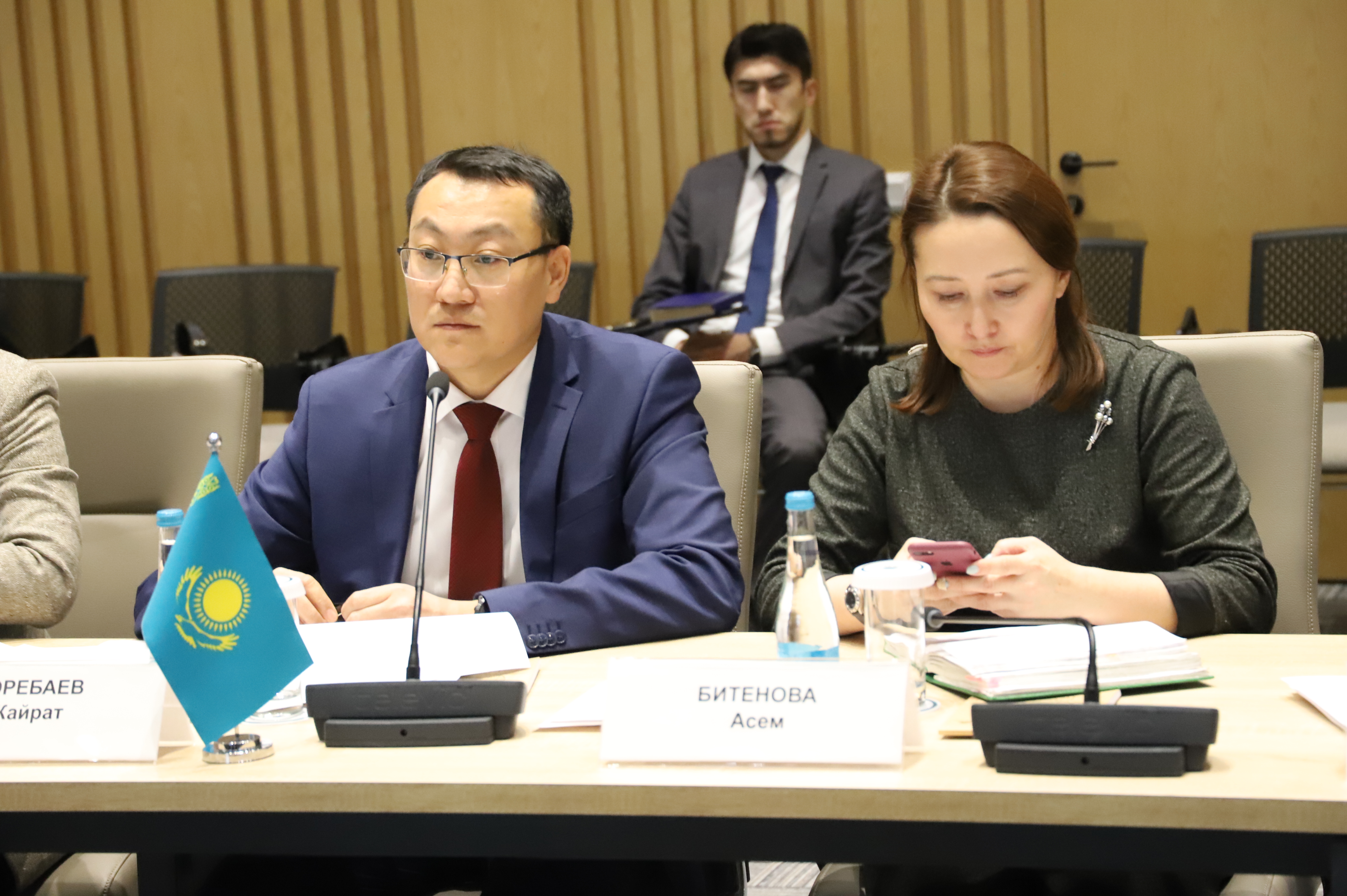
Almaty - On November 23, 2021, the 10th meeting of the joint intergovernmental commission on trade, economic, scientific, technical and cultural cooperation between Kazakhstan and Pakistan was held under the co-chairmanship of Vice Minister of Trade and Integration of Kazakhstan Kairat Torebayev and Deputy Minister for Economic Relations of the Islamic Republic of Pakistan Zubair Askhar Qureshi.
The parties discussed the state and prospects of development of cooperation in the field of trade, industry, investment, agriculture, energy, tourism and also considered the possibilities of improving access to the market of goods and services of both countries.
Speaking with a welcoming speech, Torebayev Kairat said that Pakistan is one of the promising directions of Kazakhstan in foreign trade, as well as an important strategic partner in the Asian space, with which a dialogue has been established and maintained both in a bilateral format and within the framework of common integration associations.
"Mutual trade between our countries demonstrates stable growth. Thus, by the end of 2020, the trade turnover between our countries increased by 68.5% compared to 2019 ($27.1 million) and reached $45.6 million. In just 9 months of this year, the volume of bilateral trade between Kazakhstan and Pakistan amounted to 39.4% compared to the same period last year ($34.5 million) and amounted to $48.2 million. At the same time, exports increased by 85.9% and amounted to $26.6 million, while imports increased by 6.6% and amounted to $21.6 million," Kairat Torebayev said.
At the same time, the Kazakh side notes that in order to increase mutual trade, there is a need to diversify and expand the range of goods supplied by Kazakhstan to Pakistan.
Also, the Ministry of Trade of Kazakhstan has developed a list of 110 potential goods worth $487.2 million, which are in demand in the market of Pakistan.
The sides noted the important role played by the Kazakh-Pakistani Intergovernmental Commission and stressed the priority of further deepening and diversification of bilateral trade and economic relations between the two countries.
At the initiative of the Kazakh side, work in the field of tourism was intensified and priorities for further development of tourism between the two countries were determined.
As for cooperation in the field of agriculture, the parties reached an agreement to conclude a Memorandum of Understanding on cooperation in the field of agriculture between the relevant ministries.
In addition, the co-chairs of the commission also exchanged specific initiatives to increase the volume of investments. Thus, Kairat Torebayev proposed to his Pakistani colleagues to promote investment in joint projects on the Kazakh territory of the International Center for Cross-Border Cooperation "Khorgos", which will facilitate access for Pakistani businesses to the consumer markets of the Eurasian Economic Union.
In this regard, the Kazakh-Pakistani Business Forum between investors and business circles of both sides interested in promoting investment and trade will be held within the framework of the intergovernmental commission on November 24-25 this year.