Меню
Страницы
Статья
Financial system of Mangistau region: formation and development. Department of Treasury for Mangystau region

Treasury: always up to date
After gaining independence, Kazakhstan embarked on the path of developing a market economy, and chose the Western model for the development of economic relations.
The collapse of inter-industry Union ties, galloping inflation, and unemployment became a great test for the young state. To overcome the economic crisis, it was necessary to ensure the strictest accounting and control of funds in the country. It was then that there was a need to reform economic structures and, above all, state financial management.
In January 1994, the Treasury Department Was established under the Ministry of Finance. This is a single budget execution body, which was given the functions of the budget office for accounting, as well as accounting methodology in budget institutions and the financial system. In addition, the Main Treasury Department was given greater powers, the ability to check ministries, departments, enterprises and organizations for the purpose and reasonable use of budget funds, and in case of detection of such facts – to withdraw funds that were not used for their intended purpose.
At the first stage of creating the Treasury system, territorial Treasury departments were formed in the regions where the National Bank had cash and settlement centers. They tracked the receipt of budget funds and credited them to the accounts of state institutions. Territorial administrations were legal entities, had independent cost estimates, current accounts in institutions of the National Bank of the Republic of Kazakhstan.
In 1995, the Treasury developed a new budget classification of revenues and expenditures of the budgets of the Republic of Kazakhstan, in accordance with international practice. In parallel, the functional part of the Treasury system was worked out.
In the same year, by the decree of the President of the Republic of Kazakhstan, the cash and settlement centers of the National Bank were transferred to The Treasury, on the basis of which the Budget Bank was created. This is a Bank formed for the transition period, so that its divisions and regional Treasury departments work in close cooperation, mastering the new technology for processing payments of budget organizations.
In January 1998, the Budget Bank was liquidated, and the functions of cash execution of the budget were transferred to the territorial Treasury bodies.
By decree of the Government of the Republic of Kazakhstan dated October 29, 2004, No. 1129 approved the Regulations on the Treasury Committee of the Ministry of Finance of the Republic of Kazakhstan, according to which the Treasury Committee was assigned certain functions of the Central office of the Ministry of Finance for the formation and clarification of the consolidated financial plan for financing the Republican budget for the current financial year; issuance, servicing and repayment of budget loans and funds diverted from the Republican budget; accounting for government and state-guaranteed debt obligations and claims, operations for withdrawing funds from government external loan accounts; accounting and storage of precious metals and precious stones that have become the property of the state on separate grounds, control and Supervisory functions for monitoring the development of budget funds and accounting for expenditures of state institutions; management of government and state – guaranteed debt, compliance with the requirements for debt to the Republican budget.
Mangistau regional Treasury Department, today the Department of Treasury for Mangistau region was established on July 7, 1995 by order of the Minister of Finance of the Republic of Kazakhstan dated 07.02.1995 with 7 staff units consisting of 7 people. The first head of the regional Treasury Department was Amangeldy Ahabaul Kudaibergen, who worked in this field for 33 years.
Since 2006 the Department is headed by experienced financier Hahayim Jusupova Kylikova.
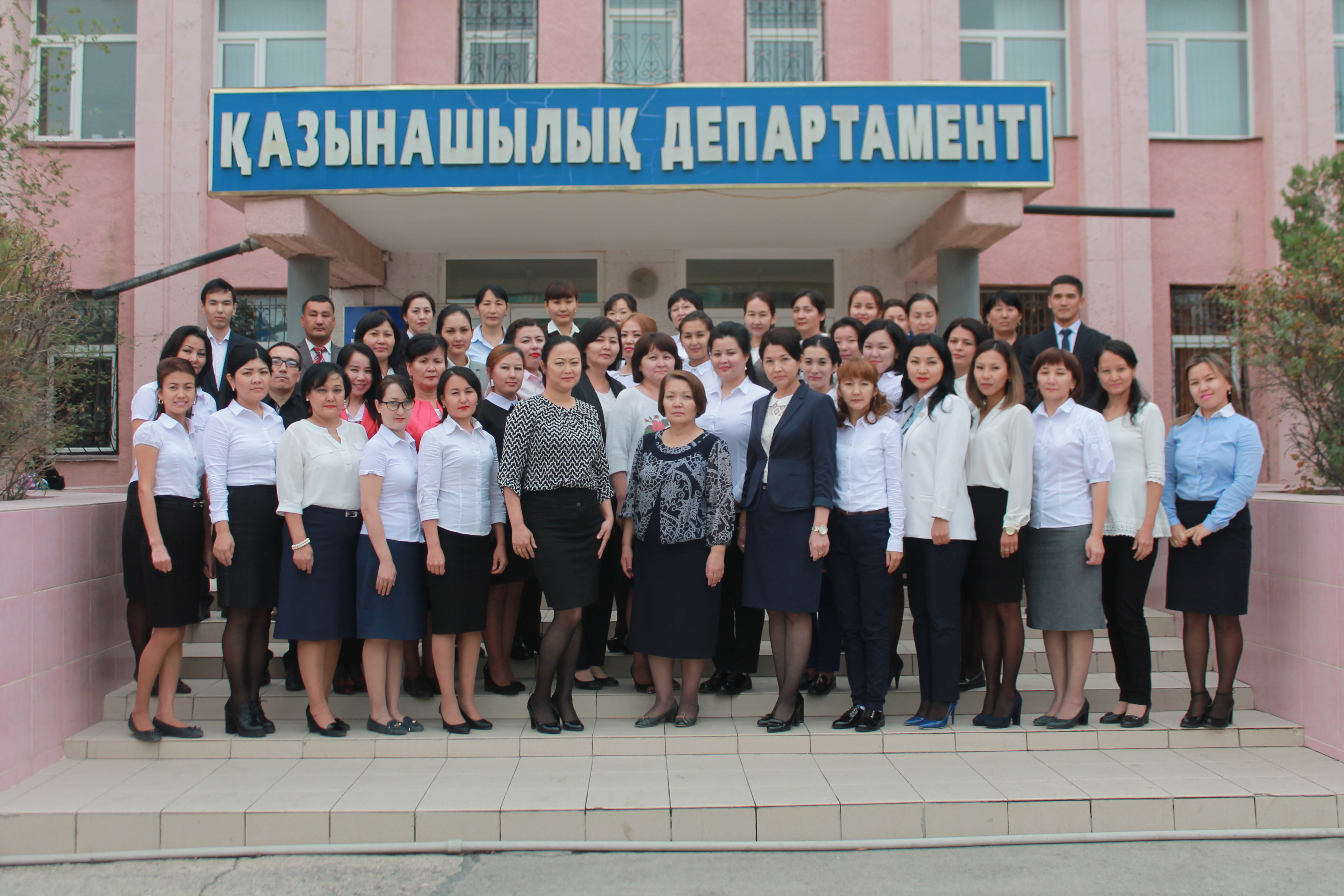
A combination of young and experienced specialists is one of the principles of forming the staff of Treasury bodies. Today, the Department has 111 employees. 93% of employees have a higher education, the average age is 37 years, and 95% of all employees are women. Among them, we can mention a number of experienced financiers who have been working since 1995-1998.Berdieva, M. Utenova, M. Sardarbek, K. Kuandykova, S. Omarova, G. Muratova, M. Doskalieva, B. Zhaylieva, S. Borambayeva. I would also like to mention veterans of the financial system, such as Zh.Kudabayeva, N. Janculova, Z. Ondasynov.
The Department has a Council of veterans, which includes all employees of the Department who have reached retirement age. These people share their rich experience in the field of compliance with official ethics and legislation, and provide practical, Advisory and methodological assistance in their work. Members of the veterans Council participate in all events organized by the Department.
The Department has its offices in Beineu, karakiyan, Mangistau, Munaili and Tupkaragan districts and the city of Zhanaozen. Offices run by experienced professionals, such as K. Kuandykov, S. Omarova, A. Saparbaev, B. Alieva, S. Borambayeva, G. Tlegenova.
Today, all state institutions of the Mangistau region (not counting institutions of special regime) are among the first in the Republic to fully connect to the information system "Treasury-client". The integrated information system "Treasury-client" covers the entire Republic, it is a set of functional characteristics that are aimed at ensuring the main goal set by the President of the country-effective management of public finances.
In self-service mode, government agencies fill out electronic forms of documents. After verification, approval and approval, these documents are automatically available in the Integrated Treasury-client information system.
The Treasury-client Information system integrates with the national certification Center (NTC) in terms of public key infrastructure and the Integrated Automated Information System "e-MinFin" in terms of receiving and processing payment documents.
The Treasury-client system serves about 8 thousand state institutions, and about 3 thousand internal users of the Committee perform real-time operations in the system, performing procedures for crediting and spending state budget funds. At the end of each month, the number of payment transactions processed in the Treasury-client IP is doubled, since during this period the main payments are made by state institutions (wages, benefits, taxes, and others). In this regard, and taking into account the importance of budget execution procedures, The Treasury's direct task is to ensure that every financial transaction is carried out in a timely manner while increasing the load on the system's performance.
Implementation of the "Treasury - client" IP provides remote servicing of state institutions. Since 2013, the processing of financial documents of state institutions has been reduced to 1 day.
At the same time, after the introduction of the "Treasury-client" information system in state institutions, the following economic effect is visible:
reduced administrative costs (for example: paper, transport costs, and time).
Integrated information system "Treasury-client" is one of the main tools of economic security of the country. This security depends to a great extent on the correct, purposeful work of the Treasury in the development of information systems and their support. Only the Treasury can save taxpayers ' money and bring it to the final recipients, fulfill the obligations assumed on behalf of the state and prevent fraud with budget funds.
Thanks to the transition to the digital mode of information exchange and electronic document management, the following positive effect is visible:
there is no irrational work of Treasury bodies on customer service and a lot of manual operator work on entering and checking primary information;
the presence of the "human factor" in the execution of the state budget is minimized;
reduced unnecessary paperwork and paper consumption;
the cessation of distraction specialists of the Treasury for execution of routine reports and certificates.
As of September 1, 2016, the Treasury Department and its regional offices provide Treasury services to 526 state institutions (83 of which are funded from the national budget, 432 from the local budget) and 11 quasi-public sector entities.
Also, in order to improve the quality of the budget process for budget execution, consulting and training seminars are held every month with financial employees of state institutions.
According to the results of the quarterly rating of the Department and its regional offices, our body has been constantly on the front line for the past few years. In addition, in order to identify the quality and performance of administrative civil servants, an assessment of their compliance with their duties is carried out. Despite not such a high salary, our employees are loyal to their work, providing services to all state institutions of the region, and feeling responsible for timely receipt of salaries by employees of institutions, transfer of pension contributions, etc.
The treasurers certainly have a big role to play in raising the quality of the state budget in a short period of time and ensuring transparency in the flow of budget funds.