GOV.KZ – Single platform for the digital resources of government agencies
On February 24 of this year, Chairman of the Industrial Safety Committee of the Ministry of Emergency Situations of the Republic of Kazakhstan Makazhanov N. paid a working visit to the Mangystau region. As part of the trip, N.K. Makazhanov took part in a meeting chaired by N. Nogaev, Akim of the Mangystau region.
Safety at social infrastructure facilities while using a gas equipment, provision of security while using elevators in multi-storey buildings, as well as the shortage of qualified specialists in the field of industrial safety issues were discussed in the meeting
At the end of the meeting, Nurlan Nogayev, the head of the region, gave a number of specific instructions to responsible persons concerning the safety of life and health of the population when using gas equipment in everyday life.
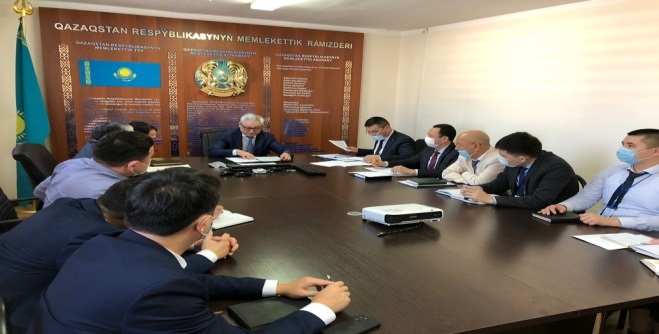
Also during the working trip, N. Makazhanov met with the staff of the Department of the Industrial Safety Committee of the Ministry of Emergency Situations of the Republic of Kazakhstan in the Mangystau region.
The meeting discussed issues relating to industrial safety, changes to normative legal acts, in particular, to the rules for industrial safety maintenance during operation of equipment handling which under pressure, to the requirements for the safety of gas supply systems, as well as requirements for strict compliance with anti-corruption legislation and the Ethics Code.
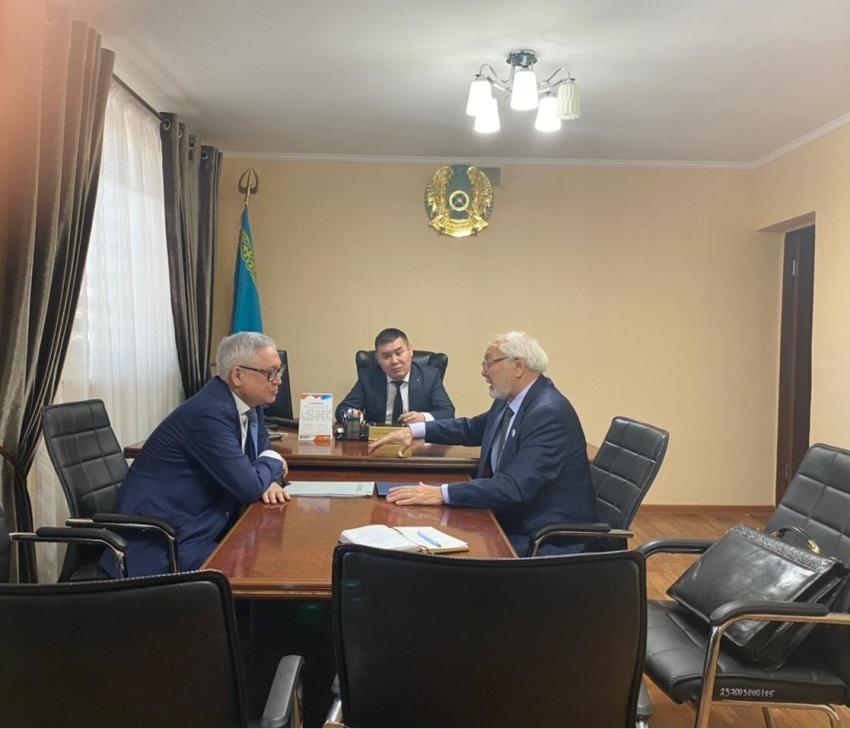
Moreover, N. Makazhanov met with K. Khairushev who is a veteran of industrial safety and emergencies. They discussed current problematic issues in the field of industrial safety in the region.
Khairushev K. is a citizen of honour of Aktau, from 1972 to 1991 he held various positions in the country's oil companies, from 1991 to 2005 he was the first head of the inspection of the State Technical Supervision of Mangyshlak (Mangystau) region, awarded the Order «Kurmet».
Инспекторами Департамента Комитета промышленной безопасности Министерства по чрезвычайным ситуациям Республики Казахстан по Костанайской области в период с 14 февраля по 18 февраля 2022 года проведена проверка по особому порядку опасных производственных объектов Государственного коммунального предприятия «ПХО «Лисаковскгоркоммунэнерго».
В ходе проверки обследовано 15 объектов, выявлено 8 нарушений требований промышленной безопасности. Инспекторами выданы предписания об устранении выявленных нарушений и наложен административный штраф по части первой статьи 298 Кодекса об административных правонарушениях.
По итогам проверки с руководством и инженерно-техническими работниками предприятия проведено техническое совещание, на котором рассмотрены нарушения, выявленные в ходе проверки, и обсуждены сроки их устранения.
The submission of applications for the state service "Certification of legal entities for the right to work in the field of industrial safety" is temporarily blocked due to the settlement of issues of confirming the qualifications of specialists to the requirements of professional standards approved under the Labor Code of the Republic of Kazakhstan in accordance with the Requirements for legal entities certified for work in the field of industrial safety (order of the Acting Minister for Investment and Development of the Republic of Kazakhstan dated December 26, 2014 No. 299).
We apologize for the inconvenience.
On November 22 of this year, the Order of the Minister of Emergency Situations of the Republic of Kazakhstan No. 463 dated September 20, 2021 "On approval of the Rules for certification of professional emergency services in the field of industrial safety" comes into force.
Certification of professional emergency rescue services in the field of industrial safety is carried out for the purpose of official recognition by the authorized body in the field of industrial safety of the powers of a legal entity to perform mine rescue, gas rescue, anti-spontaneous work at hazardous production facilities and is carried out as part of the provision of public services.
The state service is implemented on the web portal of electronic licensing in the section "Services for state bodies" http://elicense.kz
To ensure the safety of the operators of freight elevators, the loads they lift, as well as the people around them, the operation of freight elevators must be carried out in accordance with certain standards. There are "Rules for ensuring industrial safety during the operation of lifting mechanisms", approved by the Order of the Minister for Investment and Development of the Republic of Kazakhstan dated December 30, 2014 No. 359. These Rules are mandatory for organizations that own lifting devices.
When operating freight elevators, mandatory registration is required in the territorial divisions of the Industrial Safety Committee of the Ministry of Emergency Situations of the Republic of Kazakhstan (registration is not required for small freight elevators).
The owner of the elevator before the start of its operation organizes a commission for testing and commissioning of the freight elevator.
The weight of the lifted load must not exceed the maximum lifting capacity of this elevator/forklift. The operation of the freight elevator must be carried out in conditions that fully correspond to those specified in the passport for the elevator.
During the operation of a freight elevator, its owner is obliged to comply with the existing regulations and operating rules listed in the elevator instructions. At the same time:
- technical inspection, maintenance and repair must be provided in a timely manner;
- the freight elevator must be used strictly for its intended purpose;
- it must be ensured that the equipment is inaccessible to outsiders and employees who are not related to technical personnel;
- safe evacuation conditions must be provided in case of elevator failure;
- all additional devices used for communication from the elevator cabin, lighting devices, ventilation equipment (if available) must be maintained in working condition;
Elevator maintenance personnel must meet a number of requirements:
- these must be persons at least 18 years old, without medical contraindications for this work;
- freight elevator operator, electrician, elevator operator must undergo appropriate training and certification, and periodic recertification (at least once every 12 months);
- the personnel engaged in elevator maintenance must have certain qualification groups for electrical safety.
Supervision of the safe operation of the freight elevator should be carried out by its direct owner. As a rule, organizations that own freight elevators conclude contracts with specialized companies for the maintenance and repair of elevators.
The operation of the freight elevator should not be carried out and should be stopped in the following cases:
- the absence of a technical passport or information about the registration of the elevator;
- technical inspection has not been carried out;
- the standard service life specified in the elevator passport has been fulfilled;
- employees responsible for organizing the operation of the elevator, maintenance and repair of the elevator were not appointed by a separate order;
- the wear of elevator ropes exceeds the established norms;
- cracks or any other deformations were noticed in the metal structures of the elevator;
- malfunction of elevator safety devices and devices has been detected.
It should be noted that the standard operating life of elevators is 25 years. Freight elevators have been operated mainly in the city of Almaty since Soviet times. These elevators often fail, there are difficulties with repair due to the lack of original spare parts, since such elevators are no longer available. Therefore, the responsibility for safe operation lies entirely with the owners of these elevators.
Replacing freight elevators with expired regulatory service life with new ones will reduce the risks of owners.
On November 12, Minister of Emergency Situations Yuri Ilyin made a report at the Government Hour on the topic: "Ensuring industrial safety at hazardous production facilities: analysis, forecasts and proposals".
One of the important activities of the Ministry is the prevention and elimination of man-made emergencies, ensuring industrial safety. The system of state supervision in the field of industrial safety is aimed at preventing man-made accidents in mining, metallurgical, oil and gas, petrochemical, chemical and other industries that pose a threat to the safety of citizens and the environment.
In his speech, the Minister noted that the work on emergency prevention will continue and is aimed at ensuring an adequate level of industrial safety at hazardous production facilities to reduce the risks of accidents at industrial facilities.
Lifting cranes subject to registration in the territorial subdivision of the authorized body in the field of industrial safety, a full technical inspection is carried out before they are registered.
Lifting cranes that are already in operation, technical inspections are carried out in the following terms:
partial – at least once every 12 months;
full – at least once every 3 years, with the exception of rarely used cranes (cranes for servicing machine halls of electric and pumping stations, compressor units, other lifting mechanisms used only for equipment repairs).
Rarely used lifting cranes complete technical inspection is carried out at least once every 5 years. The assignment of cranes to the category of rarely used is made by the owner or the head of the organization.
An extraordinary full technical inspection of lifting cranes is carried out after:
installation caused by the installation of a lifting crane at a new location;
reconstruction of the lifting crane;
repair of metal structures of the crane with replacement of design elements or assemblies;
installation of replacement boom equipment or boom replacement;
overhaul or replacement of cargo (boom) winch;
hook or hook suspension replacements (static tests only);
replacement of load-bearing or cable-stayed ropes of cable type cranes;
installation of a portal crane at a new place of work.
Technical inspection of lifting cranes is organized by the owner or the head of the operating organization.
The technical inspection is carried out by an engineering and technical worker supervising the safe operation of lifting cranes with the participation of an engineering and technical worker responsible for the maintenance of cranes in good condition.
The technical examination aims to establish that:
the lifting crane and its installation at the place of work comply with the requirements of the manufacturer's instructions and these Rules;
the lifting crane is in good condition and ensures safe operation of moving cargo;
the organization of the system of production control and supervision, maintenance of the lifting crane complies with the requirements of these Rules.
With a full technical inspection, the crane is subjected to:
inspection;
static testing;
dynamic testing.
In case of partial technical inspection, static and dynamic tests of the lifting crane are not carried out.
Static testing of a lifting crane is carried out with a load 25% higher than its load capacity in order to determine the strength of the metal structure of the crane and its elements.
Static tests of an overhead crane and a mobile cantilever crane are carried out as follows. The crane is installed above the supports of the crane tracks, its trolley (trolleys) - in the position corresponding to the greatest deflection. With a hook or a device replacing it, the load is captured and lifted to a height of 100-200 mm, followed by exposure in this position for 10 minutes.
After 10 minutes, the load is lowered, after which the absence of residual deformation of the metal structure of the crane bridge is checked.
The crane is considered to have passed the static test if the lifted load does not fall to the ground within 10 minutes, cracks, residual deformation or other damage to the metal structure and mechanisms are not detected.
Dynamic tests of a lifting crane are carried out with a load 10% higher than the lifting capacity of the crane and is aimed at identifying hidden defects in the crane mechanisms.
During dynamic tests, lifting and lowering of the load is carried out repeatedly, as well as checking the operation of all lifting crane mechanisms when combining the working movements provided for in the operating instructions.
Technical inspection of cranes that have fulfilled the standard service life is carried out after their examination by a specialized expert organization according to the Instructions on the organization and procedure for conducting a survey of the technical condition of lifting machines that have fulfilled the standard service life, in order to determine the possibility of their further operation
Reliable and productive operation of automobile lifts is possible only if the lift is operated by the operator (operator) of the lift, who knows the lifting mechanism well and has mastered the management skills. Persons who have received special training and received permission from the qualification commission to operate the lift are allowed to work on car lifts. Work on a car lift is reduced to performing the following basic operations: preparation for departure, driving, proper installation, preparation for work, performing work operations, bringing the lift into a transport position.
The main purpose of a car lift is to work at height. These works performed by the lift are classified as high-risk works. To ensure compliance with safety regulations, the owner of the lift appoints responsible persons by order, which include:
person supervising the safe operation of lifts;
the person responsible for the maintenance of lifts in good condition;
the person responsible for the safe operation of lifts (at each work site and in each shift).
Car lifts are an indispensable component of the production process, with their help, the mechanization of various technological processes takes place.
For car lifts, the position of outriggers and the boom departure must be taken into account. During the operation of the lift, the requirements set out in the passport and the instructions for the operation of the lifts are observed.
Compared with other types of lifting mechanisms, car lifts are distinguished by the independence of movement, the possibility of operational relocation from one to another site, which allows the use of the lift for various types of work.
However, being a source of increased danger, increased requirements are put forward for the operation of such special equipment.
The work carried out by lifts near power lines is often associated with increased danger.
This is confirmed by the analysis of injuries during the work with the use of lifts. In most cases, electric shock occurs when the boom of the lift not only touches the power transmission wires, but is also located at a close distance from it - 0.5-1.2 m. Also, an accident can occur when a person who is in the cradle of a working car lift falls under the influence of step voltage.
All of the above puts the work performed near power lines on a par with the most dangerous work. As a result of targeted inspections of organizations that were carried out near power lines, it was found that in many cases these works occur with gross violations. For example, additional instruction is not carried out, work permits are not issued, places of work are not fenced, and so on. Such an attitude can lead to serious accidents.
To ensure safety, it is necessary to carry out regular inspection of lifts and additional devices, observe operating rules, safety precautions. At the same time, various unforeseen incidents can be avoided.
In accordance with Article 16 of the Law of the Republic of Kazakhstan "On Civil Protection", owners of hazardous technical devices are obliged to organize and carry out production control over compliance with industrial safety requirements; to register, de-register in the territorial subdivision of the authorized body in the field of industrial safety of hazardous production facilities.
According to the approved schedule of educational (preventive) measures in the event of a threat of committing an act of terrorism, the Department of the Industrial Safety Committee of the Ministry of Emergency Situations of the Republic of Kazakhstan in the Almaty region (hereinafter – the Department) conducted training sessions explaining to the Department's employees about the measures taken to prevent terrorist acts and other emergencies. In addition, during the classes, the staff got acquainted with the basic rules of conduct, as well as the algorithm of actions in case of a threat of a terrorist act on the territory of the Department.
In accordance with the norms of the requirements of the Decree of the Government of the Republic of Kazakhstan dated May 6, 2021 No. 305 on the organization of anti-terrorist protection of objects vulnerable to terrorism, in order to instill primary response skills among Department employees, it is planned to conduct training (preventive) activities on a monthly basis in the form of briefings and classes. At the same time, the passage of a training session by employees of the Department in the form of an instruction is necessarily displayed in the register of training activities on anti-terrorist training.
Gas is our friend when we handle it carefully, but also a dangerous and insidious enemy if we forget about it even for a moment. Household gas has practically no color or smell, but to determine its presence, microdoses of the odorant substance are added to it at the gas station to impart a specific smell.
The Law of the Republic of Kazakhstan "On Gas and Gas Supply" dated January 9, 2012 No. 532-IV contains the following requirements and rules:
- Article 19, paragraph 4. Municipal and household consumers using liquefied petroleum gas in household cylinders are obliged to conclude a contract for the maintenance of gas equipment belonging to them with a gas grid organization or the owner of a gas filling station engaged in the retail sale of liquefied petroleum gas in household cylinders;
- article 28, paragraph 5. Retail sale of liquefied petroleum gas in household cylinders is carried out by gas grid organizations and owners of gas filling stations, who are obliged to ensure the serviceable technical condition of household cylinders.
At the same time, filling of household cylinders with liquefied petroleum gas is allowed at gas filling stations and gas filling stations.
Clause 6. of Article 28 Gas grid organizations and owners of gas filling stations are obliged to:
1) to carry out subscription accounting of consumers purchasing liquefied petroleum gas in household cylinders;
2) inspect the filled household cylinders for technical serviceability;
3) to mark household cylinders with the trademark of a gas network organization or the owner of a gas filling station;
4) issue a quality warranty card for each household cylinder sold to consumers;
5) provide emergency and scheduled maintenance of gas cylinder installations.
Paragraph 7. Of Article 28 Is prohibited:
1) storage and (or) use of liquefied petroleum gas in household cylinders in residential apartment buildings with more than two floors.
WHAT YOU NEED TO KNOW WHEN USING GAS CYLINDERS.
Gas cylinders should not have irregularities in shape. Cylinder passports, collar and shoe must be undamaged.
The cylinder with a capacity of 50 liters should be painted red and have the inscription "PROPANE" white on the side. A plug must be placed on the corner valve of type WB to protect the valve thread and the lambs. To protect the valve body from mechanical damage, a protective cap must be installed on top. On the cylinder passport installed under the valve mounting, the weight of the empty cylinder, the weight of the full cylinder, the weight of the gas, the operating pressure and the period of the next technical inspection must be indicated.
Cylinders with a capacity of 27 liters should be painted red and have the inscription "PROPANE" in white on the side. The passport must be attached to the collar of the balloon. It must indicate the weight of the empty cylinder, the weight of the full cylinder, the weight of the gas, the operating pressure and the date of the next technical inspection. The KB type valve should not have visible shape irregularities and damage. A rubber O-ring must be worn on the valve.
Cylinders with irregular shape, deep scratches, cracks, corrosion without collars, shoes and passports are not allowed for operation.
It is forbidden to fill household cylinders at automobile gas filling stations. Refilling the cylinders without weighing can lead to overflow of the cylinder and, after entering the room, the cylinders are destroyed with the release of gas, which leads to a fire and explosion.
After installing the cylinders for use, the tightness of the connections is checked only with a soap emulsion. The use of open fire is unacceptable – it can also lead to a fire.