Меню
Страницы
Статья
Minister of Energy K. Bozumbayev: the dynamics of growth is impressive
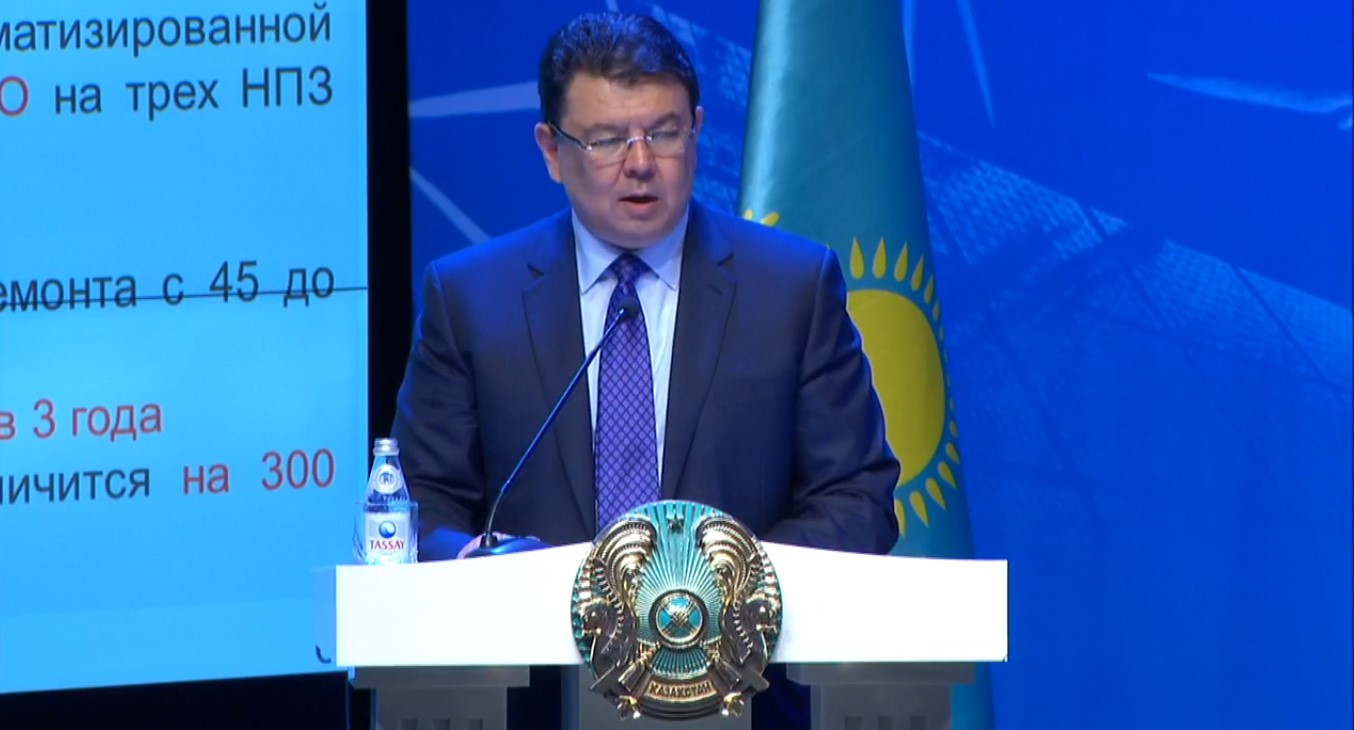
n June 19, 2018 the meeting of the Minister of Energy of Kazakhstan Kanat Bozumbayev with the population took place in Astana.
In his speech, the head of the ministry told about the priorities of the future work, plans and tasks of the ministry for the future, also dwelled in detail on the results of the work done over the past year.
The Ministry's activities are concentrated in three strategic directions: development of the oil and gas and oil and gas chemical industries; development of the electric power industry, the coal industry and the sphere of atomic energy use; improving the quality of the environment.
Concerning oil and gas industry:
The indicators by all sectors of the oil and gas industry show growth compared to the same period in 2017.
With the plan to increase oil production in 1%, in fact growth was 6.4%. The volume of oil refining amounted to 6.3 million tons of oil, showing an increase of 6.2% over the same period in 2017. With a plan to increase oil exports by 1.4%, growth was 5.7%. With a plan to increase gas production in 0.8%, growth was 6.4%. With a plan to grow liquefied and marketable gas production at 3.4% and 1%, growth was 4.7% and 7.6%.
The volume of oil production will grow and by 2025 will reach the level of 104 million tons / year.
To this end, all three major projects (Tengiz, Karachaganak and Kashagan) are carrying out further expansion and production extension activities.
In Kashagan, by 2024, the project of further expansion is expected to increase production from 13 million to 16 million tons per year. From the very beginning of the project implementation (since 1998), the volume of investments in the social and infrastructure development of Atyrau and Mangistau oblasts amounted to 570 million US dollars.
In general, the allocation of 50 million US dollars per year for social and infrastructure development.
The plan for the future development of Karachaganak envisages the implementation of projects to maintain the current production level: modernization of gas facilities, construction of the 4th compressor and the 5th infield pipeline. The implementation period in 2020 with an investment volume of more than 1.5 billion US dollars.
Over the years of development of Karachaganak, about 342 million US dollars were allocated for the social and infrastructure development of the West Kazakhstan region.
Every year, the allocation of $ 20 million for the social and infrastructure development of the region continues.
More than 30 thousand kazakhstanis work in Tengiz under the Project of future expansion. Investments in the project amount to about 38 billion US dollars, actual development over 2 years - over 11 billion dollars, and in 2018 the plan is over 7 billion dollars. After 2022, oil production in Tengiz will increase from the current 27 to 39 million tons per year.
Since 1993, Tengizchevroil has sent more 1.5 billion US dollars for social projects for the population of Atyrau region.
In general, anually about 25 million dollars are allocated for the socio-infrastructure development of the Atyrau region.
The Subsoil Code significantly simplified the granting of the right to subsoil use, shortened the time for consideration of project documents (contract up to 40 workdays), reduced administrative barriers (legal, economic expertise, project document for the conclusion of a contract were abolished).
Contests on the right of subsoil use will be continued this year, in the first half of this year. 11 subsoil plots were discovered in 5 regions (in Kostanay, Karaganda, Kyzylorda, Zhambyl, Mangistau oblasts). Contracts based on the results of the competition will already be concluded according to the norms of the new Code.
In 2018, the modernization of the Shymkent plant will be completed. The total volume of oil refining in 2018 will increase by more than 1 million tons and amount to 16 million tons.
From the beginning of 2018, the Technical Regulations of the Customs Union entered into force. Since July 2018, the quality of motor fuels must correspond to the ecological class K-4 and 5.
Introduced in this year's three refineries, the automation system for repair management (maintenance) will reduce the annual period of repair of the refinery from 45 to 20 days. The stoppage for 45 days will be carried out every three years.
The volume of oil refining at each refinery will increase by an additional 300 thousand tons per year.
The market security for 5 months of domestic petroleum products reached by gasoline - 84.8%, diesel fuel - 95%, aviation kerosene - about 36%.
To eliminate the deficit, the Ministry of Energy daily monitors the volumes of residues at oil depots and fuel imports.
As for the price of fuel, according to the rating of the International Agency Global Petroleum Prices (as of June 11 this year), Kazakhstan ranks 12th among the countries with the cheapest gasoline, and diesel fuel - 15th among 167 countries.
More expensive, gasoline, in countries such as Saudi Arabia, the United Arab Emirates, the United States, Russia, Azerbaijan.
Cheap gasoline only in 11 countries (Venezuela, Iran, Kuwait, Tukmenistan) and diesel fuel is cheaper in 14 countries (Venezuela, Iran, Saudi Arabia, Azerbaijan, Turkmenistan). Rating is formed monthly.
Construction of a new refinery: a working group was established to develop the pre-feasibility study. In the second half of the year, the location of the plant, its parameters and the financing mechanism.
The level of gasification of the country is about 47.4%. More than 1,300 settlements have access to gas. About 13 billion tenge is allocated annually from the republican budget for gasification.
Thanks to the 5-th social initiative of the Head of State, the issue of gasification of Astana, Karaganda and Akmola regions is being resolved. The solemn start of construction of the Saryarka main gas pipeline is planned in early July.
The first stage along the route "Kyzylorda-Zhezkazgan-Karaganda-Temirtau-Astana" will be completed by December 2019. Preliminary, the cost of the first stage is more than 267 billion tenge.
The 1st stage along the route will cover 171 settlements along the gas pipeline route, providing 2.7 million people with gas.
For residents of the capital, first of all, it is planned to bring gas to the residential areas "Koktal-1,2", "Zheleznodorozhny", "Southeast", right and left side, as well as to TPP-1,2,3.
From year to year, the volumes of bitumen production are being increased, thereby fully providing for the domestic demand. In 2017, 731 thousand tons of bitumen were produced, which is almost double the level of 2016. (480 thousand tons). In 2018 plans to produce 750 thousand tons of bitumen.
The implementation of large oil and gas chemical projects for the production of polypropylene with a capacity of 500 thousand tons and polyethylene with a capacity of 1,250 thousand tons continues.
The polypropylene project is under construction (the completion date is 2021).
Under the project, polyethylene is being developed a feasibility study with a strategic partner - the Austrian company Borealis (the completion date is the end of 2018). The volume of investments for two projects is more than 9 billion dollars.
During the construction phase, about 10,000 jobs and more than 1,000 seats will be created at the operational stage. The contribution to GDP from two projects is preliminary estimated at 1.5%.
Protection of the environment:
Today, favorable conditions have been created at the legislative level for the development of renewable energy sources in terms of attracting investments and introducing technologies.
Agreements were reached with the European Bank for Reconstruction and Development on the allocation of 200 million euros from the side of the bank, with an additional 480 million euros for investing in renewable energy projects in Kazakhstan.
The Green Climate Fund approved financing for Kazakhstan in the amount of 110 million dollars USA for implementation of renewable energy projects.
Today in the Republic there are 58 renewable energy sources with a total capacity of 352 MW. This year it is planned to introduce 10 renewable energy sources with a total capacity of 138 MW.
In late May - early June, the first international auction was held for RES projects with a total capacity of 245 MW.
In total, 53 companies from 6 countries of the world, such as Russia, France, Bulgaria, Turkey, China and Kazakhstan, took part in the auctions. Participants proposed bids for a total capacity of 960 MW, which 4 times exceeds the demand.
As a result, there was a reduction in the tariff for electricity at wind farms by 20%, for small hydro power plants - by 23%, for solar energy by 25.5%. Already 19 companies have the opportunity to sign contracts with a single buyer of electricity renewable energy for 15 years, at a total capacity of 194 MW.
In October this year. autumn auction auctions are planned on which the volume of the purchased installed capacity in the amount of 755 MW.
With regard to environmental regulation in 2017, work was carried out to improve the legislation in terms of reducing the burden on business.
The Business Code has introduced a risk assessment system that has reduced the number of inspections almost twofold: from 3177 inspections in 2016 to 1753 in 2017.
The issue of stimulating business in the use of green technologies is given special importance.
.
After the "EXPO-2017", 105 foreign and 28 domestic technologies of which 98 were selected by Akimats and National companies for implementation. Akimats of SKR, Kostanay Pavlodar and Karaganda regions have already introduced 9 technologies.
Until the end of 2018 it is planned to introduce 9 more technologies of EXPO.
In the sphere of waste management, the following achievements are achieved. Since 2015, the share of recycled and recycled industrial waste has grown 1.3 times, for SDW 5 times. 69% of the country's population is provided with collection and collection services. The share of polygons corresponding to environmental and sanitary requirements is 16%.
The akimats develop complexes of measures for the modern utilization and processing of SDW with a broad involvement of the business. For today, separate collection at different stages is introduced in 40, and sorting - in 19 settlements. More than 130 enterprises are engaged in the collection, sorting and processing of solid waste, producing more than 20 types of products from recyclables.
In Almaty, the PPP envisages the construction of a waste sorting complex in the Alatau district with a capacity of up to 1500 tons per day. The completion date is approximately the second half of 2018.
In Uralsk, the Finnish company ICM Recycling started implementation of the project for the construction of a waste sorting complex from this year. Currently, work is underway to provide communications.
In Karaganda, the Finnish company SET CleanTech together with LLP "Gorkomtrans of the city of Karaganda" plans to implement a project for processing waste products with synthesis gas.
A significant contribution to the management of waste is played by the implemented RRF mechanism. During the period of implementation of the RRP (2016-2017), 136 thousand tons of waste were collected and processed. The amount of payments to processors amounted to more than 5 billion tenge.
More than 2 thousand containers for collecting mercury-containing lamps and batteries for the amount of about 1 billion tenge have been manufactured and handed over to the akimats. From individuals and legal entities about 40 thousand cars were purchased for the disposition of 5.6 billion tenge.
In 2018, more than 3 billion tenge is allocated for the collection, transportation and processing of packaging waste and electrical equipment. This year it is planned to put into operation sorting lines in 7 settlements, 5 waste processing facilities in the cities of Shymkent, Karaganda, as well as in the Almaty region and in the Kyzylzhar district of the North Kazakhstan region.
Work is continuing on the elimination of historical pollution. Today, 15 objects of historical waste are in the republic's ownership, 3 of them have been liquidated, in particular: mercury-containing wastes in Karaganda, oil sludge in Mangistau region, toxic chemicals in Toguzak village, Kostanay region.
In total, about 94 million tenge was received from the implementation of these projects in the republican budget.
This year, the Ministry plans to remove the liquid chemical waste from the Temirtau Electrometallurgical Combine in the Karaganda region, assess the impact and cost of hazardous waste in Kostanai and Mangistau regions, and also the disposal of the source of ionizing radiation of cesium 137 in the Karaganda region.
Press service of the Ministry of Energy of the Republic of Kazakhstan