Меню
About anti-corruption issues
Anti-corruption is the most important strategic priority of the state policy of Kazakhstan. In the Address of the President of the Republic of Kazakhstan, Leader of the Nation Nursultan Nazarbayev to the people of Kazakhstan, “Strategy-2050: a new political course for the established state” emphasizes the need to “... sharply strengthen the fight against corruption, including by improving anti-corruption legislation, in order to achieve our ultimate goal - to eradicate corruption as a phenomenon. "
The state guarantees the protection of constitutional rights and freedoms of citizens from criminal encroachments, ensuring the inevitability of the state’s reaction to any offenses and holding the perpetrators accountable under the law.
In accordance with the legislation of the Republic of Kazakhstan:
- a person reporting a corruption offense or otherwise assisting in the fight against corruption is protected by the state;
- Information on the person assisting in the fight against corruption is a state secret;
- if necessary, bodies fighting corruption, ensure the personal safety of persons assisting in the fight against corruption.
The authorized body in the fight against corruption and corruption crime is the Anti-Corruption Agency of the Republic of Kazakhstan (Anti-Corruption Service) (in the regions - territorial Departments), which is a special state body that carries out law enforcement activities aimed at preventing, detecting, suppressing, disclosing and investigating criminal and other unlawful attacks on human and civil rights, the interests of society and the state in the field of economic and financial activities, the fight against corruption.
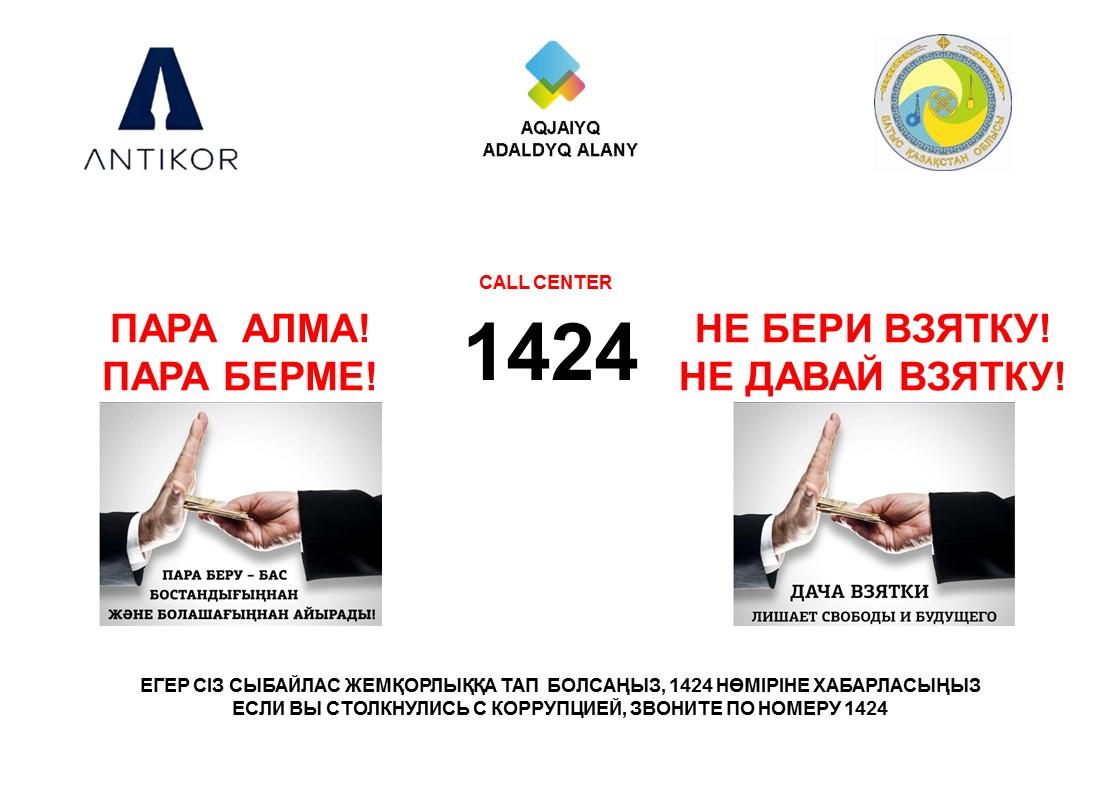
Helplines of the Department of the Agency of the Republic of Kazakhstan on combating corruption in the West Kazakhstan region: call-center 1424, +7 (7112) 98-47-20.
PREVENTION AND PREVENTION OF CORRUPTION
Offenses creating conditions for corruption:
- unlawful interference in the activities of other state bodies, organizations;
- the use of their official powers in resolving issues related to the satisfaction of the material interests of these persons or their close relatives and relatives;
- the provision of benefits not prescribed by law (protectionism, nepotism) upon admission and promotion of public service;
- the provision of undue preference for legal entities and individuals in the preparation and adoption of decisions;
- providing anyone with any assistance not provided for by law in the implementation of entrepreneurial and other activities related to the extraction of income;
- the use in personal or group interests of information obtained in the performance of public functions, if such is not subject to official distribution;
- unreasonable refusal of information to individuals and legal entities, the provision of which is provided for by law, its delay, transfer of false or incomplete information;
- the requirement from individuals or legal entities of information, the provision of which by these persons is not provided for by law;
- transfer of state financial and material resources to the election funds of individual candidates;
- repeated violation of the procedure established by law for consideration of appeals of individuals and legal entities and the solution of other issues within their competence;
- giving gifts and providing non-official services to higher officials to obtain property benefits, benefits or advantages using the official powers of these persons;
- explicit obstruction to individuals or legal entities in the exercise of their rights and legitimate interests;
- delegation of authority to state regulation of entrepreneurial activity to individuals or legal entities engaged in such activities, as well as to control and supervise it;
- transfer of state control and supervision functions to organizations that do not have the status of a state body;
- participation in gambling of a monetary or other property nature with higher or lower, or officials who are otherwise dependent on their service or work.
Civil servants should:
- resist the manifestations of corruption, prevent corruption-related offenses or acts involving corruption or creating conditions for corruption;
- suppress the facts of corruption offenses by other public servants;
- if he has reliable information about a corruption offense, he must take the necessary measures to prevent and terminate such an offense, including immediately informing the higher head, the management of the state body in which he works, and authorized state bodies in writing.
The leadership of the state body is obliged, within one month from the date of receipt of the information, to take measures on statements of the public servant about corruption offenses, cases of inducing him to commit these violations, including by organizing inspections and sending appeals to the authorized bodies.
The leadership of the state body is obliged to take measures to protect the public servant who has reported reliable cases of corruption offenses, inducing him to commit these violations, from prosecution that infringes on his rights and legal interests.
Civil servants should not allow actions (inaction) that impede the exercise by individuals and legal entities of their rights and legitimate interests.
A RESPONSIBILITY:
Receiving a bribe (Article 366 of the Criminal Code of the Republic of Kazakhstan) by a person authorized to perform public functions, or an equivalent person, or a person holding a responsible public office, or an official, as well as an official of a foreign state or international organization, personally or through an intermediary of a bribe to in the form of money, securities, other property, a right to property or property benefits for oneself or other persons for actions (inaction) in favor of the bribe giver or persons represented by him, if such actions (inaction) are included in the official powers of this person, or strength of official position may contribute to such actions (inaction), and equally for general patronage or connivance -
shall be punished by a fine in the amount of twenty to fifty times the amount of the bribe or by imprisonment for a term of up to five years, with confiscation of property, with life deprivation of the right to occupy certain positions or engage in certain activities.