Меню
Страницы
Статья
Museum
Museum reserve - "Khan Ordaly Saraichik"
Saraichik is one of the most ancient monuments of Kazakhstan. Saraichik is the cradle of the Kazakh Horde. A unique property of our independent Republic. Great heritage of the Kazakh people. Saraichik - admiration for the sources of antiquity and a connecting thread with the future. Saraichik is a tribute to the memory of the sages who lived, who wrote the Chronicle of our State, and gratitude for the revival of the forgotten.
The history of the emergence of this city is attributed by historians to the XIII century, that is, they are associated with the period of the invasion of Genghis Khan and Khan Batu. According to the facts that have survived to this day, written primary sources about this town appeared in the first half of the XIV century. It is in them that Saraichik is spoken of as a city where trade and applied arts were developed.
The first data about Saraichik was written by the famous Arab scientist-geographer, traveler Ibn Batuta. One of his trips to Asia in 1334 passed through "Ulken Saray". At that time he visited Saraichik. He writes about this as follows: “Having overcome the ten-day journey by horse-drawn transport from Saraichik, we got to the city of Saraidzhuk. This beautiful blooming city was located on the coast of a wide, deep-water and strong-flowing river called Ulysu (translated as Great Water). And the second in the world after Baghdad, a floating bridge was built here. Sarayjuk in Mongolian means Small Palace. At that time, Altyn Orda was the main Palace, and Saraichik was called the Small Palace. Hence the name Saraishyk (translated from Kazakh - small).
During the reign of the Kazakh Khan Kasym, Saraichik became the first capital of the Kazakh Horde.
The city was destroyed in 1580 by the Cossacks by order of Tsar Ivan the Terrible.
On the basis of the materials of historians collected over many years, the exhibits found over the years of excavations, especially on the basis of the richest material of archaeological excavations in 1996-2000, the museum-reserve "Khan Ordaly Saraishyk" was created, which was opened in 1999 on September 3.
The complex includes:
Khan's Pantheons. The author is the former akim of the Atyrau region, now the akim of Almaty Imangali Tasmagambetov.
Height 17 meters, 8-sided. Monuments to seven khans buried in Saraichik are installed between the walls. The names of the khans and the dates of their reign are inscribed on the black marble.
Khans:
-
1. Mengu-Temir (1266-1282)
2. Toktagu (Tokty) (1291-1312)
3. Zhanibek (1343-1353)
4. Amir Okhas (1440-1447)
5. Kasym Khan (1511-1518)
6. Shikh Mamai (1542-1549)
7. Zhusip (Yusup) (1549-1554).
Museum
The museum is equipped with exhibits of historical value that were found during archaeological excavations. A model of the city of Saraichik was developed in the XIV century.
Atyrau Regional Local History Museum
The Atyrau Regional Local History Museum was founded on July 22, 1939, on the basis of the decision of the organizing committee of the Presidium of the Supreme Soviet of the Kazakh SSR on the basis of the school museum.
On November 5, 1940, the museum was officially opened to visitors.
The museum fund contains about 50 thousand valuable historical exhibits on the history of the region, nature, art and culture.
1) Hall "Mystery of the Century"
The Sarmatian tribes lived at the turn of the 3rd-4th centuries BC. They were engaged in nomadic cattle breeding and partly in sedentary agriculture.
In 1999, archaeological excavations were carried out in the Zhylyoy district of the Araltobe burial mound from the north-eastern side. In the course of archaeological work, the researchers determined the time of the Sarmatians' habitation in the second millennium. Glass beads, bow arrows, arrowheads, fragments of a dagger, a fragment of an earthen vessel, an iron saber, a staff were found in this burial ground. After the restoration of the golden clothing of the Sarmatian leader, an exposition of the Sarmatian leader was opened in the museum in 2000.
2) Hall "Consonance of the Ages".
The history of the Kazakh people, the united tribes of that era of the Aryans, Sakas, Huns, as well as the early feudal states (Turks, Turgeshes, Karluks, Oguzes, Kipshaks, Karakhanids) is presented in the hall "Consonance of Ages". Samples of drawings of Arabic and Orkhon-Yenisei writing are shown.
The greatness of the Kazakh steppes is presented in this room: handicrafts, artificial types of ornamentation, stone sharpening, patterns, weapons, tribal signs, arhartases, koshkartases, kulpytases, which were erected over the heads of ancestors.
3) Hall of Archeology.
In the hall of archeology, the settlements Saraichik (XII-XIV) and Aktobe-Laeti (XII-XIV) are relatively described. Historical exhibits, coins, jugs, beads, ceramic dishes were found there.
4) Hall of Ethnography.
In the hall of ethnography of the Kazakh people, the life creativity of a person was formed, and the secrets of material and spiritual culture are also told. Here visitors are plentifully informed about handicrafts, jewelry by masters, national costumes, knitted on a loom.
Atyrau Regional Museum of Fine and Decorative Applied
Art named after Sh.Sariyev
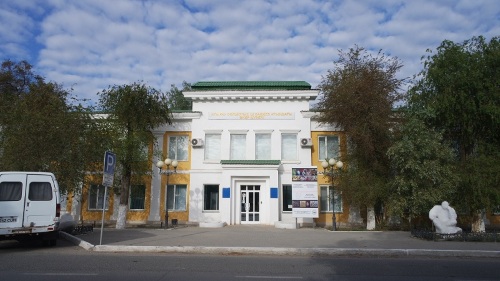
The Atyrau Regional Museum of Fine and Decorative and Applied Arts was organized on the basis of the Decision of the Executive Committee of the Atyrau Regional Council of People's Deputies dated 11/15/1990 No. 308.
The museum was opened for residents of Atyrau and guests of the city on April 2, 1992. The canvases for the main exposition were provided by the Directorate of Art Exhibitions of the Ministry of Culture of the Republic of Kazakhstan.
In 1999, on the anniversary of the celebration of the 100th anniversary of Kazakhstani oil, the regional akimat provided the museum with a building restored at the expense of the National Oil and Gas Company "Kazakhoil" (now "KazMunayGas").
The total area of the museum is 991.9 m2.
Eight spacious, beautifully decorated halls introduce visitors to the main exhibitions:
1.central hall (period from 1950 to 1970)
2.the ancient art of Mangyshlak
3.the hall of the ancient era
4.modern visual arts
5.graphics
6.graphics
7.arts and crafts
8.painting by Shaimardan Sariev
The original fund of the museum consisted of 1211 works. Over the next years, the collection was replenished with works of local and republican artists.
Now in the fund of the museum there are 1294 exhibits (paintings, graphics, arts and crafts). Among them are graphic works of famous Kazakhstani artists A. Kasteyev, K. K. Khodzhikov, U. Azhiyev, V. I. Antoshchenko-Olenev, E. N. Babad, K. Ya. Baranov, E. Besembinova, A. S. Besembinov , N. Gaeva, A. A. Guriyeva, T. N. Govorova, A. A. Dyachkina, I. N. Isabayeva, A. Ismailova, I. E. Kvachko, M. Kisamedinova, S. V. Kukuruza, T Mukata, B.P. Pak, E.M.Sidorkina, I.Ya.Stadnichuk, V.V. Timofeyeva, Sh.Sariyev and many others; paintings by masters of the brush of the RK-S.A. Mambeev, G.M. Ismailova, S. Romanov, J. Shardenov, L. Leontiyev, I. Nurmukhamedov, M. Kalimov, M. S. Kenbayev, A. A. Sydykhanov, local artists - K. Dosniyazov, J. Aralbayev, A. Aitmagambetov, K. Amanov, A. Zhantasov, R. Slekenov, S. Karibayev, E. Zhumabayeva and others; products of decorative and applied art by masters of applied art - S. and A. Bapanovs, L. Kalimova, K. Aytkaliyev, A. Nazarkul and others.
The work of the museum is not limited to the storage and replenishment of the fund with exhibits, republican and regional exhibitions - vernissages, meetings are constantly held, traveling exhibitions outside the museum are organized. Work is underway with visitors in aesthetic and artistic directions. The museum has a fine arts studio for gifted children. More than 25 schoolchildren of the city's schools acquire skills here and improve their knowledge of art and visual arts. All conditions have been created for this.
Professional artists-teachers work with them. Exhibitions, contests, quizzes and meetings with famous artists of the region are held. The administration of the museum pays much attention to educational, scientific and practical activities; in the future, unique and interesting exhibitions of our Kazakhstani artists are planned.