Меню
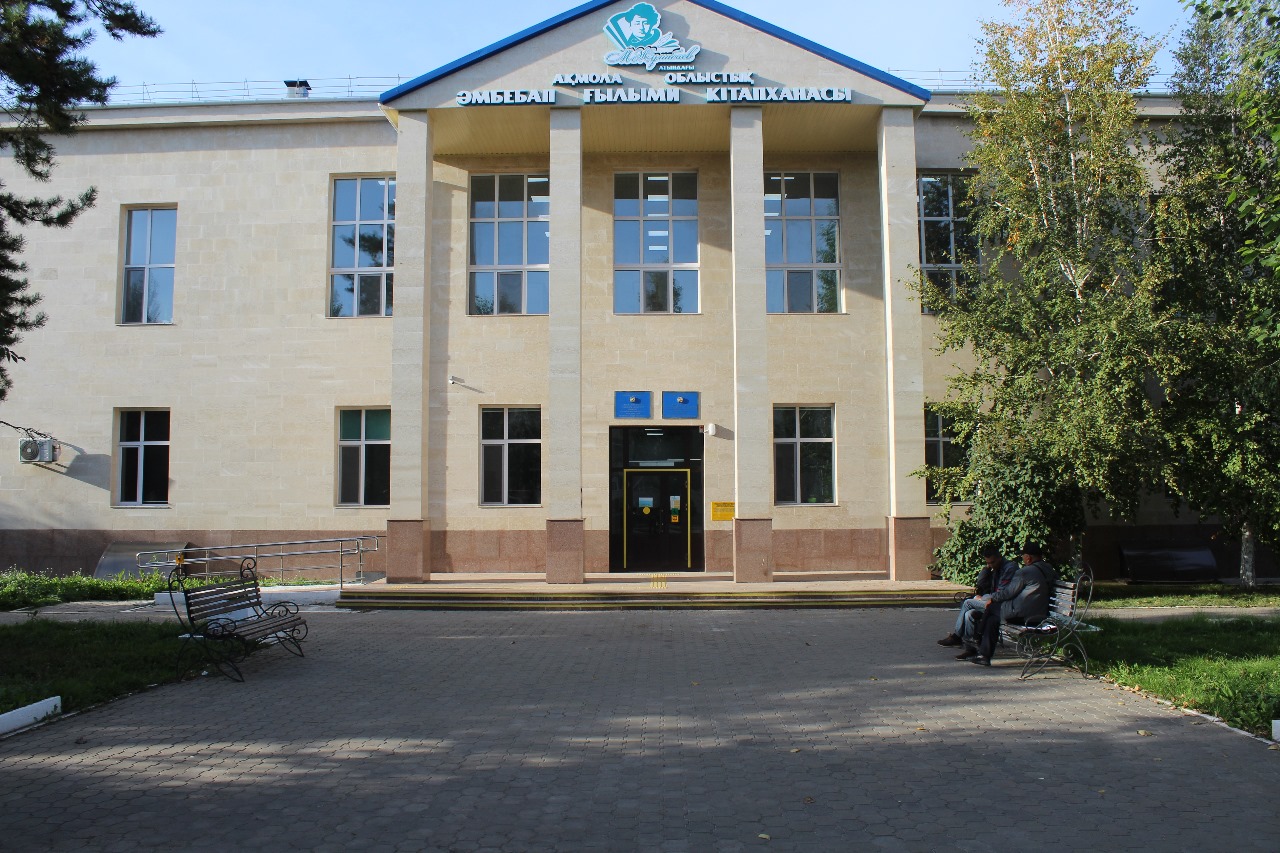
The Akmola Regional Universal Scientific Library named after M. Zhumabayev is the largest book depository, information, bibliographic and methodological center for public services and coordination of all library institutions in the region. The Akmola Regional Universal Scientific Library named after M. Zhumabayev was established in 1946 (the name was the Kokshetau Regional Library).
There are 336 libraries in the library system of the Akmola region, of which 329 are state-owned, of which 286 are in rural areas.
There are 4 libraries in standard buildings, 325 in adapted ones. The state library network includes: 1 – Akmola Regional Universal Scientific Library named after Magzhan Zhumabayev, 17 district, 3 city centralized library systems.
The book collection of the libraries of the state network is 4,430,210 copies, including 1,507,100 copies in the state language (+12,114). The book collection in rural areas is 3,005,272 copies, including 1,122,276 copies in the state language.
The modernization of the library sector continues. The total number of Model Libraries in the region is 88, including 65 model rural libraries. If in 2023 there were 42 coworking centers in the region's libraries, then in 2024 their number increased by 1 and amounted to 43. The number of computers in the region's libraries is 726, of which 424 are in rural areas. Compared to 2023, the fleet of computer equipment decreased by 103, of which 5 in rural areas. The number of libraries connected to the Internet increased by 1 in comparison with 2023, including rural areas increased by 1.
In 2024, after two years of major repairs, the Akmola Regional Universal Scientific Library named after Magzhan Zhumabayev was opened. After the renovation, the literary center was opened-the office of the writer, playwright, poet Tolegen Syzdykovich Kazhybaev. The study contains personal belongings of the writer: manuscripts, books by the author, a suit, a desk, a typewriter and other personal items. And also, the Saken Zhunusov conference hall, as part of the 90th anniversary of the Kazakh writer-playwright, winner of the State Prize of Kazakhstan. Books from the writer's personal library and photographs are on display in the conference hall.
The total number of readers is 315,923 (40% of the population reads), book sales in 2024 are 5,259,162 copies, visits are 3,645,655 people. In 2024, 38,228.4 million tenge was allocated from the local budget for the purchase of books (65,297 copies, of which 39,612 copies were in the state language).
The library has a typical building. The year of construction of a typical two–story brick building is 1971. Since 1992, it has been named after Magzhan Zhumabayev. The total area is 2997.9 sq.m., the main area is 1568.2 sq.m.
1985 – the beginning of the first stage of library computerization, in 1994 the RABIS module "Reader registration", "Cataloger", "Search. Order".
AOUNB named after M. Zhumabayev is actively conquering the information space of the region. For this purpose: the following innovative projects are continuing to work: "Alley of Diligence", "Golden Book", "Tula" and "Uly esimder – urpaq jadynda", "Encyclopedia of villages of Akmola region", "Library in the new global media space", "Polyglot". To increase the number of visits, the library pays great attention to interest clubs: there are 8 club formations: The Creative People's Club "Strings of the Soul", "Dialogue", "Serper", "Young Politicians", "Balalar áleminde – In the world of children", "Balalar aǵylshyn klýby – Children's English Club – Funny English", Linguistic club "Sunday Meeting – Bookclub". On November 10, the opening of the information and educational center "Altyn Arka" in local history, environmental and tourist areas at the Information and Bibliographic Department took place.
The activities of the regional library are carried out by 10 departments:
Library Development Department;
Service Department;
Information and Bibliographic Department;
Literature Acquisition and Processing Department;
The department of storage of the main fund;
Art Literature Department;
Department of Literature in Foreign Languages;
Department of Automation of Library Processes;
Department of Mass Events and Public Relations;
Department of organizational support.
Interesting moments of the library's history
The development of librarianship in Kokchetavsky district
Kokshetau is one of the most interesting and unique cities in Kazakhstan. His birth is connected with a historical event – the annexation of vast lands of Kazakhstan to Russia in October 1731.
On the basis of the "Charter", 8 external districts were opened in the Middle Zhuz. The opening of one of the districts was entrusted to Colonel A. Grigorovsky. On March 8, 1824, his detachment of mounted Cossacks and 35 officials set out from the Peter and Paul Fortress along a straight caravan road to Mount Kokshetau (translated from Kazakh as "blue mountain"). On April 29, 1824, the district "Order" was opened in a solemn ceremony with the participation of many Kazakh residents at the foot of the southern side of Kokshetau Mountain. In the autumn of 1824, a Cossack village named Kokchetavskaya was founded near Bukpa Hill. And in 1868, the village received the status of a city and became known as the city of Kokchetav (Akmola region, the center of Omsk) with a population of 3 thousand people. There were 2 churches and 2 mosques in the city. All this formed the spiritual life of the townspeople. It was only in 1908 that the library was opened, which had a small collection (several dozen books) and was housed in one room.
Libraries opened very slowly in Kokchetau county, and they were few in number. The library's readers were officials and officers. The indigenous population was mostly illiterate, led a nomadic lifestyle, did not visit libraries, and there were no Kazakh–language literature in libraries, and there were no librarians of indigenous nationality.
In 1914, there were only 9 libraries in Kokchetav county with a book collection of 2.8 thousand copies, with an average of 300 books per library. 97% of the county's population was illiterate.
After the October Revolution, there was a change in librarianship. Since the improvement of the culture of the population was directly related to the elimination of illiteracy, the management of this issue in Kokchetavsky district is entrusted to the district department of public education. On December 15, 1919, the first People's House was opened in Kokchetava, which had sectors: drama, music, library and lecture. Similar houses began to be created in regional centers and other settlements. 42 libraries, 231 reading huts, and 68 other cultural and educational institutions were re-established.
The main attention was paid to improving the quality of library book collections and replenishing them with literature in their native language.
At the beginning of 1928, there were 12 mass libraries in the territory of Kokchetavsky uyezd, and the book collection amounted to 7.2 thousand copies.
The number of libraries in rural areas has decreased from 8 to 2, due to the aftermath of the civil war and the difficulties of the reconstruction period.
By 1934, the network of mass libraries in the Kokchetav district increased to 163, and the collection totaled 189.3 thousand copies of books.
During the Great Patriotic War, libraries, like other institutions of the country, were rebuilt, their activities were subordinated to the interests of the country's defense. Librarians carried out extensive military-patriotic and operational information work, designed exhibitions, posters, stands, patronized hospitals, fulfilled requests from wounded and evacuated people for books, etc.
By the end of the war, the network of mass libraries in Kokchetav district had been reduced by two, mainly in rural areas (139 to 69 libraries).
Creation of a regional library in the city of Kokchetava
A library was organized at the People's House, established in 1919 in the city of Kokchetava. It occupied 2 rooms, they housed a subscription and a reading room. There was a librarian who worked there. The library's collection totaled 2,000 books.
Since 1926, two people have been working in the library: a librarian and the head of the library. The collection has increased to 3 thousand copies. However, recruitment is at the lowest level. Literature was sent without orders, very little. The library served children and adults. Events were held, loud readings were held, exhibitions of novelties were arranged, literature was processed by themselves, an alphabetical and systematic catalog was kept, literature was sent to the sowing company in the districts.
Since 1930, the library has been renamed the central district library and moved to another building on Uritskaya St., where it occupied 3 rooms.
Since 1936, the central district library has become the central city library. Since 1938, he has been moving to a room on the street. The Soviet one, where it was located until 1946. Another librarian is being added to the library staff. The fund is increasing to 5,000 copies. The number of readers is growing. The readers include: teachers, party workers, and the intelligentsia of the city.
During the war, the main readers were residents from other cities.
In connection with the formation of the Kokchetav region under the Kokchetav City Executive Committee on the basis of the Decree of the Supreme Council of the Kazakh SSR (dated March 15, 1944), the department of cultural and educational work was organized in the same year.
On September 12, 1945, the State Staff Commission approved the staff of the department of 10 people.
1946 was the year of the birth of the Kokchetav regional library, which was organized on the basis of the central city library with a book collection of 7 thousand copies of books (decision of the regional executive committee of February 15, 1946).
According to the staffing table, as of August 15, 1946, the library staff includes: the director, the head of the children's department, the head of the reading room, three librarians, an accountant, a fireman, a cleaner.