Меню
Страницы
Статья
General information
The Republic of Kazakhstan is located in the center of Eurasia, and is at the same time a European-Asian state. Most of the country is located in Asia, and a smaller part is located in Europe. This geographical location influenced the history, the formation of statehood and the development of Kazakhstan. Its territory already in the Paleolithic era became the place of settlement of the first people. Now important trade, economic routes and routes pass through the republic, which allows connecting Kazakhstan with both European and Asian states. Such a synthesis can be traced throughout the Kazakh history, which is very rich, dynamic, filled with bright events.
Periodization of the history of Kazakhstan
- An ancient stage of development.
- The first Kazakh state.
- Kazakhstan in the Middle Ages.
- New time.
- Joining Russia in the 18th century .
- The Soviet period.
- Independence.
Primitive history
A million years ago, the first people who inhabited the Karatau tract appeared on the territory of modern Kazakhstan. These were gatherers who, during the Paleolithic, developed neighboring territories. The Stone Age was replaced by the Mesolithic and Neolithic, which left traces of people's stay in Kazakhstan. This part of Eurasia has become one of the centers of formation of nomadic civilizations. Ancient tribes tamed and mastered the horse, learned to make products from stone, bone, metals. Archaeologists find traces of tribes living in Kazakhstan who were engaged in animal breeding, agriculture, and fought with neighboring tribes. In the Bronze Age, people who inhabited the Kazakh steppes mastered the war chariot, which can be found on numerous rock paintings. They were made by people in sanctuaries and temples, placing the chariot next to dancing people, gods, camels, bulls. This suggests that this transport was of particular importance in the society of the ancient Kazakhs. Representatives of the nobility, including warriors, were buried by the tribes in huge mounds. The most famous include:
- Begaza Necropolis.
- The Dandybai Necropolis.
- Tagiskent Necropolis.
During the Bronze Age, daggers, weapons, knives, jewelry were already made, as well as ancient copper mines were mastered. Most of them are still in use. It was during the Bronze and Copper periods that large cities and settlements began to appear, which protected moats. Warriors, priests, artisans and nobles lived behind the powerful walls.
The Age of Iron
It is associated, first of all, with the tribes of the Scythians, whom Greek historians and philosophers called Scythians. But in Asia, including Persia and China, they were called sakas and se. These tribes were nomadic pastoralists, perfectly mastered the bow and arrow. They created the first state association in Kazakhstan, which arose in the steppes in the 6th century BC. It existed for three centuries, and collapsed in the 3rd century BC. The capital was the city of Semirechye, in the south-east of modern Kazakhstan.
The Saks were a developed civilization, as evidenced by the presence of their own mythology, art, and writing. The Saka Scythians made unique jewelry made of bronze and gold, which are now exhibited in museums around the world. The Sakas were ruled by kings who were also priests at the same time.
In the 1st millennium BC, Kazakhstan, like other regions of Eurasia, came under the influence of the Turks, who caused a change in the ethnic situation. Archaeologists have established that the Kazakh steppes and valleys have become a place of constant internecine wars. As a result, the settlement of the Turks in Europe and Asia began:
- Pechenegs, Polovtsians, Oguzes, and black hoods migrated to Eastern Europe.
- To the southeastern regions of Central Asia - Karluks, Uzbeks, Turkmens, Kipchaks, Turgesh, etc.
- Seljuks and Turkmens migrated to the Caucasus and Asia Minor.
The period of the early Middle Ages
Kazakhstan was located in the center of migration processes that took place in Europe and Asia in the 5-7 centuries. Therefore, it is not surprising that unstable state associations constantly arose here in the period from the 6th to the 13th centuries. In particular, the Karluk and Turgesh kaganates, the proto-states of the Kimeks, Kipchaks, and Oguz. In the 13th century, the Mongols came to the Kazakh steppes. They founded two uluses here - Jochi and Jagatai, on the basis of which such state formations as Mogolistan, Ak-Orda, and the Kazakh Khanate were later formed. The common features of the first states were: The mixed nature of economic development. Simultaneous development of cattle breeding and agriculture.
The coexistence of populations in the steppe and cities. Active development of trade. Many cities were located along the Great Silk Road. Through him, the Kazakhs traded with the countries of Western Europe, Kievan Rus, Seljuk Kaganate, Japan, Korea, China, Iran, Constantinople. The proximity to the Silk Road contributed to the spread of new religious movements in Kazakhstan - Islam, Christianity, Buddhism, which displaced paganism. But only Islam managed to occupy the main positions, as evidenced by numerous historical and architectural monuments. Ancient mosques and minarets have been perfectly preserved in the steppes, indicating that Kazakh tribes adopted Islam in the 8th-9th centuries. New trends in culture, dance, painting, architecture also penetrated. In the 14th and 15th centuries, the processes of formation of the Kazakhs as a separate people ended.
The State of the Kazakhs
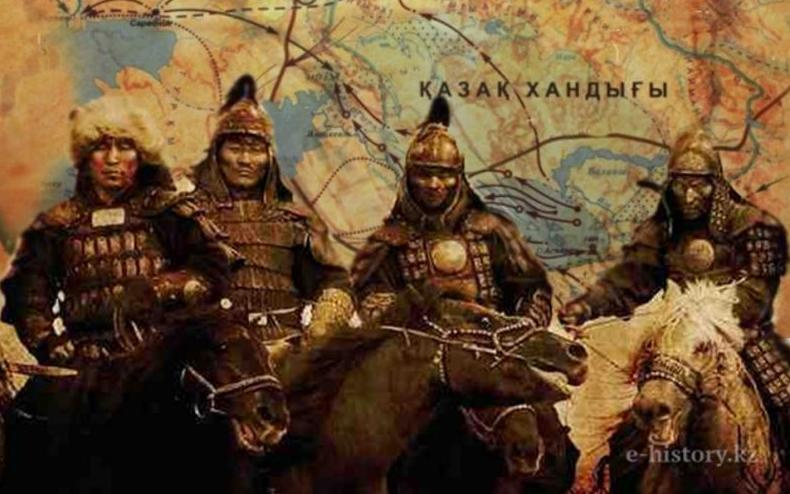
At the beginning of the 16th century, the first Kazakh state emerged in the steppes of modern Kazakhstan. This happened during the reign of Khan Kasym. In the future, his successors began to expand the borders of the state – zhuzes were formed in Central, Western Kazakhstan, in Semirechye. These associations were governed by clans headed by khans. They ruled independently, but the appearance of unity of the Kazakh state was constantly maintained. But periods of calm in the country gave way to long internecine wars for power, territory, wealth. Such an abrupt development - from recession to recovery - was characteristic of most of the states of that time that existed in Europe and Asia. When periods of relative stability came, the rulers of Kazakhstan did everything possible to strengthen the borders of the state and carry out reforms. For example, in the second half of the 16th century, the norms of customary law were codified, the state structure of the khanate was determined. Nevertheless, it was difficult to keep Kazakhstan from disintegration, since a single trade market, a single economic and political system was not formed. This was used by external enemies, for example, the Mongols. Their representatives concluded separate separate alliances with the Kazakh Khans.
18th century: "the great calamity"
The most frequent attacks on the Khanate were carried out by the Mongol-Dzungars, who lived in the territory between Altai and Tien Shan Mountain. The Dzungars intensified campaigns against the Kazakhs in the early 18th century, which caused mass migrations of the population from the Zhuzes, worsened the internal situation in the middle of the Kazakh Khanate. The period in the history of Kazakhstan, which began in 1723 and ended in 1727, is called the years of the great disaster. It was the peak of the Kazakhs' struggle against the Dzungars.
The rulers of individual zhuzes made attempts to unite in order to protect the country from the Mongol invasion, but the situation was constantly deteriorating. At that time, one of the rulers of the Kazakhs, Khan Abulkhair, who ruled the Younger zhuz, went to join the Russian Empire. Some local khans opposed this decision, but in 1731 the Younger Zhuz became part of Russia.
Thus, at the beginning of the 1730s, the territory of Kazakhstan was divided into three parts:
- The younger zhuz was ruled by Russia.
- The middle Zhuz remained independent, but repelled the attacks of the Mongols.
- The elder zhuz has already been conquered by the Dzungars.
Now the Kazakhs were protected from the attacks of the Mongols by Russian troops. Gradually, Russia's power in the Kazakh steppes strengthened and expanded. In the 1770s - 1780s, Russian laws and management traditions began to be introduced into the zhuzes. At the end of the 1780s, Kazakhs were allowed to settle further than the Urals and settle the regions of the Volga region. At the beginning of the 19th century, the Bukeevskaya Horde was formed here.
As part of Russia: loss of independence
The remaining regions of the Kazakh state were incorporated into the Russian Empire during the 1820s - 1840s. This was facilitated by internal contradictions between the Zhuzes and Khans, as well as the loss of Britain's struggle for possession of Central Asia. As a result, the Senior and then the Middle zhuzes were annexed to Russia. If the Kazakh khanates at first had relative autonomy and independence in internal affairs, then these rights were later eliminated. The reason for this was the policy of maneuvering individual Kazakh khans between China and Russia. So the rulers of the Zhuzes sought to find the best development option, tried to preserve the feudal statehood of the Kazakhs and conduct their own independent foreign and domestic policy.
In 1822, the Russian government decided to completely eliminate the khan's power and form a separate district on the site of Kazakhstan. These changes were fixed in the document "The Charter of the Siberian Kyrgyz", which was developed by M. Speransky. Kazakhs were managed on the basis of the Charter. Russia sought to turn new subjects into farmers, which provoked the resistance of the Kazakh population. From time to time, uprisings and local conflicts broke out, which only caused the strengthening of the power of the Russian Empire in this part of the Eurasian continent. In the second half of the 19th century . The resistance of the Kazakhs was practically broken, and the zhuzes began to be governed by Russian laws.
The presence of Kazakhstan in Russia had the following consequences for the history of the Kazakhs and the further development of their state traditions:
- The territories of the Kazakh zhuzes were divided into separate regions, without taking into account ethnic borders.
- The quantitative ratio of the sedentary and nomadic population living in the steppes has changed. New forms of economic and economic activity began to emerge. In particular. Regions that were engaged in settled cattle breeding and settled agriculture began to actively develop.
- The differentiation of society has intensified, which caused a large number of Kazakhs to move away from agriculture, and the transition to industrial production. Mostly impoverished peasants got jobs in factories and factories.
- The nature of trade has completely changed, which now began to take place in the form of fairs. Elements of usury and private farming began to penetrate into trade.
- Railways were built on the territory of Kazakhstan, which contributed to the development of transit trade and the establishment of links with other regions of the empire.
Kazakhstan in the 20th century: from the Soviet Union to independence

In the early 1900s. Kazakhstan was divided into several regions:
- Akmola.
- Semirechenskaya.
- Syrdarya.
- Uralskaya.
- Semipalatinsk.
- Turgayskaya.
- Mangyshlak-Transcaspian.
Separately, there was the Bukeevskaya Horde, which was included in the Astrakhan province.
The liquidation of the monarchy, the establishment of Soviet power, the formation of the Soviet Union affected Kazakhstan, as well as other republics that became part of the USSR. The above regions were united as part of the Kyrgyz Autonomous Republic, which happened in 1920. A few years later, the name of the republic was changed to Kazakh, which was administratively divided into several regions - Akmola, Turgai, Semipalatinsk, Ural, Bukeevskaya, Syrdarya, Zhetysu, one province – Orenburg, one autonomous association - Karakalpak.
The capital of the new republic was the city of Kyzyl Orda, which is now called Alma-Ata. In the mid-1930s, the autonomous republic became a full-fledged Kazakh SSR within the Soviet Union.
Simultaneously with the processes of administrative division, the active industrialization of the republic was carried out. As a result, Kazakhstan quickly turned into a major industrial center of the Soviet Union.
During the Second World War, enterprises from almost all over the USSR were evacuated to Kazakhstan, which were responsible for supplying the defense and technical industries of the Union with products.
In the mid-1950s, Kazakhstan began to develop a new industry – space, thanks to which the Baikonur military training ground was built here. From it, in 1961, the first ship was launched with Yuri Gagarin on board. Rockets and satellites are still being launched from the landfill. Now Baikonur is leased by the Russian Federation until 2050. In another city of Kazakhstan – Semipalatinsk - another test site was built, where nuclear and atomic weapons were tested.
In the second half of the 20th century . Kazakh steppes were also mastered, which were transferred to the needs of agriculture. This allowed the republic to take a leading position in the global grain supply market. And this status remains with Kazakhstan today.
Late 20th century - early 21st century

As many republics after the collapse of the Soviet Union, Kazakhstan became sovereign. The State declared independence in December 1991, followed by a period of international recognition from the countries of Europe, Asia, and the United States. During the 1990s, important changes took place in Kazakhstan. Firstly, the country has become a member of numerous international, European, regional organizations, structures and associations. Secondly, a currency was introduced – tenge. Thirdly, the constitution was adopted, the capital was moved to the city of Astana, a population census was conducted. Fourth, the Semipalatinsk test site has been liquidated.
In the 21st century. Kazakhstan was included as a republic that was at the stage of reform and constant changes, establishing contacts with neighboring states. The country's leadership supports the development of the history and national culture of the Kazakhs, the revival of ancient traditions. In 2017-2018, the President of the country decided to translate the Kazakh alphabet into Latin. The introduction of the Latin alphabet will be gradual and will affect all spheres of public and political life of the country. The modern foreign policy of the republic is aimed at expanding regional ties, cooperation with Russia, the United States of America, the European Union, and CIS members.