Меню
Информация
There are 680 cultural institutions in the West Kazakhstan Region, including:
- 2 drama theaters
- 2 concert venues
- 357 libraries
- 262 houses and clubs of culture
- 5 mobile cultural centers (autoclubs)
- 5 cinemas (3 privately owned)
- 15 cinema installations
- 25 museums
- 1 exhibition hall
- 3 parks
- 2 centers
- the State Inspectorate for the Protection of Historical and Cultural Heritage
Construction:
In 2025, the construction of 11 objects was planned in the region (including rural clubs in Shchapov, Makarov and Koshim (Baiterek District), the Dostyk cultural and sports complex; district libraries in Syrym and Zhanibek, rural clubs in Konekketten and Kabyrshakty (Akzhaik District), a rural club in Akkhozy and a cultural and sports complex in the village of Shoptikol (Karatyube District) and a cultural and sports complex in the village of Zhaksybai (Zhanibek District) and major repairs were planned for 7 facilities (the Youth Palace, the A. Ostrovsky Drama Theater, the M. Sholokhov Museum in Baiterek District, houses of culture in the rural settlements of Kentubek, Bumakol, and Zharsuat in Borli District, and the H. Bokeev Kazakh Drama Theater), as well as 2 scientific restoration projects (the Khan Mosque and the mausoleum of Zhangir Khan within the Khan Ordasy Museum-Reserve). As a result, 11 facilities have been commissioned.
This year, a creative hub titled “Ozge Epic Oral Creative Hub” was opened at the Youth Culture Palace, focusing on creative activities.
For the first time in our country, sector, a project is being implemented in the field of culture to modernize 25 rural libraries in cooperation with the “Qazaqstan Halqyna” Foundation. A total of 6 district libraries and 19 rural libraries were selected to participate in the project. At the expense of the local budget allocated by the regional akimat, repair work was carried out on library buildings, and the 'Kazakhstan Halkyna' fund provided them with modern equipment and replenished their book collections.
In addition, the construction of the library in the village of Shchapovo, Baiterek District, has been completed.
Cultural and Leisure Activities:
There are 262 club institutions operating in the West Kazakhstan Region, including 12 district houses of culture (including 1 in the city of Aksai), 109 rural houses of culture, 105 rural clubs, 31 urban houses of culture and clubs (including the Kyzyltal Club and the House of Friendship in Aksai), and 5 mobile cultural units (autoclubs) operating in rural areas. Of these, 118 institutions are housed in standard-purpose buildings, while 139 are located in adapted premises.
Over the course of the year, 15,482 cultural events were held in the West Kazakhstan Region, reaching a total audience of 1,613,235 people.
Clubs and Creative Groups:
There are 1,473 clubs operating in the region, involving 18,975 participants, including 945 children’s clubs with 12,356 children enrolled.
In the West Kazakhstan Region, 123 creative groups hold the honorary titles “People’s” (Folk) and “Exemplary”, of which 95 are titled “People’s” and 28 “Exemplary”, with a total of 3,093 participants. Their distribution by area is as follows: Kaztalov District — 13, Taskala District — 12, Syrym District — 12, Burli District — 12, Terekty District — 11, Zhanakala District — 9, Akzhaik District — 9, Baiterek District — 9, the city of Uralsk — 9, Shyngyrlau District — 8, Zhanibek District — 7, Bokeyorda District — 6, and Karatyube District — 6.
The number of staff positions amounts to 145. Creative groups holding the “People’s” title are fully provided with directors, choreographers, and accompanists.
According to Order No. 364-NQ of the Minister of Culture and Information of the Republic of Kazakhstan dated August 1, 2025, 13 creative groups in the West Kazakhstan Region were awarded new “People’s” and “Exemplary” titles in 2025.
In 2025, the region’s creative groups became laureates of 114 competitions, including 28 international, 48 national, 6 regional, and 32 regional-level (oblast) awards.
Museum Activities:
To promote the historical and cultural heritage of the West Kazakhstan Region, 25 museums provide services to the population, including 2 public museums, 2 district museums, the Khan Ordasy Historical, Cultural, Architectural and Ethnographic Museum-Reserve, the Zhaiyk Ancient Settlement Museum-Reserve, and the Regional Museum of History and Local Lore with 18 филиалами.
The museum collections of the West Kazakhstan Region received 7,140 new exhibits, bringing the total holdings to more than 226,561 items.
Over the year, museums were visited by 95,759 people. During this period, 11,131 guided tours, 400 public events, 168 exhibitions, and 164 lectures were conducted.
In addition, 2,685 museum exhibits were converted into digital format.
Library Services:
Project for the Modernization of 25 Rural Libraries:
For the first time in the country’s cultural sector, a project to modernize 25 rural libraries was implemented in collaboration with the “Qazaqstan Halqyna” Foundation.
In the West Kazakhstan Region, there are 357 public libraries, 328 of which are located in rural areas. For this project, 6 district libraries and 19 rural libraries were selected.
The project working group surveyed all 25 rural libraries, developed design projects based on the requirements and wishes of library users, and prepared the technical specifications. The Akimat of the West Kazakhstan Region committed to carrying out the renovation works in the libraries according to the design plans. During the implementation of the project, the Akimat renovated the selected libraries, while the “Qazaqstan Halqyna” Foundation provided necessary technical equipment and furniture, as well as over 20,195 books across 800 titles for each library to replenish the collections.
Between 2024 and 2025, the 25 rural libraries were modernized and are currently serving the public.
As of January 1, 2026, the library system of the region includes 357 libraries, 328 of which are located in rural areas.
As of January 1, 2026, the total library attendance reached 2,693,336 people (2,617,512 in 2024). The number of registered library users was 292,095 (289,109 in 2024), showing an increase of 2,986 users compared to the previous year.
The library collection as of January 1, 2026, totals 5,991,787 items, including 2,667,519 items in Kazakh (5,957,007 total items, 2,686,065 in Kazakh in 2024), reflecting an increase of 20,219 items over the previous year.
The number of books issued to readers reached 5,333,884 items (5,267,604 items during the same period in 2024), marking an increase of 66,280 items compared to the previous year.
Concert Activities:
Throughout 2025, 184 concerts were held by regional concert organizations, including 10 international-level events, 6 national-level events, 122 regional-level concerts, and 32 touring performances, 9 of which took place abroad. The total audience numbered 54,820 people.
The ensemble of the G. Kurmangaliyev Regional Academic Philharmonic toured internationally, performing in Turkey, Turkmenistan, the Czech Republic, and Russia.
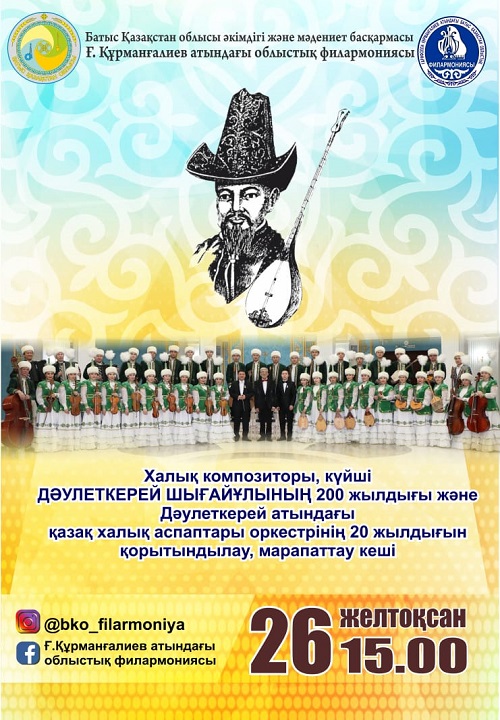
Between April and June, several major cultural events were held: the concert “KÜI-KERUEN” by the orchestra’s dombra group, dedicated to the 155th anniversary of the kuyshi-dombra player and one of the founders of the Kazakh National Orchestra of Folk Instruments, Naushi Bukeykhanov, as well as the 25th anniversary of the Dauletkerei Kazakh Orchestra of Folk Instruments; the musical evening “NAGYZ QAZAQ — DOMBYRA” featuring traditional singers, held in celebration of the 90th anniversary of People’s Writer of Kazakhstan and State Prize laureate Kadyr Myrza Ali; and a classical music evening by Honored Figure of the Republic of Kazakhstan, world-renowned pianist Amir Tebenikhin.
Concert organizations also held events in the cities of Almaty, Turkestan, Shymkent, and Atyrau.
As part of the 30th anniversary of the “Atameken” Folk Dance Ensemble, a three-day international and national festival was held. The festival program included a national conference, the ensemble’s solo creative evening “The World of Beautiful Dance”, and a gala concert featuring dance groups from the Ak Zhaiyk region.
In addition, at the World International Ethno-Festival “World of Nomads”, held in the city of Astana, the artists of the philharmonic ensemble delivered performances at a high professional level.
Theatrical Activities:
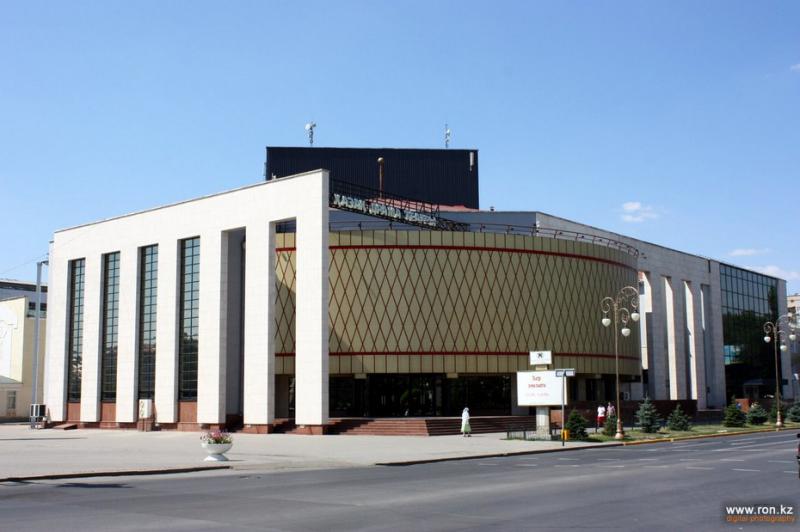
In 2025, two regional drama theaters — the H. Bokeeva kazakh drama Theater and the A. N. Ostrovsky drama Theater — staged 309 performances, which were attended by 47,963 spectators. The theaters’ repertoire included 109 productions, of which 11 were new premieres, including 7 performances for adult audiences and 4 children’s productions.
New productions staged in 2025 included:
- Bokeeva kazakh drama Theater: Documentary drama “Dina”, comedy “The Government Inspector”, drama-requiem “QADYR-ADAM”, drama “Two Striving for a Flower”, and the fairy tale “I Will Be a Champion”.
- N. Ostrovsky drama Theater: Theatrical performance “Christmas Tree”, theatrical show for Theatre Day, the production “Spring Will Not Come for Me…” dedicated to the 80th anniversary of the Great Patriotic War, the drama “Three Sisters”, and the fairy tales “Ryaba the Hen” and “This Wonderful New Year”.
Historical and Cultural Heritage:
As of today, 2,134 historical and cultural monuments are under state protection in the region, including 30 monuments of national (republican) significance and 2,104 monuments of local significance.
LANGUAGE POLICY
In order to implement the Concept for the Development of Language Policy in the Republic of Kazakhstan for 2023–2029, approved by Resolution No. 914 of the Government of the Republic of Kazakhstan dated October 16, 2023, systematic efforts are being carried out.
In 2026, 90,351 thousand tenge was allocated for the implementation of language policy (85,641 thousand tenge in 2025), of which 38,000 thousand tenge was earmarked for training courses in the state language and English.
According to the results of a sociological survey, the share of the population proficient in the state language reached 86.5% in 2025 (86% in 2024).
Starting from May 2025, the Department organized free training courses for regional residents in the state language (710 participants) and English (700 participants).
Based on the monitoring of document management in the state language for the fourth quarter of 2025 (October–December), including departments, territorial divisions, and subordinate organizations, the indicator reached 97%.
In April 2025, 300 civil servants and employees of organizations providing public services took the KazTest language proficiency assessment. The results showed that 45% of civil servants demonstrated above-average proficiency in the state language, while 41% of employees of public service–providing organizations demonstrated intermediate-level proficiency.
In 2025, approximately 1,000 enterprises across the region received methodological assistance.
In May 2025, the Ministry of Science and Higher Education of the Republic of Kazakhstan, jointly with the Department of Culture, Language Development and Archival Affairs of the West Kazakhstan Region, held a national seminar on the topic “Language Legislation: Opportunities, Initiatives and Challenges.”
The event was attended by Yerbol Tileshov, Chairman of the Committee on Language Policy, and Deputy Abzal Kuspan, during which amendments to the legislation were discussed.
From September 16 to 20, 2025, the international festival “Altyn Kopir” was held in the city of Uralsk. The purpose of the festival was to establish close cultural and social ties with representatives of the Kazakh diaspora of the Russian Federation living in regions bordering the West Kazakhstan Region, to preserve national identity, strengthen spiritual, historical and cultural heritage, and provide methodological and organizational support in learning the native language.
Representatives of the Kazakh diaspora from the Samara, Saratov, Orenburg, Astrakhan, and Volgograd regions of the Russian Federation took part in the event.
One of the important holidays of independent Kazakhstan, where representatives of more than one hundred ethnic groups live in peace and harmony, is the Day of Languages of the People of Kazakhstan. In the region, it was celebrated on September 5 with a nationwide language festival titled “Til – Tutashtyk Tuy.”
In 2025, the language festival was dedicated to the Day of Languages of the People of Kazakhstan and the 180th anniversary of the birth of Abai Kunanbayuly.
The Language Month was held in all districts of the region and in the city of Uralsk. At the regional level, around 200 events were organized as part of this initiative. All activities aimed at developing the state language policy were focused on preventing language conflicts and expanding the use of the state language in all spheres of public life.
Human Resources and Methodological Work
More than 6,000 employees work in 681 regional cultural institutions. The total number of cultural sector specialists who completed professional development training amounts to 273 people.
In order to attract young professionals to the cultural sector, information and outreach activities were carried out regarding available vacancies. Adaptation and mentoring programs were organized for young specialists, along with opportunities to participate in professional development courses and training seminars. In addition, to create conditions for professional growth, young specialists were involved in creative projects and competitions.
As part of methodological support, a regional seminar of the “Methodist” club was held on the topic “Digital Platforms — New Opportunities.” During the seminar, an exchange of experience was organized to enhance the digital literacy of district methodologists.