"On new approaches to the work of the Judicial Jury under the Supreme Judicial Council"
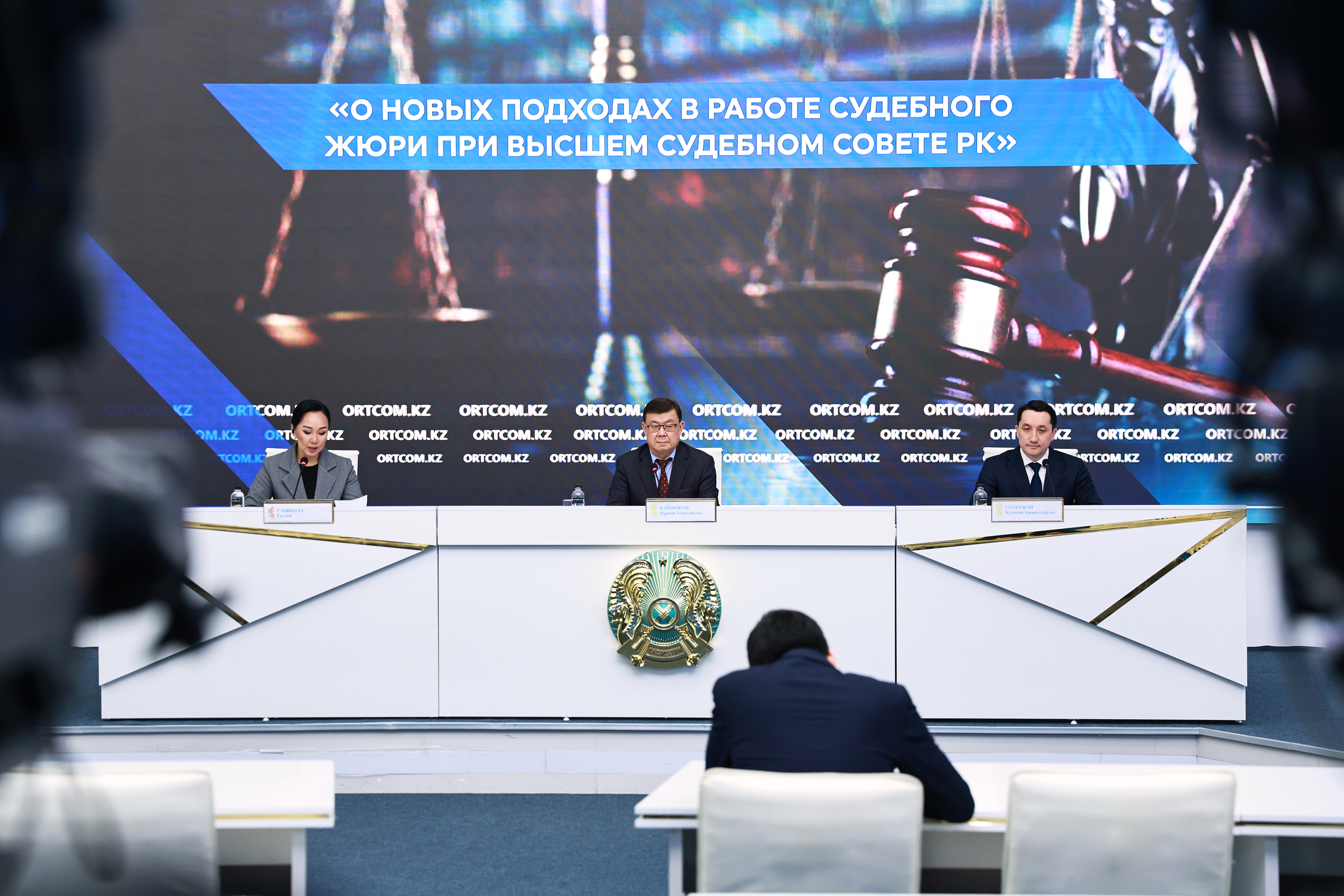
A press conference was held at the Central Communications Service under the President of the Republic of Kazakhstan on the topic "On new approaches to the work of the Judicial Jury under the Supreme Judicial Council", where the Chairman of the Judicial Jury at the Supreme Judicial Council of the Republic of Kazakhstan Nurzhan Kayypzhan and the Head of the Division on ensuring the activity of the Judicial Jury of the Office of the Supreme Judicial Council of the Republic of Kazakhstan Kuanysh Salimzhan took part.
In order to ensure constitutional guarantees for the independence of judges and in accordance with international practice, important measures were taken in 2019 to modernize the work of the Judicial Jury. The Judicial Jury, which was previously part of the Supreme Court, was separated from the judicial system and transferred to the jurisdiction of the Supreme Judicial Council.
Subsequently, as part of the taken reforms, mechanisms aimed at effective ensuring the principles of independence, objectivity and maximum transparency in the work of the Judicial Jury, contributing to improving the disciplinary process and increasing confidence in the judicial system, were developed. A new procedure has been introduced for the formation of a Judicial Jury and the selection of judges for its membership, aimed at increasing the objectivity and impartiality of the disciplinary process.
Candidates for judges to the Judicial Jury are now recommended by decision of the expanded plenary session of the Supreme Court, which is attended by judges of the Supreme and local courts. After that, the candidates are approved by the decision of the Supreme Judicial Council, which has the right to reject any candidate if he does not meet the established requirements.
Due to the introduction of the new mechanism, the composition of the Judicial Jury was expanded from 9 to 15 members. The increase in the number of members of the Judicial Jury occurred due to the involvement of judges of various levels, which contributes to more objective and balanced decision-making. Now the Judicial Jury consists of 4 judges of the Supreme Court, 5 judges of regional courts and 4 judges of the district level.
This expansion of the staff allows to take into account the opinions of representatives of all judicial instances, which improves the quality of taken decisions. An important novel is the inclusion into the Judicial Jury of not only judges, but also representatives of the legal community. This ensures maximum objectivity and impartiality of the made decisions.
The law also provides an exhaustive list of grounds for considering the issue of disciplinary liability of a judge, which contributes to improving transparency and fairness in the work of the Judicial Jury. Currently, judges can be disciplined only in two cases: for gross violations of the law when considering court cases and materials, as well as for committing misconduct contrary to judicial ethics.
Chairmen of courts and judicial collegium could be held brought to liability for improper execution of their official duties directly provided by the Constitutional Law "On the Judicial System and the Status of Judges of the Republic of Kazakhstan". In addition, the liability of a judge for committing defamatory misconduct can occur only on the grounds provided by the Code of Judicial Ethics, which was adopted on October 4, 2024 at the IX Congress of Judges. In 2024, significant changes were made to the legislation aimed at strengthening guarantees of the rights of judges and increasing the effectiveness of disciplinary proceedings. The new amendments provide additional guarantees for the rights of judges in the disciplinary process. In particular, judges are now required to familiarize themselves with the case materials before sending them to the Judicial Jury.
The judge is also given the right to involve representatives from among lawyers and legal consultants to participate in the consideration of a disciplinary case, which contributes to a more open and fair process. The legislation also strengthened the independence of judges by prohibiting the use of materials from operational investigative activities of law enforcement agencies to initiate disciplinary proceedings against judges.
These measures are aimed at eliminating the risk of possible pressure on judges and ensuring their independence. According to the Decree of the Head of the State dated December 18, 2024, amendments were made to the Regulation on the Judicial Jury, which change the procedure for reviewing complaints against judges. The analysis showed that about 70% of appeals to the Judicial Jury relate to disagreement with judicial acts and complaints on actions of judges in specific court cases, including violations of the principles of justice and procedural norms.
According to the new amendments, complaints related to disagreement with judicial acts and violations of the rule of law during the consideration of cases can now only be checked by higher courts in the framework of appeal or cassation proceedings and are not subject to review by a Judicial Jury. An important novel is the possibility of appealing the decisions of the Judicial Jury. In case of disagreement with the decision, the judge has the right to appeal to the Supreme Judicial Council.
The Council, after careful consideration of the arguments, has the right to cancel the decision of the Judicial Jury, terminating disciplinary proceedings, or to send the materials for reconsideration. In 2024, the Judicial Jury considered 77 disciplinary cases. By the decisions of the Judicial Jury, 40 judges were brought to various types of disciplinary liability. Out of 77 disciplinary cases that entered into proceedings, the Judicial Jury terminated 33 or 45.2% of the total number of cases.
These measures are aimed at improving the quality of judicial work, strengthening confidence in the judicial system and improving the level of justice in the country.