"Protect feed from fire"
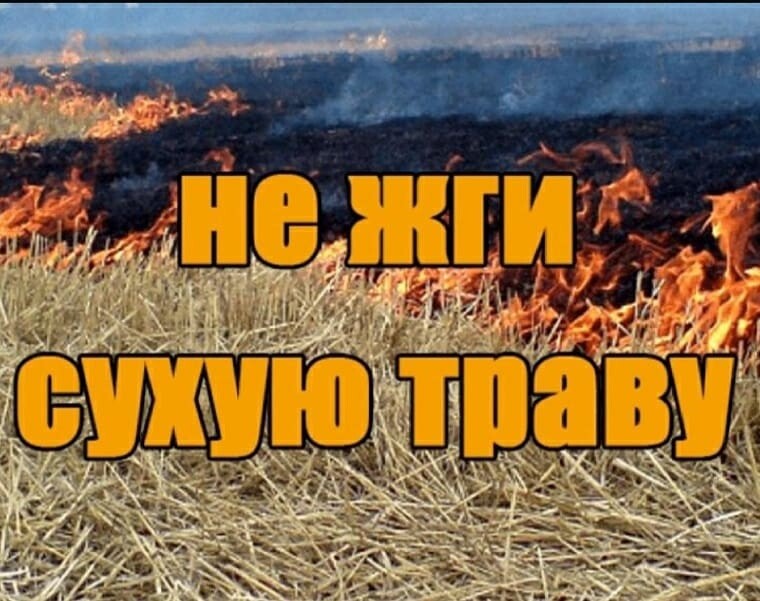
The work in the fields of a large number of equipment and people, the peculiarities of the climatic conditions of the steppes, the presence of winds and the abundance of grass vegetation, contribute to the occurrence of steppe fires.
There have been cases in the region when tens and hundreds of hectares of rich haymaking, grazing lands turned into a sea of fire within a few hours, destroying hay, koshars and grain massifs on their way.
And all this happens only through the fault of people who are in the field, the steppe.
For grain growers, there should be no more important task than to prevent crop losses, to remove every last grain from the fields. An important condition for combating grain losses is the protection of the crop from fires.
Crop protection from fires is one of the most important tasks. It is always necessary to remember such a truism that it is easier to prevent a fire than to put it out.
Fire prevention measures do not require large capital expenditures.
The most important thing is to be strictly careful in handling fire. And this means: do not throw un-extinguished cigarette butts and matches, do not make a fire near grain arrays and dry thickets, near straw and hay ricks.
On July 15, there was a fire of the steppe 18 and more than 213 hectares of grass were destroyed.
In order to protect grain arrays from fires, plowing strips are created around them even before the bread ripens. It is especially necessary to plow grain massifs from the side of railways, highways and dirt roads. The width of the plowing strip should be at least 3 meters.
A serious fire hazard is represented by harvesting units-tractors and combines, if they are not equipped with serviceable spark extinguishers or have faulty ignition power systems. Some tractor drivers remove the side covers of the tractor hood while harvesting bread, hay and feed. This leads to the fact that dry grass or straw gets on the hot exhaust manifold of the engine and a fire occurs. As a rule, a tractor is destroyed by fire and the fire passes to the fields. To avoid such cases, it is necessary to protect the exhaust manifolds of the engines of all harvesting machines with metal nets or tin shrouds.
The fire safety rules provide that all harvesting units – tractors, combines, harvesters, are equipped with fire-fighting equipment: fire extinguishers, brooms, shovels, a cat or a tarpaulin. It is forbidden to take harvesting machines into the field without fire-fighting equipment.
Field camps should be located closer to water sources, and their territory should be cleared of grass cover and the locations of residential trailers and tents, parking lots of cars and other equipment, fuel depots and kitchen fires should be plowed, and they should also be removed from each other by at least 100 meters. At the same distance, the field camp should be located from grain arrays, stacks of straw and hay.
Smoking is allowed only in specially designated and fire-equipped places. In addition, it is necessary to have a stock of brooms, shovels, fire extinguishers and water in containers at the field camp.
All persons assigned to work in the field should be instructed about the rules of fire safety.
Often, fires on grain arrays occur as a result of non-compliance with precautions when burning stubble. Burning of stubble should be carried out only in calm weather and in compliance with the following rules:
The burned area should be plowed along the perimeter with a strip of at least 3 meters;
Persons responsible for performing this work should constantly be near the burned area and make sure that the fire does not spread over the plowing strip;
In the event of a wind, the burning of stubble should be stopped by creating rowed strips in the path of fire propagation. To do this, it is necessary to have tractors with plows ready near the burned area.
Protection of the crop from destruction by fire, control over the implementation of fire-fighting measures during harvesting, as well as during the transportation and storage of grain is the business of the entire public, the responsibility of every agriculture.