Reading literacy: skills for conscious and comprehending reading
Reading literacy is the foundation of functional literacy. Reading literacy is a person's ability to understand and use written texts, to think critically and engage in reading in order to achieve personal goals, expand knowledge and opportunities, and participate in social life. Successful mastering reading skills is a key indicator of overall cognitive development.
The participation of Kazakhstani schools in the PIRLS international reading literacy monitoring study is one of the targeted mechanisms for developing educational and information skills of younger schoolchildren. This help them not only achieve a high level of understanding by the end of 4th grade, but also contributes to building reading literacy of young people of Kazakhstan. The PIRLS aims to compare fourth graders’ text comprehension level in different countries of the world, as well as to identify differences in national educational systems in teaching reading literacy. It also aims to assess their ability to think logically.
Teaching school students to read accurately, freely, consciously, and expressively is one of the objectives of education, particularly for language and literature teachers.
There are four qualities of reading skills: accurate reading, fluent reading, conscious reading, expressive reading. The main goal of learning to read is to develop these skills in children.
Interest in reading emerges when the reader is fluent in conscious reading and develops cognitive motivations for reading. Conscious learning can generally be defined as understanding. The ability to comprehend what one reads develops gradually in children, throughout their educational and cognitive work, along with knowledge acquisition, life experience and the development of logical thinking
Reading comprehension means reading without distortions, that is, reading without errors, which affects the meaning of what is read.
Conscious, comprehending reading is one of the main challenges of today. From childhood, when teaching children to read, it is crucial to develop their ability to freely express their thoughts in the well-structured manner.
When students fully master comprehending and conscious reading, their motivation for learning increases. It is important to immediately provide students with challenging tasks and make them stay motivated.
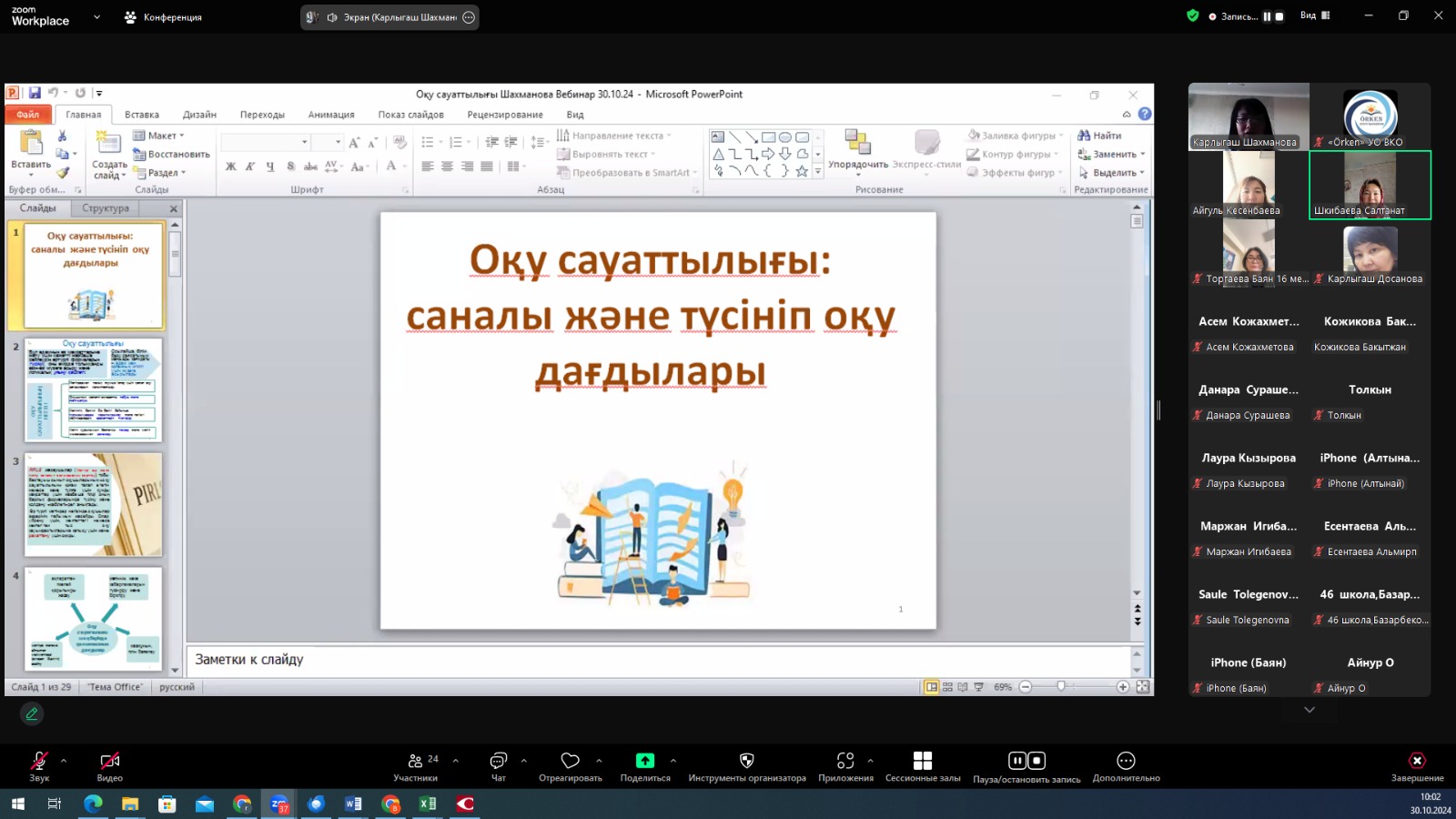
Taking into account the current challenges and in accordance with the work schedule of the autumn vacation school, Örken East Kazakhstan Regional Scientific and Methodological Center for Informatization and Educational Development of Education Administration of East Kazakhstan region, jointly with Karlygash K. Shakhmanova, a primary school teacher from Multidisciplinary Gymnasium No. 5 and Teaching Excellence Center of Ust-Kamenogorsk city, held an interactive webinar, exploring various skills for conscious and comprehending reading.
Teachers should choose appropriate methods based on the quality of the class's knowledge, the age characteristics of children, and gradually increase the complexity of the tasks as they master the material. This depends on the creative abilities and experience of the teacher.