Intermediate assessment in grades 5 to 8, and 10 in the subjects “Kazakh language”, “Kazakh language and literature” (T1, T2)
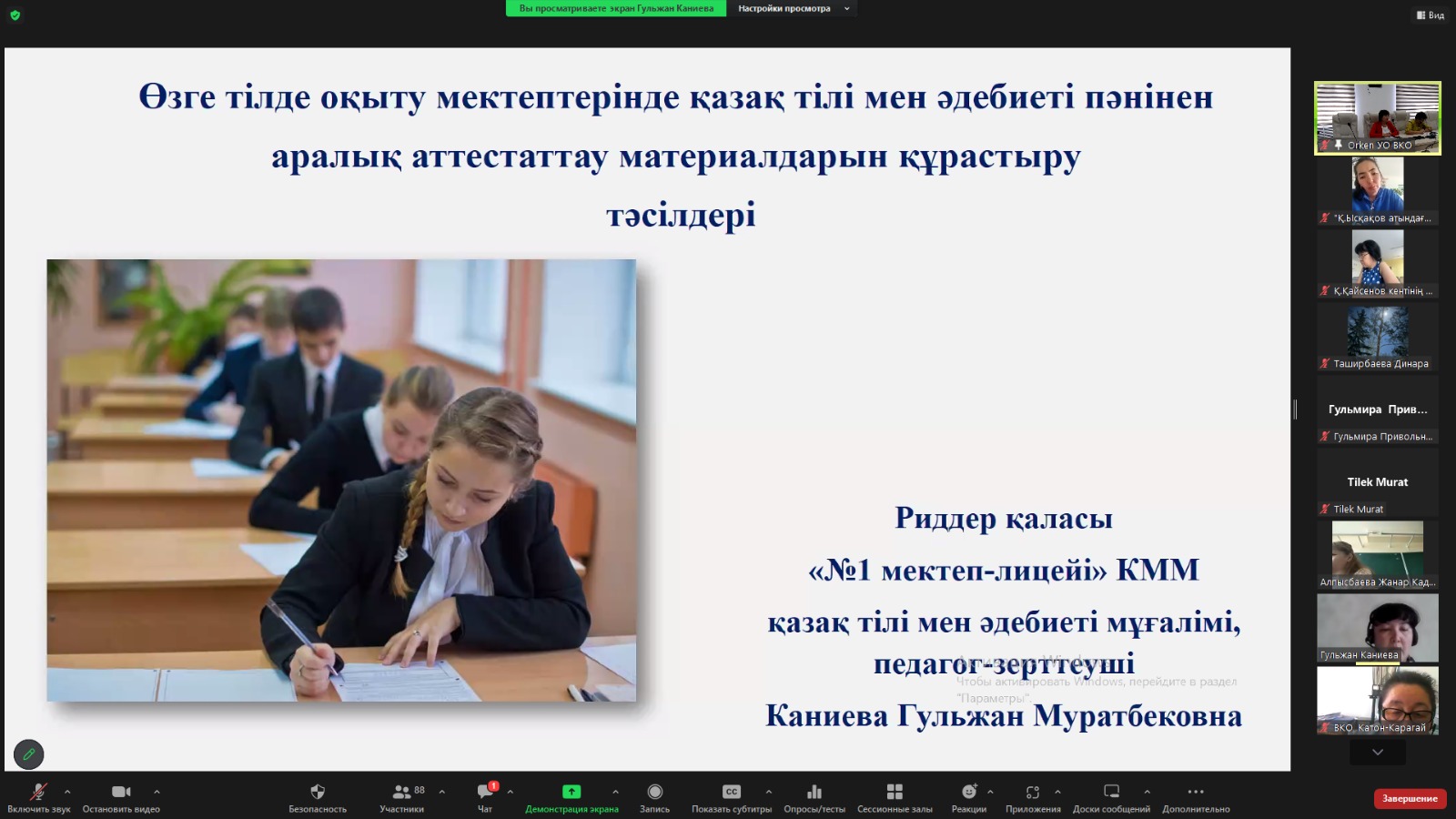
On May 24, 2024, Örken East Kazakhstan Regional Scientific and Methodological Center for Informatization and Education Development of Education Administration of East Kazakhstan region held a regional meeting with the participation of deputy headmasters responsible for academic affairs, leaders of subject associations, teachers of the Kazakh language and literature (T1, T2).
The goal of the meeting was to determine the need for developing and formalizing the examination work for assessing the quality of learners’ mastery of the part of the content or the whole volume of one subject following the end of this school year in grades 5 to 8, and 10, as well as providing methodological assistance.
During the seminar, the following experts shared their experiences:
- Botakoz T. Omarova, a teacher of the Kazakh language and literature, deputy headmaster for academic of Yu. Gagarin Secondary School No. 3 of Education Department of Shemonaikha district, on the topic “5-8, 10 synyptarda aralyk attestattau emtikhanyna grammatikalyk tapsyrmalardy azirleu zholdary”;
- Gulzhan M. Kaniyeva, a teacher of the Kazakh language and literature of School Lyceum No. 1 of Education Department of Ridder town, on the topic “Kazak tili men adebieti pani boiynsha aralyk attestattau materialdaryn kurastyru tasilderi”;
- Dinara B. Tashirbaeva, a teacher of the Kazakh language and literature of Novo-Bukhtarma Secondary School No. 1 of Education Department of Altai district, on the topic “Aralyk attestattauda kazak tili paninen erekshe bilimdi kazhet etetin balalarmen daiyndyk zhumystary”.
The speakers demonstrated examples of intermediate assessment’s materials, showed how to develop assessment materials in accordance with the educational program of the State Educational Standard (listening, speaking, reading, writing), and outlined the development of examination tasks based on methodological recommendations and in conformity with the age characteristics of each grade. They also discussed the assessment criteria covering the scale from five to 30 points.
Deputy head of Methodological Department of Social Sciences and Humanities, M. Asanova, drew the participants’ attention to the need to collect information about the exam participants, the percentage of the knowledge quality indicator, as well as the commentary on the knowledge quality indicator when analyzing the results of the intermediate assessment.