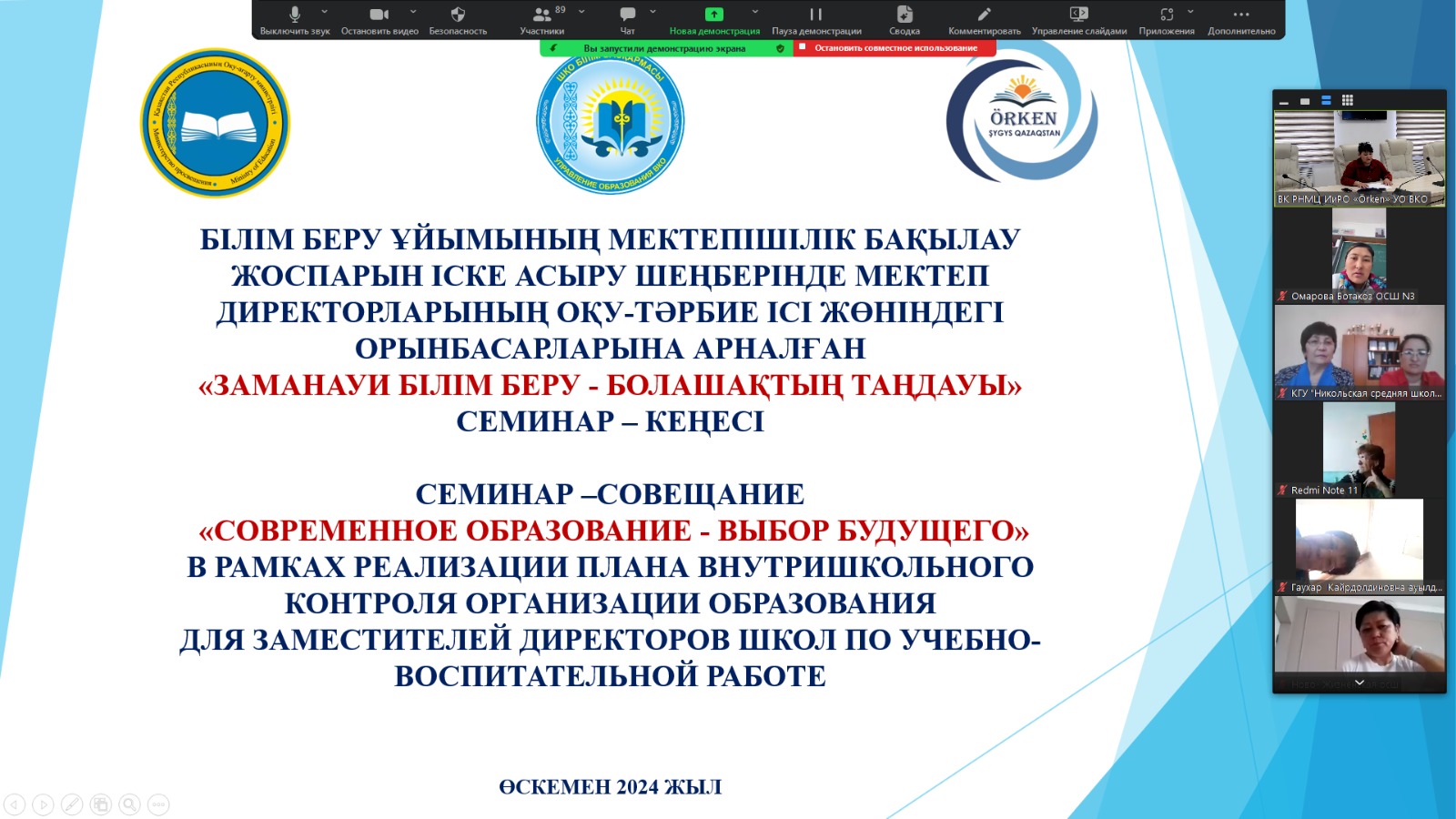
Seminar - meeting “Modern Education – the Choice of the Future”
Internal school control is a system for evaluating the educational process in accordance with national requirements and the needs of learners and teachers. It aims at improving the activities of educational organizations, including enhancing the quality of education and upbringing, as well as increasing the professionalism of teaching staff.
On May 4, 2024, Örken East Kazakhstan Regional Scientific and Methodological Center for Informatization and Education Development of Education Administration of East Kazakhstan region held a seminar entitled “Modern Education - the Choice of the Future”, as part of implementing the internal school control plan of educational organizations for deputy headmasters responsible for educational work. A total of 100 people participated in the event.
The speakers of the event: deputy headmasters for educational work of Nikolskaya Secondary School of Education Department of Altai district B.A. Belgibayeva, G.N. Aimkhanova; deputy directors of Lyceum School No. 1 A. O. Metelkina, G. V. Antropova; deputy headmasters of Secondary School No. 2 E. Yu. Byvsheva, N.V. Afanasyeva; deputy headmasters of Secondary School No. 16 S. V. Taukhanbayeva (with the Russian language of instruction), Sh.R. Iksanova (with the Kazakh language of instruction) of Education Department of Ridder town. The speakers provided a detailed report on pedagogical monitoring conducted in order to identify shortcomings in the work of the teaching staff and determine ways to address the issues related to monitoring and analysis of the quality of education and training at different education levels in the 2023-2024 school year, as well as briefed on the issues of mid-term and final certification, and emphasized the positive and negative aspects identified as a result of monitoring.
In the concluding part of the seminar, the head of a department of Örken East Kazakhstan Regional Scientific and Methodological Center for Informatization and Education Development of Education Administration of East Kazakhstan region A.Zh. Kantayeva, based on the overall analysis of the results of the work done by the mentioned schools, recommended systematizing the interaction between families and schools, enhancing staff professionalism through research and experimental activities as part of the school development program, organizing joint efforts to ensure successful learning and personal socialization. She highlighted the importance of systematically conducting work to implement the internal school control with the aim of modernizing the internal school information model of the education quality assessment system.
The seminar adopted the recommendations for further work on internal school control. All the speakers received certificates.