Ways to develop students’ scientific literacy in biology lessons
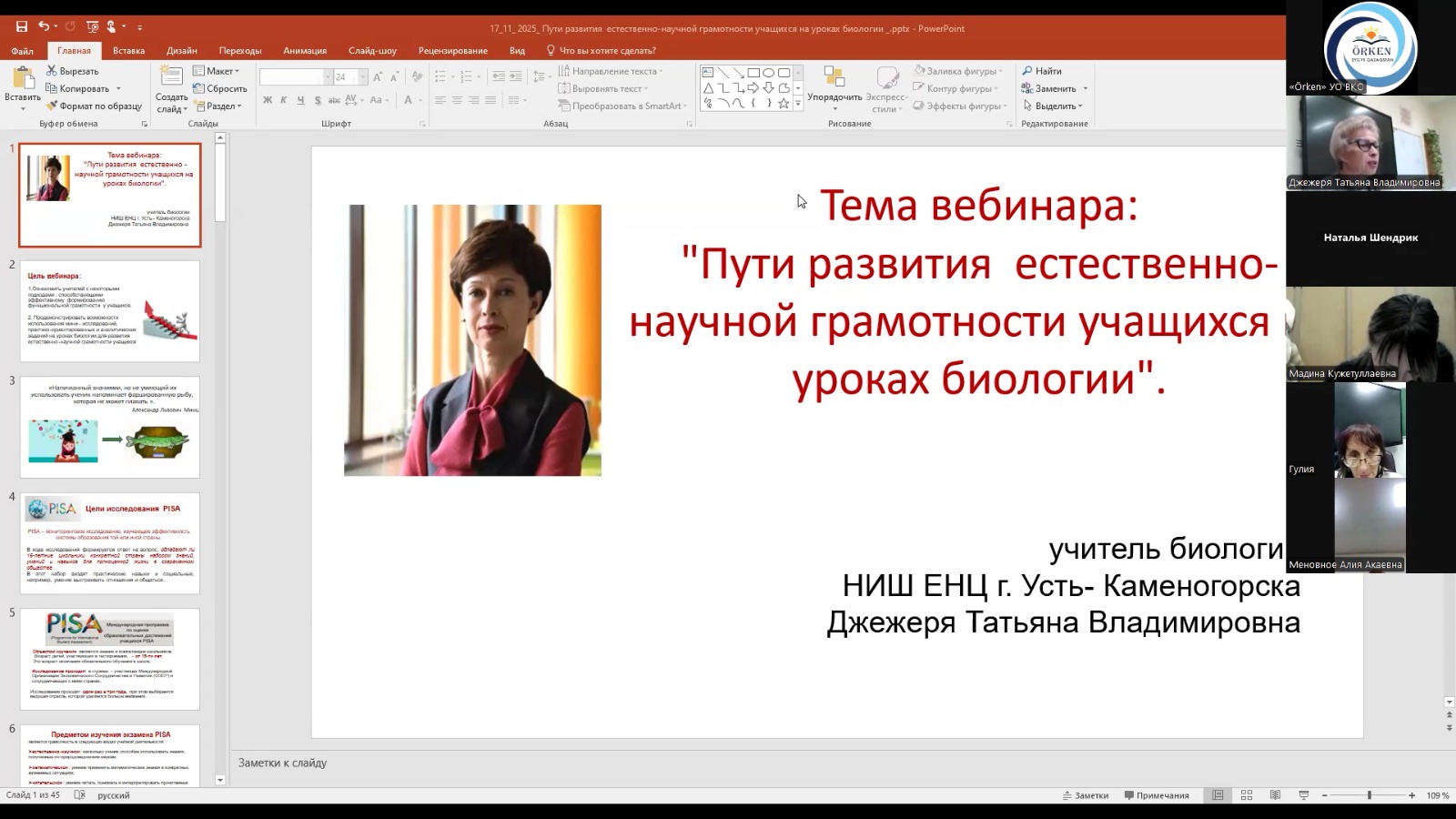
On November 17, 2025, an online master class titled: “Ways to develop students’ scientific literacy in biology lessons” was held as part of methodological webinars for teachers of East Kazakhstan region. The event was organized by Örken East Kazakhstan Regional Scientific and Methodological Center for Informatization and Education Development of Education Administration of East Kazakhstan region.
Tatyana V. Jezherya, a teacher of biology of Nazarbayev Intellectual School of Natural Sciences and Mathematics of Ust-Kamenogorsk city, conducted this online master class for teachers. The ZOOM conference was attended by teachers of natural sciences from all over the region.
The goal of the webinar was to bring to the attention of teachers effective approaches and practical tools for developing functional literacy of schoolchildren as a key indicator assessed in PISA international study.
At the beginning of the meeting, the speaker reminded participants that scientific literacy is not just a mere educational background, but the ability to apply knowledge in real-life situations. A quote by Alexander Mints vividly illustrates this thesis: “A student stuffed with knowledge, but unable to use it, is like a stuffed fish that cannot swim.”
The master class focused on the following three main pathways for developing scientific literacy:
The use of practice-oriented tasks. Using examples from PISA materials, such as “Tobacco Smoking” and “Corn” Tatyana V. Jezherya demonstrated how familiar topics from the school biology curriculum can be connected to the issues of health and ecology. This helps students not just memorize facts, but understand causal relationships and make informed decisions.
Conducting mini-studies. The speaker explained the advantages of this approach: the ability to quickly process a large volume of information, to develop teamwork skills and targeted development of specific research competencies.
Modeling as a form of project activity. This method allows students to solve practical problems in conditions of limited time and resources, developing critical thinking, creativity and teamwork skills.
The materials presented at the webinar are of high practical value. They help teachers not only prepare 15-year-old students for PISA testing, but also make lessons for high school students more useful in the context of preparing for the final assessment.
The master class was an important contribution to the professional development of teachers of the region and confirmed that the development of scientific literacy is not an additional burden, but a modern and effective teaching approach that represents the future of Kazakhstan’s education system.