Year of Working Professions: For over 100 years, the North Kazakhstan region College has been training personnel for the agricultural sector
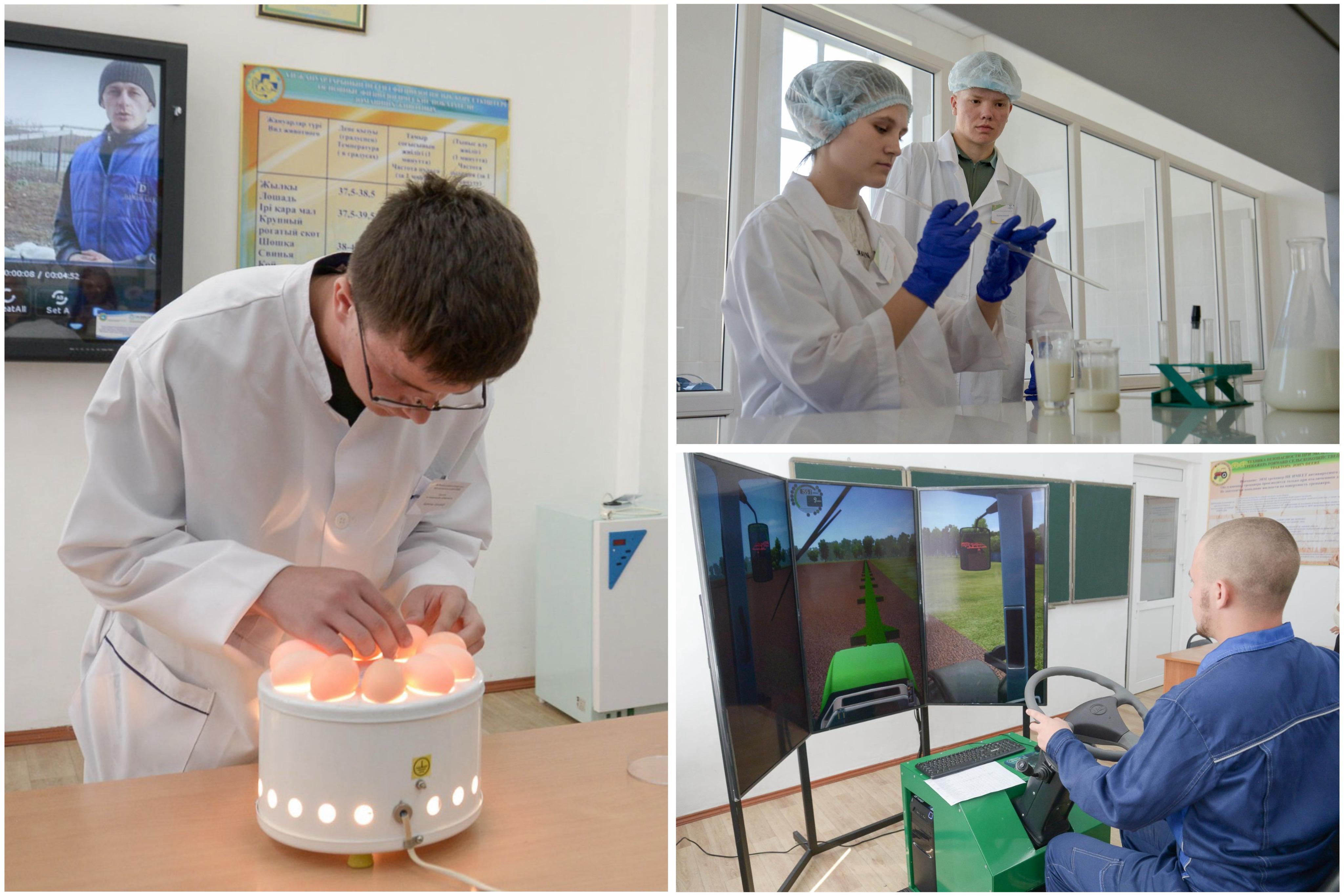
In the Year of Working Professions, declared by the President of the country, special attention is paid to educational institutions that form the basis of Kazakhstan's human resources potential. Among them, a special place is occupied by the Higher Agricultural College named after Zhalel Kizatov in the village of Pokrovka, North Kazakhstan region. For over a hundred years, this educational institution has been making a significant contribution to the development of the agro-industrial complex, training qualified specialists in demand both in the North Kazakhstan region and beyond.
The history of the college began in 1923, when the agricultural school was transformed into an agricultural technical school. Today, applicants can choose a profession to their liking — more than 600 students study at the college in 9 specialties, and the dynamic learning environment helps them exchange knowledge and experience.
"To be more precise, the history goes back to 1885. Our basic farms and social partners accept students for practical training. On average, there are more than 20 partners in livestock farming and processing. If you take into account all areas — including forestry, agronomy, mechanics, veterinary medicine, then the number reaches 50, and in the region - more than 100. 400 hectares of our own land. We grow wheat, barley, oats, potatoes, and earlier oilseeds. The harvest goes to feed our mini-farm, and the surplus is sold," the Director of the educational institution Beimbet Bugasov shares.
The college is proud of its modern base: the Competence Center and 12 laboratories, including veterinary medicine, dairy production and plant growing expertise. There is a training farm, a slaughterhouse, a mini-factory and even simulators for driving John Deere tractors. All this allows students to master the profession not only in theory, but also in conditions as close as possible to real work.
"The demand is really high today: both full-time and part-time departments, both are open. The training of personnel here is at the proper level," Temirzhan Saduov, a college teacher, says. "Mostly, graduates go to work in their specialty. Most often, they go to veterinary stations, as well as to limited liability partnerships that are engaged in animal husbandry. The classrooms have everything you need. All the equipment clearly shows what a student should be able to do in production. There are no problems with the courses either. Recruitment is within 30 people per year, sometimes we manage to conduct two courses. Previously, they lasted three months, now — a month."
The development of the college has also been noted at the republican level. The institution became a participant in the project "Modernization of Technical and Vocational Education" and received an international grant in the specialty "Veterinary Medicine". In 2019, the college entered the "Zhas Maman" program, which made it possible to equip it with modern equipment and take personnel training to a new level. Students note that classes are not only theoretical — teachers actively include practice and try to instill an interest in the profession.
"I am studying in the specialty "Veterinary Science", student Aleksandr Karpenko says. "I chose this profession because I love animals, my soul lies in it. In addition, my whole family works in this field: my grandfather was a zootechnician, my mother was a veterinary orderly. Probably, this began in childhood, when I spent a lot of time with my grandfather at work, in agriculture. In the future, I want to enter a university in the specialty "Veterinary Science", to work in a veterinary clinic. Perhaps, over time, I will switch to pedagogy. Our teachers make classes interesting, try to go beyond the textbooks."
Today, the Higher Agricultural College named after Zhalel Kizatov is not just an educational institution, but the pride of the North Kazakhstan region, confirming that the region is the center for training in-demand specialists for the whole country. Here, centuries of experience and modern technologies are combined, new ideas are born and a generation of young professionals is formed, on whom the future of the agro-industrial complex of Kazakhstan depends.