What will change from April 1 for shoe entrepreneurs
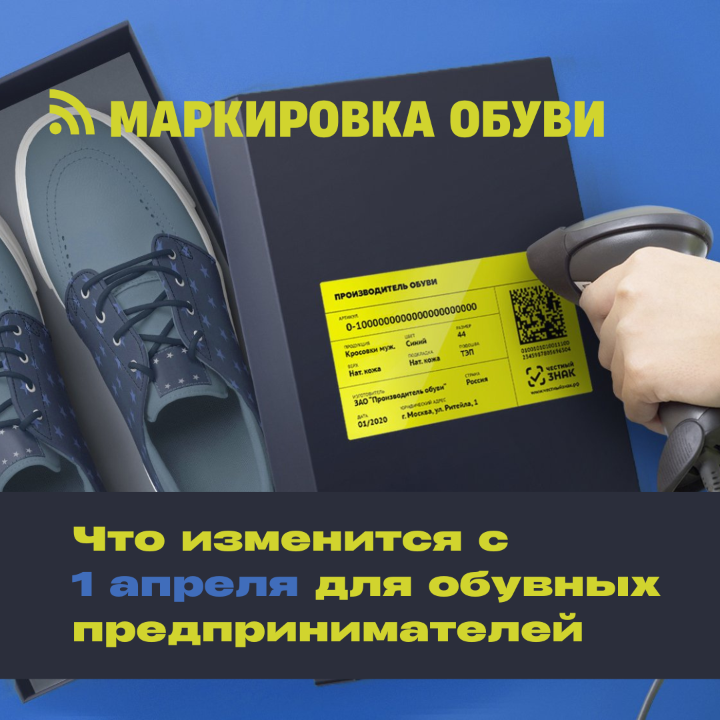
On April 1, 2023, the period when it was allowed to sell shoes that were not registered in the system of digital labeling and traceability of goods ends. At the request of entrepreneurs, this period was extended from April 1, 2022 to April 1, 2023. What will change for shoe entrepreneurs, what responsibility is provided for violation of the rules and why it is necessary to register shoes in the system of instant traceability – we explain in this material.
Background
On November 1, 2021, by a government decree, mandatory labeling and traceability of shoe goods was introduced in Kazakhstan – this is a system that registers information about each product that enters the country and traces it through a unique data matrix code, demonstrating the entire path of the goods from the manufacturer/importer to the end consumer. The task of the labeling and traceability system is to make the trade turnover in Kazakhstan transparent. In fact, this is a kind of Track&Trace systems that are used in progressive regions around the world as a standard for digitizing the commodity route, the main and proven effect of which is to reduce the level of the shadow economy.
In Kazakhstan , the system of labeling and traceability extends to three commodity groups: tobacco (the marking code replaced the function of the excise stamp from January 1, 2022), footwear products (from November 1, 2021) and from July 1, 2022 – the phased introduction of labeling and traceability of medicines. The commodity groups subject to mandatory labeling (i.e., to the case-by-case accounting and traceability of the full path of the goods) are selected according to the main criteria: 1) a high level of the shadow economy; 2) a high threat to public health.
If the need to digitize the turnover of tobacco products and medicines does not raise questions, then the choice of the footwear product group is not obvious to everyone. According to official data, the share of shadow shoe turnover in Kazakhstan is 48%, that is, every second pair of shoes is imported into the country illegally. A large flow comes from China, and if we rely on customs statistics, the discrepancies in the data reveal the full picture: in 2021, the Chinese customs service recorded exports to Kazakhstan in the amount exceeding the Kazakh data by more than 2 times, and this is almost $ 780 million. These figures clearly assess the volume of the shadow economy in the turnover of footwear products, which became a good reason for the introduction of their traceability.
How was mandatory labeling and traceability of shoe products introduced
Before the introduction of mandatory labeling and traceability of any product group, a test period is conducted – a pilot project in which entrepreneurs voluntarily participate in order to understand the system, assess opportunities and risks, adapt business processes and prepare for the start when working in the system becomes a mandatory legislative rule.
So, from June 30, 2019 to December 31, 2020, a pilot project on shoe labeling was conducted in Kazakhstan. The project was attended by 19 participants in the turnover of shoes – 5 manufacturers-sellers, 13 importers-sellers and 1 authorized economic operator (all are residents of the Republic of Kazakhstan), i.e. wholesale and retail trading companies. During the project, technical aspects were worked out: physical marking, generation and transmission of codes, work of market participants with a database, scanning of marked shoes by outlets and consumers, database maintenance, development of a mobile application for consumers, receiving and transferring goods and removing the code of units sold from circulation.
The results of the pilot project were discussed at public hearings on May 11, 2021 and the results of the regulatory impact analysis on the introduction of shoe labeling were approved by the decision of the interdepartmental commission on July 7, 2021. By the Decree of the Government of the Republic of Kazakhstan No. 588 dated August 31, 2021, shoe goods are included in the list of mandatory goods subject to labeling in the Republic of Kazakhstan.
Thus, since November 1, 2021, the marking and traceability of footwear products has become a mandatory requirement, which is enshrined in the legislation of the Republic of Kazakhstan. However, in fact, entrepreneurs still expressed unwillingness and asked for concessions, and the supervising state bodies supported and implemented an overwhelming number of concessions in the NPA at the request of the business.
For example, a Single operator of marking and traceability of goods in Kazakhstan in the period from April 1, 2022 to December 31, 2022 issued marking codes free of charge to entrepreneurs registered in the system for marking residues. Also, importers of shoes were allowed to carry out marking on shoes at their own warehouses in the Republic of Kazakhstan after customs clearance, etc. until November 1, 2023. At the request of the business, the functionality of the system has been repeatedly changed and adapted. In addition, training events, individual consultations and “live” meetings with entrepreneurs were held on an ongoing basis to receive and collect feedback.
For 1.5 years since the introduction of mandatory labeling of footwear products in the Republic of Kazakhstan, as of March 1, 2023, more than 2.8 thousand participants in the turnover of goods (including 115 manufacturers, 774 importers and 1602 retailers, 341 wholesale sellers) were registered in the information system of labeling and traceability of goods (including 115 manufacturers, 774 importers and 1602 retailers, 341 wholesale sellers), more than 1,226,725 were registered in the catalog of goods product cards. All this testifies to the high dynamics of business participation in the shoe labeling project.
«We have been working in the information system of labeling and traceability of goods since the very beginning of the introduction of labeling of footwear products, namely since November 2021. We have dealt with all stages of the labeling process and have established smooth operation according to all procedures. Thanks to this, we are ready by April 1, 2023, since we have completely marked all the remnants of unmarked shoes and are selling them. Our work was also improved by the function of mutually recognized codes with the Russian Federation, as the time was significantly reduced and the processes for importing shoes were simplified. We positively assess the labeling system of goods, and we hope that competition in the footwear market will become more honest» — said Larisa Sitarova, head of Kaspiy—Obuv LLP.
Kaspiy-obuv LLP is an importer of shoes, which is sold under the «Unichel» trademark. This is the largest Russian shoe holding, which produces 3 million pairs of shoes annually and accounts for about 10% of all leather shoes produced in the Russian Federation. The holding unites 3 shoe factories in Chelyabinsk, Zlatoust and Orenburg and more than 600 stores in 250 cities of Russia and Kazakhstan, employing over 5,000 employees.
What will change from April 1, 2023?
One of the main concessions for business was the permission to sell unmarked shoe remnants (which were delivered before the start of mandatory shoe labeling, that is, until November 1, 2021) until April 1, 2023. Initially, this deadline was set for April 1, 2022, but at the request of entrepreneurs to provide more time to adapt to the new rules, the deadline was extended for one year. This means that since April 1 of this year, according to the rules of labeling and traceability of goods, businesses have no right to sell unmarked shoe remnants. Otherwise, the rules of marking and traceability have not changed.
It should be noted that there are no penalties for violation of the rules of marking and traceability of footwear products in the legislation of the Republic of Kazakhstan.
Currently, the Administrative Code of the Republic of Kazakhstan provides for fines for non-labeled products, but they relate only to tobacco products, since earlier the labeling code replaced the function of the excise stamp and penalties for its absence remained the same. Namely, according to Article 283 of the Code of the Republic of Kazakhstan "On Administrative Violations" by the Law of the Republic of Kazakhstan dated July 11, 2022 No. 137-VII "On Amendments and additions to the Code of the Republic of Kazakhstan on Administrative Offenses":
“The turnover of excisable goods without means of identification, as well as with means of identification of an unidentified sample and (or) not identifiable, entails a fine on individuals in the amount of 50 MCI (153,150 tenge), on small businesses – in the amount of 150 MCI (459,450 tenge), on medium-sized businesses in the amount of 200 MCI (612,600 tenge), for large business entities in the amount of 500 MCI (1,531,500 tenge), with the confiscation of excisable goods that were the direct subject of the offense, as well as with the deprivation of a license.”
It is worth paying attention once again that the law does not provide for a fine for violating the rules of labeling and traceability of shoe products.
The effect of marking and traceability of shoe products
As a result of the introduction of digital labeling and traceability, official shoe imports increased by 13 million pairs (30%) (from 37.2 million pairs to 53.1 million pairs). Before the introduction of labeling for the period 2018-2020, the indicator of shoe imports varied in the range of 35-39 million pairs.
In addition, tax revenues from shoe entrepreneurs registered in the marking and traceability system of goods by the end of 2021 increased by 55% compared to 2020, and by the end of 11 months of 2022, tax revenues increased 2.2 times compared to the same period of 2021.
The dynamics of the growth of shoe imports in the Republic of Kazakhstan and a noticeable increase in budget revenues in the form of tax revenues indicate the effectiveness of the labeling system and traceability.