Government delegation met with greenhouses of Turkestan region
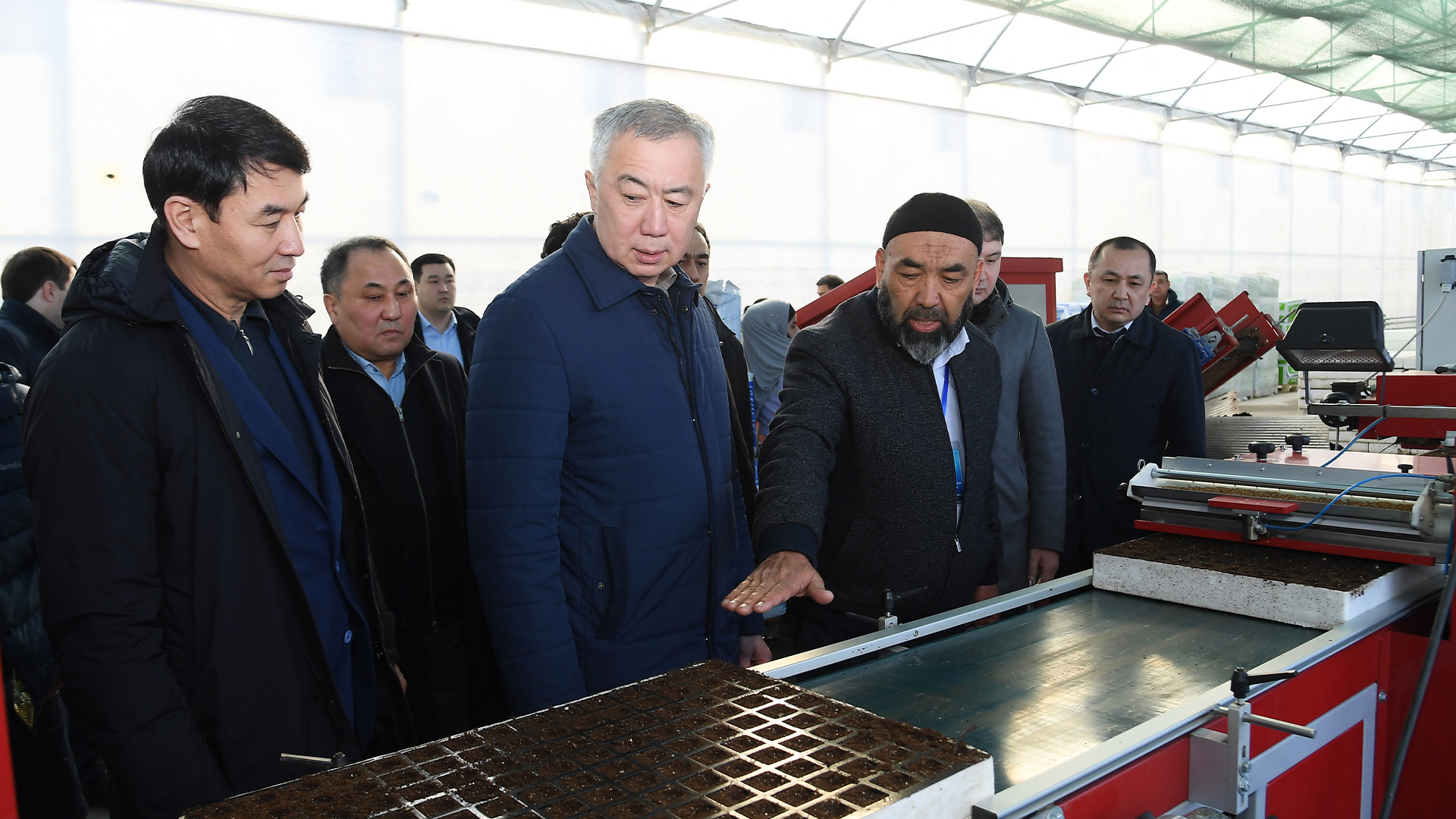
To return subsidies to greenhouses and help with coal in return for uninterrupted supplies of vegetables at market prices to the domestic market of the country – a government delegation headed by Deputy Prime Minister - Minister of Trade and Integration Serik Zhumangarin visited the Saryagash district of Turkestan region, where they discussed with farmers the situation with the development of greenhouses in the region.
Turkestan region is one of the leading regions of the country for the production of greenhouse vegetables. The share of the region, according to statistics, accounts for 67% of the greenhouses of the republic, these are greenhouses with a total area of 844 hectares. Of these, 170 farms on 46 hectares have recently suffered due to heavy snowfall and fuel shortages. The most popular vegetables – cucumbers and tomatoes – were sown on 1.3 hectares. As it turned out, 94% of greenhouses that could not withstand the abundant mass of snow were of light construction, built manually by farmers themselves. As farmers noted at the meeting, the owners build them as cheaply as possible in order to recoup their expenses as quickly as possible. If there is stable support from the state or long loans at low interest, farmers will be able to build greenhouses according to the required standards and technologies. Now the Akimat of the Turkestan region is engaged in operational measures to support the affected farms, the government of the country is developing future systemic measures.
We have come to you on behalf of the government to decide together how the greenhouse industry should develop further," Serik Zhumangarin addressed the participants of the meeting. – Specialists from Uzbekistan have also come with us, who are ready to share their experience, technologies and other issues of greenhouse maintenance. First, the state needs a result. There were subsidies to greenhouse farms before, but it brought little benefit: greenhouses were listed as operating, but did not produce anything. If the state provides subsidies, then in return you have to sell enough vegetables to the domestic market and at a market price. The second is certification. In order to receive subsidies in the future, the greenhouse will have to meet production standards. To do this, a national standard for greenhouses will be adopted. The corresponding instruction has already been given to the Committee of Technical Regulation and Metrology, we also offer you to take an active part in the development of this standard, to help with knowledge in practice. And third, on coal: a representative of the Ministry of Industry has come with us, he will announce solutions that will help in the future to avoid such emergencies as this year.
Vice-Minister of Agriculture Abulkhair Tamabek said that 140 billion tenge was allocated through the Agro-Credit Corporation to finance spring field work, work is underway to include greenhouses in the direction of financing under this program. After making appropriate changes to the terms of the program, greenhouses will also be able to receive loans not exceeding 5%.
Now we are considering options for subsidizing greenhouses, but the basis will take into account the costs of electricity and gas. In other areas, support measures are already available, the state subsidizes half of the costs of seeds, fertilizers, plant protection products. We will also develop a standard for greenhouses. Everyone who meets the requirements of the standard and accepts counter obligations will receive subsidies, - he said.
Daniyar Kaltaev, chairman of the national association of cotton producers and farmers, said that greenhouses are ready to issue all the necessary documents.
It is profitable for us to receive per-hectare subsidies, we used to work under this scheme. As subsidies were abolished in 2018, all greenhouse buildings stood up," he says. - We did not have documents for greenhouses, as there was no need for them, we did not receive subsidies. But now we are ready to be certified. Our suggestions: there is no coal in the off-season, and if there is, it is of poor quality. Greenhouses do not have the money to buy coal in advance, there is no place to store it in sufficient quantity. And all this leads to the uncompetitiveness of our products. We ask the Ministry of Industry and Infrastructure Development, JSC NC "KTZ" to supply us with social coal in advance.
Zhanat Igisinov, Head of the Coal Industry of the Industrial Development Committee of the MIID of the Republic of Kazakhstan, proposed to hold negotiations with key coal mining enterprises of the country and conclude contracts for the supply of coal directly from coal mines in order to provide greenhouse farms in the region with coal in a timely manner.
There is no need to go anywhere, contracts can be worked out in the region. And for its part, the Ministry of Industry is ready to assist in negotiations with coal mining companies on the supply of coal. Only everything needs to be done in advance, and not with the onset of cold weather. Coal does not lose its properties from storage, - he stressed.
Following the meeting, most of the participants agreed that certification, standardization and planning of greenhouse production are needed. Small farms that cannot pass certification alone should form cooperatives.