The Kazakh-Chinese Laboratory for Biological Safety received accreditation in the Republic of Kazakhstan
This means a high level of organization of the laboratory and its compliance with international standards.
To obtain a certificate of conformity or other document confirming the safety of their products, entrepreneurs need to conduct its tests, which are performed by the appropriate laboratories. One of these laboratories has just recently passed the accreditation procedure for compliance with the requirements of GOST ISO/IEC 17025-2019 "General requirements for the competence of testing and calibration laboratories".
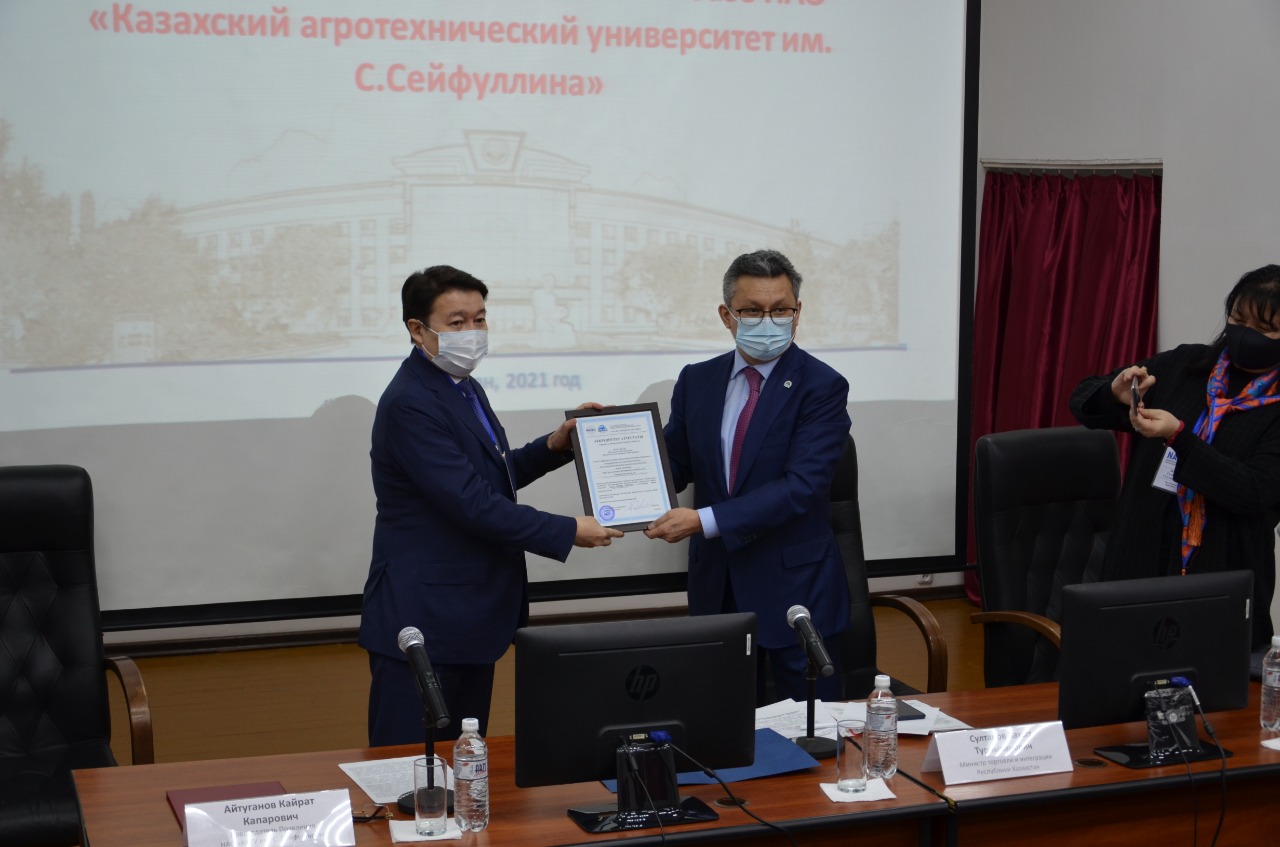
Today, on April 5, 2021, the Minister of Trade and Integration Bakhyt Sultanov handed over the certificate of accreditation of this laboratory, which was conducted by the NCA under the Ministry of Trade, and also got acquainted with its activities.
The laboratory operates on the basis of the Kazakh Agrotechnical University named after S. Seifullin of the Ministry of Agriculture of the Republic of Kazakhstan.
Created for the purpose of studying and diagnosing infectious animal diseases, the laboratory is equipped with the necessary equipment and operates on the basis of the BSL-2 safety standard.
Currently, there is an active scientific work going on here, for the development of which the Chinese partners at home won a grant of $ 1 million, and this laboratory was included in the list of laboratories "One Belt, One Road". In addition, according to the NCA specialists, the laboratory has a great prospect of obtaining such accreditation in China, which means increasing confidence in Kazakhstan's products. As noted in the KTRM, today Chinese standards are considered among the highest in the world.
At the same time, the laboratory plans to expand the scope of accreditation so that in the future it will be able to provide 2 more services for PCR and serological diagnosis (ELISA) of infectious diseases (common diseases for all animal species, diseases of cattle, birds, sheep, pigs, bees).
Also, the Agrarian University reported that in 2021 and 2022, two more laboratories are being prepared for accreditation (zootechnical analysis of feed and milk and food safety (LPB), information and technical support of which is important in creating an effective production of livestock products.
The LPB will also assess the quality and safety of food products and raw materials of animal and vegetable origin (meat and meat products, milk and dairy products, fish products, beekeeping, crop production and animal raw materials); research on the quality of milk and other products; forensic veterinary expertise (examination of controversial issues related to the purchase and sale of animals, diseases and deaths of animals, falsification, poaching, etc.).
In this regard, today Kazakh entrepreneurs were also invited to the laboratory, who, for example, are engaged in the production of organic feed additives for farm animals and birds, as well as dry mare's milk, etc.
After all, if earlier they often ordered such research in laboratories in Russia, Ukraine, the EU and other countries, then with the advent of this type of laboratory, they will be able to do it in Kazakhstan, which will significantly reduce their costs.
The laboratory was established within the framework of the Kazakh-Chinese intergovernmental agreements in order to eliminate mutual technical barriers that hinder the export of domestic goods.
Further, through joint efforts of the MIT, the Ministry of Agriculture and the University, it is planned to continue to increase the scientific basis for increasing the competitiveness of domestic products and thereby open up new opportunities for Kazakhstani manufacturers.