A single national goods catalog will be launched in Kazakhstan
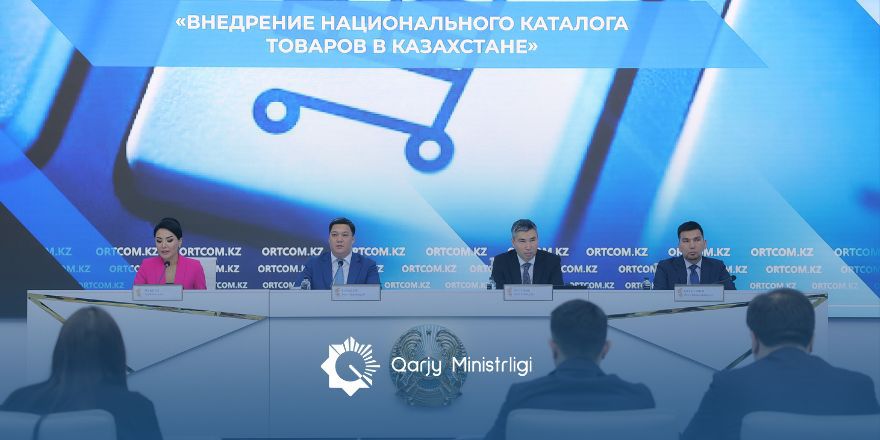
Today, at a press conference held by the Central Communications Service under the President of Kazakhstan, Aset Turysov , Vice Minister of Finance and Aset Nussupov, Vice Minister of Trade and Integration announced the introduction of a National Goods Catalog in Kazakhstan, effective January 1, 2026.
The National Goods Catalog (NGC) will become a centralized and reliable source of information on goods used by government agencies and the business community. The implementation of the NGC provides, for the first time, a single state standard for the description and identification of products, replacing the numerous disparate reference books that existed in various departments and organizations.
Today, there are many different reference books and catalogs used in various procedures—government procurement, customs and the electronic invoice, labeling, statistics, receipts, etc. This leads to duplication, inconsistencies, and difficulties in tracking and accounting for goods, works, and services. The solution to this problem was the creation of the National Goods Catalog. The NGC will ensure end-to-end identification of goods by unique GTIN/NTIN codes and will become a reference source of data connected to all key processes: wholesale and retail trade, customs declarations, receipts, electronic trading platforms, budget planning and execution, and others" said Vice Minister of Finance Aset Turysov.
The national goods catalog is compiled in Kazakhstan on government servers, taking into account the specifics of the local market and requiring that data be maintained in the state language. This guarantees complete technological independence, stability, and compliance with domestic requirements. The NGC provides a unified format for describing goods, including the correct identification code, name, characteristics, images, and accompanying information. Each product receives its own unique card, which becomes a “single passport” that is equally recognizable by all information systems.
A simple example: in one system, a product is called a “milk drink,” in another, “kefir,” and in a third, “fermented milk product.” Formally, these are three different products, although in practice, they are all the same product. The fragmentation of classifiers led to errors, duplication of information, slow processes, and difficulties in traceability. The NGC completely eliminates these barriers. We are creating a single ‘digital passport’ for goods with the name, composition, characteristics, manufacturer, and unique National Trade Item Number (NTIN)," explained Aset Nussupov, Vice Minister of Trade and Integration.
Thus, the introduction of the NGC will eliminate data fragmentation, duplicate entries, and inconsistencies in goods catalogs, and ensure end-to-end information consistency in public procurement, trade, accounting, and inventory management, as well as on commercial electronic platforms and marketplaces. Thanks to a standardized approach, all market participants will work with uniform and up-to-date information, which will increase the transparency and quality of processes.
The speakers also emphasized that NGC is often confused with digital labeling in society. Kazakhstan is currently developing a three-level system for classifying and cataloging goods, with each level performing its own function. GCGWS (General Classifier of Goods, Works and Services) provides a unified system for classifying goods, works, and services that is necessary for budget planning, general statistics, and analytics at the state level.
The national goods catalog is the primary and universal level, where each product name is recorded together with the manufacturer. Digital marking is the lowest and most accurate level, where each unit of goods and batch is recorded. The tool is used in a limited number of product categories and addresses issues such as counterfeiting, traceability, expiration dates, and tax compliance.