Speech by President Kassym-Jomart Tokayev at the opening ceremony of the VII Congress of Leaders of World and Traditional Religions
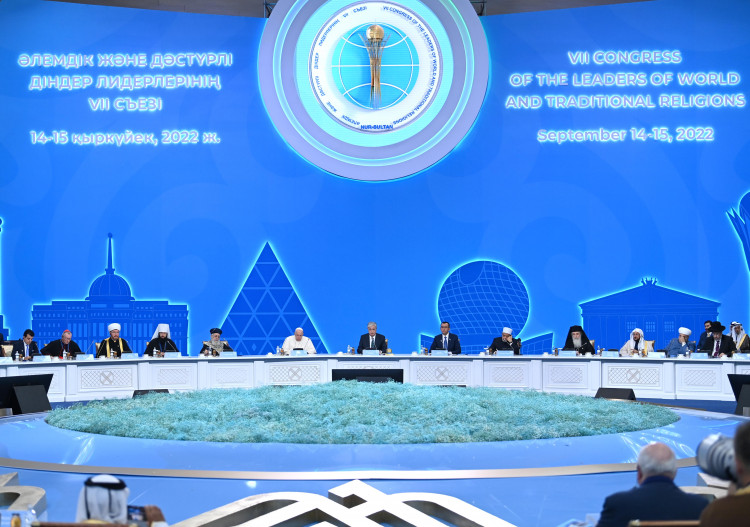
Your Holinesses!
Dear participants of the Forum!
The theme of this Congress is the development of humanity in the post-pandemic period.
The spread of the coronavirus has significantly affected all spheres of life – economy, politics, and social relations.
Unfortunately, the global health care system was not prepared to effectively cope with this global challenge.
The acute phase of the fight against this insidious disease triggered both an increase in narrow nationalism – vaccine nationalism, export and travel bans – but also a weakening of international institutions.
Therefore, given the risk of new pandemics, a careful rethinking of global cooperative health mechanisms is required.
Furthermore, new approaches are necessary in international trade and economic cooperation, as well as in the support for developing countries.
Quarantine measures disrupted supply channels and had a negative impact on services, tourism, transport, and other industries.
The crisis hit developing economies hardest, reinforcing poverty and inequality, accelerating global inflation.
We are faced once again with food shortages in the least developed regions of the world.
At the same time, geopolitical confrontation between major powers has intensified, increasing tensions in different parts of the world.
The previous system of international security is collapsing.
Extremism and terrorism remain serious threats.
The sanctions-induced energy crisis threatens the achievement of carbon neutrality we had just set.
This is not a goal we can afford to ignore. Natural disasters over the last two decades, mostly related to climate change, amounted to approximately three trillion dollars.
Unfortunately, tension, mutual distrust, and even hostility are returning to international relations.
What can we rely on to counter today's challenges? History provides only one answer – goodwill, dialogue and cooperation. There are no other guarantees of success.
Kazakhstan has always favored solving any disputes exclusively at the negotiating table in the spirit of the UN Charter. Threats, sanctions, and the use of force do not solve problems.
At such moments we must turn to humanistic ideals.
Their main custodians are, of course, traditional religions.
The absolute value of human life, respect for each other's interests, mutual assistance, openness, equality and justice – these are the pillars of new security system.
That is why the moral authority and voice of spiritual leaders are crucial today.
In this regard, I would like to note the great historical significance of the call of Pope Francis and the Grand Imam of
al-Azhar, Dr. Ahmed El-Tayeb, outlined in the document “Human Fraternity for World Peace and Living Together”.
Today, we all depend on each other – no global problems can be solved without constructive dialogue and mutually beneficial cooperation.
Our country has consistently promoted principles aimed at achieving peace, comprehensive security and sustainable progress in the international arena.
Kazakhstan has been one of the leaders of the global movement against nuclear weapons. We initiated the Conference on Interaction and Confidence-Building Measures in Asia, which is supposed to become Organization. We have chaired the UN Security Council, the OSCE, and the Organization of Islamic Cooperation.
We also support and work hard to promote a constructive development agenda at the regional and global levels.
In our domestic agenda, we also place a high priority on strengthening unity, consolidation and effective dialogue.
Today, Kazakhstan has embarked on an ambitious program of reforms.
Their success largely depends on the solidarity of our multi-ethnic and multi-confessional nation and the peace and harmony in our land. We are building a Just Kazakhstan to make our state effective and prosperous.
Therefore, we make emphasis on political transformation of our country.
Our new economic policy is aimed at ensuring a more fair distribution of the national income and increasing the welfare of all citizens equally.
We want international trade and investment partnerships to be drastically enhanced.
In the energy and extractive industries, we consistently raise environmental requirements, and expand the use of renewable energy sources.
Your Holinesses!
Dear participants of the Congress!
The challenges we face today require an understanding of the role of religions and spiritual leaders in global processes.
In this regard, I would like to present several themes for discussion.
Firstly, all traditional religions share a set of basic principles: the sacred value of human life, mutual support, and the rejection of destructive rivalry and hostility.
I am convinced that these principles should form the basis of a new world system today.
We need a fundamental modernization and harmonization of theoretical concepts and practical approaches in culture, politics, economics and society.
To revive the true spirit and meaning of civilization, we need a large-scale reformation in all spheres of life.
Secondly, we see that, while politicians argue, spiritual leaders desire and seek to draw closer together.
This is a pivotal trend. It is the efforts and dialogue of spiritual leaders that can eventually show humanity a way out of the current confrontation.
The experience of this large-scale dialogue strengthens spiritual leaders to actively pursue various peacemaking initiatives.
This is essential to ending military conflicts and the suffering of people in conflict zones around the world.
Spiritual leaders are the guardians of the conscience of humanity. Therefore, who better than you to show the way to mutual trust, goodness and peace.
Now, more than ever, humanity is in need of solidarity.
To build a new system of international security, we all need a new global movement for peace. I believe the role of spiritual leaders in this matter is paramount.
Thirdly, given that we now live in a digital world, it is important to systematically promote the ideals of humanism and enduring spiritual values.
We see how new technologies are radically changing all spheres of human life before our eyes. The pandemic has only accelerated and deepened this process.
Digital communications, the Internet, and social networks play a huge positive role, erasing borders between people in all corners of the earth.
But at the same time, we observe how societies are being fragmented and polarized under the influence of digital technology.
For many, the virtual world already replaces the real one.
Therefore, in the new digital reality it is necessary to raise the question of cultivating spiritual values and moral guidelines in a new way.
The cult of knowledge and education without the right system of education of the younger generations will not lead humanity to universal progress and prosperity.
Religion has always fulfilled this basic function of education.
The Quran, the Bible, the Torah, and other scriptures are imbued with ideas of humanism, compassion, and mercy.
They reject aggression and radicalism, condemn violence, and preach tolerance and moderation.
The high mission of religious leaders in the modern era is to bring these fundamental truths to the people.