August 29 the International Day of Action against Nuclear Tests
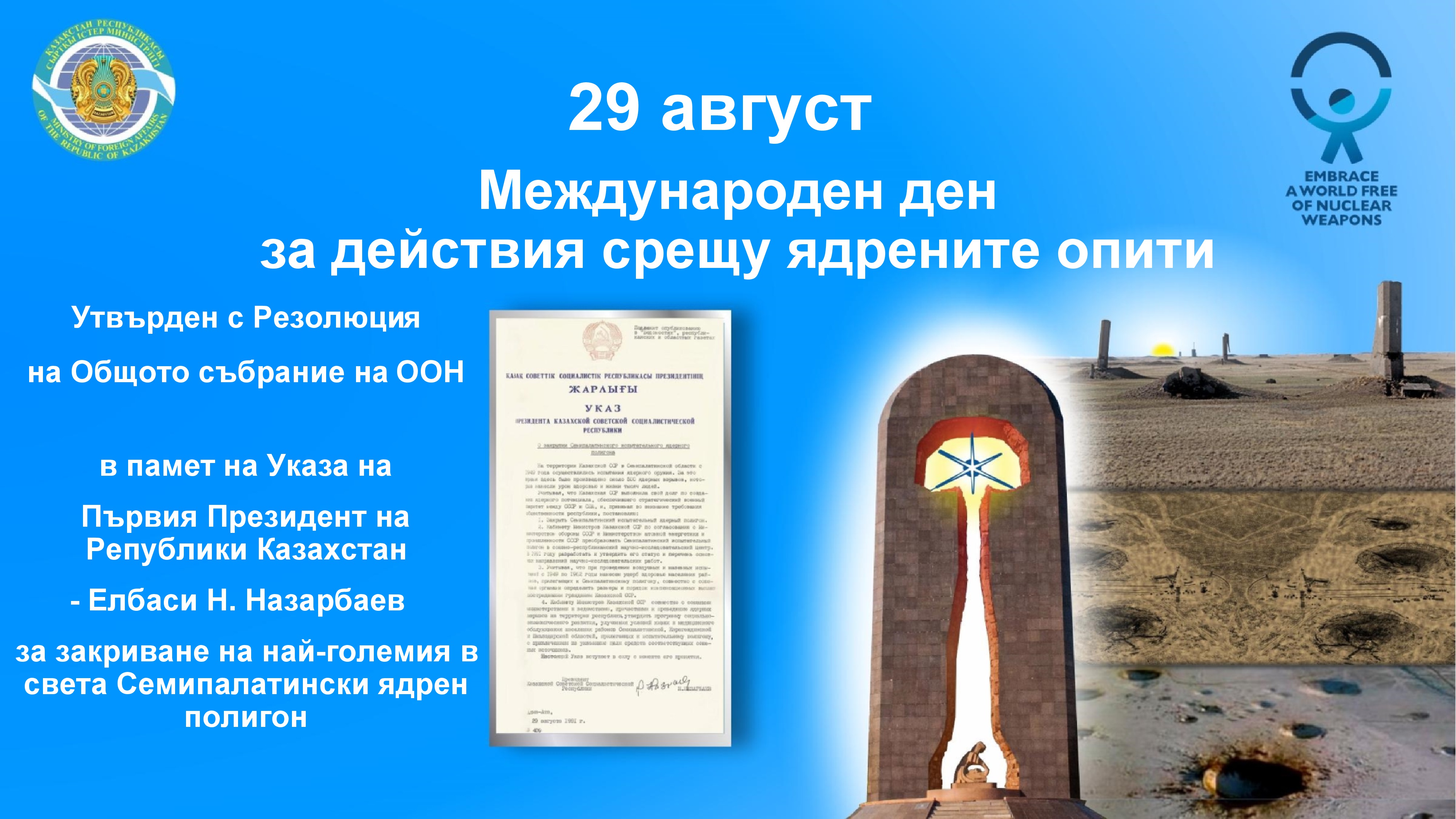
On June 18, 2009, at a solemn event dedicated to the 20th anniversary of the cessation of testing at the Semipalatinsk nuclear test site, as well as on July 1, 2009 at the opening of the III Congress of Leaders of World and Traditional Religions, President of the Republic of Kazakhstan N.A. Nazarbayev took the initiative to declare August 29 as the World Day of Renunciation of Nuclear Weapons.
After gaining independence in 1991, Kazakhstan abandoned the world's fourth-most destructive arsenal of nuclear weapons inherited from the Soviet Union, and on August 29, 1991, it closed the largest Semipalatinsk nuclear test site, which became the most significant contribution to strengthening the non-proliferation regime.
As a result of a long process of coordination, a draft resolution "International Day against Nuclear Tests" was submitted to the First Committee of the UN General Assembly. The resolution was co-sponsored by 26 States.
On December 2, 2009, the UN General Assembly adopted a resolution declaring August 29 “the International Day of Action against Nuclear Tests”, according to which events will be held annually aimed at reminding the world of the terrible consequences of nuclear tests and preventing their resumption in the future. This is a recognition by the international community of the importance of the date of August 29, the day of the official closure of the Semipalatinsk test site, which is of historical significance not only for Kazakhstan, but for all mankind.
The resolution calls on all Member States, the UN system, civil society, academia, the media and individuals to properly celebrate “the International Day against Nuclear Tests”, including using all elements of awareness-raising work
The International Day of Action against Nuclear Tests was first held in 2010. Since then, this Day has been celebrated annually by holding various events around the world, including symposiums, conferences, exhibitions, competitions, publications, lectures at academic institutions, informational broadcasts and other events. The United Nations also holds events dedicated to this Day on an annual basis.