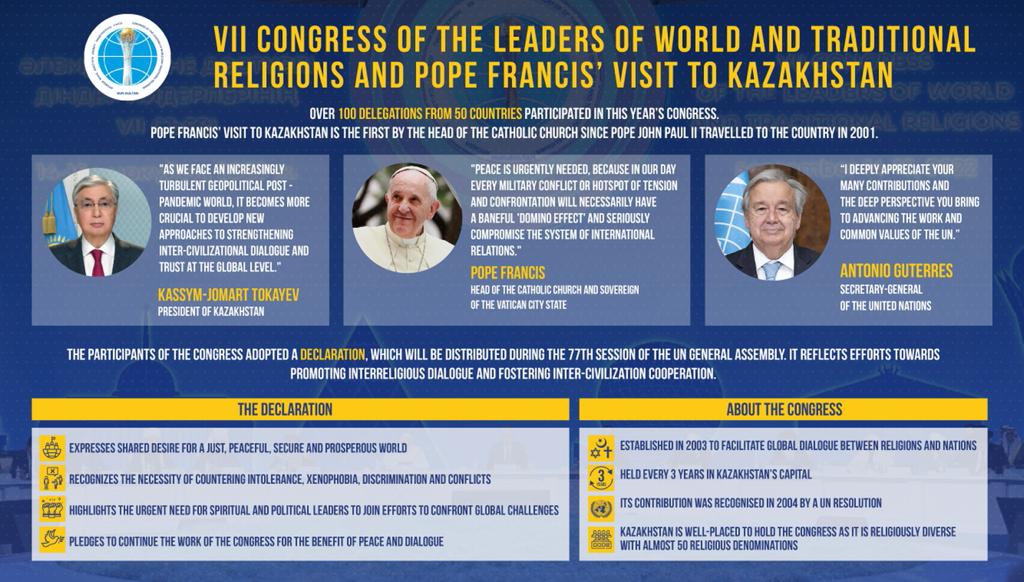
ӘЛЕМДІК ЖӘНЕ ДӘСТҮРЛІ ДІНДЕР ЛИДЕРЛЕРІНІҢ VII СЪЕЗІНІҢ ДЕКЛАРАЦИЯСЫ
Біз, VII съезге қатысушылар – әлемдік және дәстүрлі діндердің рухани лидерлері, саясаткерлер, халықаралық ұйымдардың жетекшілері,
әділ, бейбіт, қауіпсіз және гүлденген әлемге деген ортақ ұмтылысымызды басшылыққа ала отырып,
адамзаттың рухани және әлеуметтік дамуындағы жалпыға ортақ құндылықтардың маңыздылығын бекіте отырып,
әлеуметтік, этномәдени және діни айырмашылықтар негізінде төзімсіздік пен өшпенділікке,ксенофобияға,кемсітушілік пен жанжалдарға қарсы тұру және оларды еңсеру қажеттілігін мойындай отырып,
діни және мәдени әртүрліліктің байлығын құрметтей отырып,
қайырымдылық іс-әрекеттері, жанашырлық, мейірімділік, әлеуметтік әділеттілік пен ынтымақтастық адамдар мен қоғамдардың жақындасуына ықпал ететінін сезіне отырып,
жеке адамның өзін-өзі және дінаралық даму үшін білім беру мен діни ағартудың құндылығын мойындай отырып,
қоғамдағы әйелдердің рөлі мен құқықтарының маңыздылығын растай отырып,
материалдық теңсіздік біздің әлемді наразылыққа, әлеуметтік шиеленіске, қақтығыстар мен дағдарыстарға әкелетінін атап өте отырып,
климаттың өзгеруі, кедейлік пен ашаршылыққа, ұйымдасқан қылмыс, терроризм және есірткі сияқты пандемиядан кейінгі әлемдегі жаһандық сын-қатерлерді шешудің маңыздылығын мойындай отырып,
діни қудалауға және адам өмірі мен қадір-қасиетіне қол сұғуға алып келетін экстремизмді, радикализмді және терроризмді ең батыл түрде айыптай отырып,
әлемде мемлекетаралық және халықаралық шиеленіс ошақтарының құрылуын айыптай отырып,
гуманитарлық көмек пен қорғауды қажет ететін мигранттар мен босқындар санының жаһандық көбеюіне алаңдаушылықты білдіре отырып,
қақтығысушы тараптар арасында диалог және татуласу үшін жағдай жасауға жәрдемдесуге деген нық ниетін білдіре отырып,
рухани және саяси лидерлердің қазіргі әлемдегі мәселелерді шешу үшін бірлескен күш-жігерінің жіті қажеттілігін сезіне отырып,
барлық халықаралық, өңірлік, ұлттық және жергілікті бастамаларды, сондай-ақ дін лидерлерінің дінаралық, мәдениетаралық және өркениетаралық диалогқа жәрдемдесу жөніндегі күш-жігерін қолдай отырып,
пандемиядан кейінгі кезеңде діни қоғамдастықтар, халықаралық, ұлттық және қоғамдық мекемелер, сондай-ақ үкіметтік емес ұйымдар арасындағы ынтымақтастықты жандандыруға ниет білдіре отырып,
Әлемдік және дәстүрлі діндер лидерлері съезінің жұмысын түрлі діндер, конфессиялар мен діни ілімдер өкілдері үшін халықаралық дінаралық диалог алаңына айналғанын тағы да қуаттай отырып,
дінаралық, мәдениетаралық және өркениетаралық диалогты кеңейту жөніндегі одан әрі нақты қадамдарды қабылдаудағы Әлемдік және дәстүрлі діндер лидерлері съезінің мүмкіндігін көрсете отырып,
- БІЗ ОРТАҚ ҰСТАНЫМҒА КЕЛДІК ЖӘНЕ КЕЛЕСІ ТУРАЛЫ МӘЛІМДЕЙМІЗ:
БізӘлемдік және дәстүрлі діндер лидерлерінің съезі бейбітшілік пен діндер, мәдениеттер мен өркениеттер арасындағы диалог игілігі үшін өзінің тұрақты қызметін жалғастыруынабар күш-жігерімізді саламыз
- Біз әлемнің пандемиядан кейінгі дамуы мен әлемдік процестердің жаһандануы және қауіпсіздікке төнетін қатерлер жағдайында Әлемдік және дәстүрлі діндер лидерлерінің съезі бейбітшілік пен ынтымақтастық үшін диалогты нығайту, сондай-ақ рухани және адамгершілік құндылықтарды ілгерілету жөніндегі бірлескен күш-жігерді іске асыруда маңызды рөл атқаратынын мәлімдейміз.
- Біз пандемияның жағымсыз салдарын тек бірлескен күш-жігермен, бірлесіп жұмыс жасау және бір-бірімізге көмек көрсету арқылы жеңуге болатындығын мойындаймыз.
- Біз кез-келген әскери қақтығыстың басталуы, шиеленіс пен текетірестің ошақтарды қоздыру «домино әсеріне» ие болатынына және халықаралық қатынастар жүйесінің бұзылуына әкелетініне сенімдіміз.
- Біз экстремизм, радикализм, терроризм және зорлық-зомбылық пен соғыстардың барлық басқа нысандары, қандай мақсаттар болса да, шынайы дінге ешқандай қатысы жоқ және оларды түбегейлі қабылдамау керек деп санаймыз.
- Біз ұлттық үкіметтер мен уәкілетті халықаралық ұйымдардан соғыстар мен әскери жанжалдардың салдарынан экстремистер мен террористер тарапынан құқықтар мен зорлық-зомбылыққа ұшыраған барлық діни топтар мен этникалық қауымдастықтарға жан-жақты көмек көрсетуді өтініп сұраймыз.
- Біз әлемдік лидерлерді әлемдегі жағдайды тұрақсыздандыруға әкелетін агрессивті және деструктивті риторикадан бас тартуға, біздің әлеміміздің барлық бұрышындағы қақтығыстар мен қантөгістерді тоқтатуға шақырамыз.
- Біз әлемнің түкпір-түкпірінен келген дін лидерлері мен көрнекті саяси қайраткерлерді достық, ынтымақтастық және бейбіт қатар өмір сүру үшін диалогты үздіксіз дамытуға шақырамыз.
- Біз әлемдік және дәстүрлі діндер лидерлері мен көрнекті саяси қайраткерлерді ұзақ мерзімді тұрақтылыққа қол жеткізу үшін шиеленістерді реттеу процесіне белсенді тартуды жақтаймыз.
- Біз тері түсі, жынысы, нәсілдері, тілі мен мәдениетіндегі плюрализм және айырмашылықтар Жаратушы Алланың еркінің даналығының көрінісі екенін атап өтеміз. Құдай діни әртүрлілікке жол береді, сондықтан қандай да бір дінге және діни ілімге мәжбүрлеудің кез-келгені қолайсыз.
- Біз барлық халықтарға әлеуметтік әділеттілік пен ынтымақтастық орнату үшін дінаралық және конфессияаралық үнқатысуды іске асыру жөніндегі практикалық бастамаларды қолдауға шақырамыз.
- Біз Біріккен Ұлттар Ұйымының және басқа да халықаралық, үкіметтік және өңірлік институттар мен ұйымдардың өркениеттер мен діндер, мемлекеттер мен ұлттар арасындағы диалогқа жәрдемдесу жөніндегі күш-жігерімен ниеттеспіз.
- Біз Қасиетті Тақ пен Әл-Азһар Әл-Шариф арасындағы (БҰҰ БА-ның 2020 жылғы 21 желтоқсандағы«Халықаралық адамзат бауырластығы күні» A/RES/75/200 қарарымен қабылданған) ортақ игілік үшін сенушілер арасында бейбітшілікке, диалогқа, өзара түсіністікке және өзара құрметке шақыратын «Бейбітшілік пен бейбіт қатар өмір сүрудің пайдасына адами бауырластық туралы» құжаттың және «Мекке декларациясының» (2019 жылы мамырда Меккеде қабылданған) маңыздылығы мен құндылығын мойындаймыз.
- Біз әлемдік қоғамдастықтың ғылым, техника, медицина, өнеркәсіп және басқа да салаларда қол жеткізген прогресін қолдаймыз, бірақ бұл ретте оларды рухани, әлеуметтік және адами құндылықтармен үйлестірудің маңыздылығын атап өтеміз.
- Біз әлеуметтік мәселелер көбінесе адамдарды шектен тыс көзқарастар мен істерге итермелейтінін түсінеміз және әлемнің барлық мемлекеттерін өз азаматтары үшін лайықты өмір сүру жағдайларын қамтамасыз етуге шақырамыз.
- Біз рухани құндылықтар мен адамгершілік бағдарлардың маңыздылығын елемейтін адамдар мен қоғамдар өздерінің адамгершілігін және шығармашылығын жоғалтуға бейім екенін атап өтеміз.
- Біз әлемдік саяси және бизнес көшбасшыларын қазіргі қоғамдардың дамуындағы сәйкессіздіктерді еңсеруге назар аударуға және халықтың түрлі топтары мен әлемнің түрлі елдерінің әл-ауқатындағы алшақтықты қысқартуға шақырамыз.
- Біз әлемдік және дәстүрлі діндер лидерлері арасындағы диалогтың бейбітшілікті сақтауға ықпал ететін мемлекеттер мен қоғамдардағы әлеуметтік-саяси процестерге оң әсерін тигізетінін атап өтеміз.
- Біз Аллаһ Тағалланың барлық адамдарды нәсілдік, діни, этностық немесе өзге де қатыстылығына немесе әлеуметтік жағдайына қарамастан тең етіп жаратқандығын негізге аламыз, сондықтан бір-біріне деген құрмет пен өзара түсіністік бүкіл діни уағыздардың негізінде жатыр.
- Біз саяси және қоғам қайраткерлерінің, журналистер мен блогерлердің сөз бостандығын мойындай отырып, оларды діни жалпылаудан сақ болуға және экстремизм мен терроризмді қандай да бір ұлтпен немесе дінмен теңестірмеуге, сондай-ақ дінді саяси мақсаттарда пайдаланбауға шақырамыз.
- Біз діндер мен мәдениеттердің құрметпен қатар өмір сүруін нығайтуда және қауіпті жалған діни нанымдарды бұзуда білім беру мен діни ағартудың рөлін арттыруды жақтаймыз.
- Біз отбасы институтын нығайтудың маңыздылығына ерекше назар аударамыз.
- Біз әйелдердің қадір-қасиеті мен құқықтарын қорғауға, олардың отбасы мен қоғамның тең құқылы мүшесі ретіндегі әлеуметтік мәртебесін арттыруға, сондай-ақ олардың мәдени және діни салалардағы бейбіт процестерге қатысуын көтермелеуге атсалысамыз.
- Біз әлемдік цифрлық дамудың сөзсіздігін, сондай-ақ діни және рухани лидерлердің цифрлық теңсіздік мәселелерін шешуде саяси қайраткерлермен өзара іс-қимыл жасаудағы рөлінің маңыздылығын атап өтеміз.
- Біз ой-пікір білдіру бостандығын құрметтей отырып, діни білімнің, дінаралық толеранттылық пен азаматтық бейбітшіліктің ілгерілеуі үшін діни құндылықтардың маңыздылығын түсіндіру, сондай-ақ діндерге жалпы төзімділікті қалыптастыруға БАҚ-пен және қоғамның басқа да институттарымен диалогты дамытуға ұмтыламыз.
- Біз барлық сенім мен ізгі ниетті адамдарды осы қиын қыстау кезеңде бірігуге және біздің ортақ үйіміз – Жер планетасында қауіпсіздік пен келісімді қамтамасыз етуге үлес қосуға шақырамыз.
- Біз дұғаларымызды одан әрі гүлденген әлем үшін өркениетаралық, дінаралық және мемлекетаралық диалогты кеңейтуге елеулі үлес қосатын планетадағы барлық ізгі ниетті адамдарды қолдауға шақырамыз.
- Біз әскери қақтығыстардан, табиғи және техногендік апаттардан зардап шеккен аймақтардағы мейірімділік пен жанашырлық әрекеттерін қолдауға шақырамыз.
- Біз коронавирустық пандемияның салдарын жеңу үшін күш салуда халықаралық ұйымдар мен ұлттық үкіметтерге бірлесіп қолдау көрсетуге шақырамыз.
- Біз Съездің және осы Декларацияның мақсаттары адамзаттың қазіргі және болашақ ұрпақтарын өзара құрмет пен бейбітшілік мәдениетін ілгерілетуге бағыттау болып табылатынын және әлемнің кез келген елінің, сондай-ақ БҰҰ институттарын қоса алғанда, халықаралық ұйымдардың мемлекеттік басқаруында пайдалануға қолжетімді екенін растаймыз.
- Біз 2023-2033 жылдарға арналған жаһандық дінаралық диалог алаңы ретінде Әлемдік және дәстүрлі діндер лидерлерінің съезін дамыту тұжырымдамасын әзірлеуді Съезд Хатшылығына тапсырамыз.
- Біз Қазақстан Республикасының өркениетаралық, дінаралық және конфессияаралық диалогтың беделді және жаһандық орталығы ретіндегі рөлін растаймыз.
- Біз Әлемдік және дәстүрлі діндер лидерлерінің VII Съезін шақырғаны үшін, гуманистік бастамалар үшін, сондай-ақ жаңғырту мен прогреске, бейбітшілік пен келісімге қосқан үлесі үшін, Қазақстан Республикасына және Президент Қасым-Жомарт Тоқаевқа алғыс айтамыз.
- Біз Қазақстан Республикасына Съезді тамаша ұйымдастырғаны үшін, ал Қазақстан халқына – мейірімділігі мен қонақжайлылығы үшін, алғысымызды білдіреміз.
- Біз Әлемдік және дәстүрлі діндер лидерлері съезінің қызметін жалғастыруға ұжымдық мүдделілігімізді және келесі VIII Съезді 2025 жылы Қазақстан Республикасының астанасы Нұр-Сұлтан қаласында өткізу ниетімізді растаймыз.
* * *
Осы Декларация Әлемдік және дәстүрлі діндер лидерлерінің VII съезі делегаттарының көпшілігімен қабылданды, бүкіл әлемдегі билікке, саяси көшбасшыларға, дін қайраткерлеріне, тиісті өңірлік және халықаралық ұйымдарға, азаматтық қоғам институттарына, діни бірлестіктер мен жетекші сарапшыларға беріледі. Сондай-ақ ол БҰҰ Бас Ассамблеясының 77-ші сессиясының ресми құжаты ретінде таратылады.
Қазіргі Декларациядағы қағидалар барлық мүдделі елдердегі саяси шешімдерде, заңнамалық нормаларда, білім беру бағдарламаларында және бұқаралық ақпарат құралдарында есепке алынуы үшін барлық өңірлік және халықаралық деңгейлерде таралуы мүмкін.
БІЗДІҢ БАРЛЫҚ ДҰҒАЛАРЫМЫЗ ҚАБЫЛ БОЛСЫН
ЖӘНЕ
БАРЛЫҚ ХАЛЫҚТАР МЕН ЕЛДЕРГЕ
БЕЙБІТШІЛІК ПЕН ӨРКЕНДЕУДІ ТІЛЕЙМІЗ!
ҚАЗАҚСТАН РЕСПУБЛИКАСЫ
НҰР-СҰЛТАН ҚАЛАСЫ
2022 жылғы 15 қыркүйек
Imam Yahya Pallavicini’s statement at the Session 3
of the Seventh Congress of Leaders of World and Traditional Religions
“The contribution of religious leaders and politicians to promoting global interfaith dialogue and peace and countering extremism, radicalism and terrorism”
Nur-Sultan
15 September 2022
Interreligious cooperation as the antidote to hatred and violence
Excellency Maulen Ashimbayev,
It is my honour to convey the best wishes and greetings of Peace to You, to the distinguished leaders of the Republic of Kazakhstan and to the blessed people of this beautiful land from Italy and from COREIS, the Italian Religious Islamic Community, as well as from EULEMA the European Council of Muslim Leaders.
Fraternity conjures up a familiarity, an intimacy, a union between two or more human beings by virtue of a common origin that both precedes and determines the existence of brothers and sisters, an origin that can be represented by the love of the same parents, or by certain people belonging to the same religious community or by obedience to a contemplative “confraternity”, by virtue of a call or vocation that follows a specific authorized rule.
People can be brothers because they are children of the same family as Cain and Abel or Ishmael and Isaac or Moses and Aaron and interpret this fraternity through fratricide or through noble lineage working to complement each other on a mission to give testimony to and adore the One God.
Pope Francis’ encyclical letter entitled “Fratelli tutti” (“All brothers”), alongside the Document on Human Fraternity for World Peace and Living Together (Abu Dhabi, 2019) clearly condemns all fratricide and violence, hatred and social injustice, especially in the name of the pretext of a religious reason or justification.
The two sons of the patriarch of Abraham’s monotheism, Ishmael and Isaak, have two almost parallel paths that never seem to meet: each is the son of Hagar and Sarah respectively and of the father and prophet Abraham, who seems to be the only thing the two brothers have in common. Yet both, upon the death of their father and after having buried him together, inherit his duty to pass on sincere worship to the One God and both will generate a blessed lineage of believers faithful to the teaching of the prophets despite episodes of fratricidal violence, civil disorder and political corruption occurring over the centuries. These are sacrilegious disorders precisely because they ignore the sacred nature of human life but also of prophetic fidelity.
Islamic doctrine describes both Moses and Aaron as prophets i.e. as elected to the service of guiding the people to react to the forgetfulness of God’s order and identity. Moses is also given the task of passing on a message, a Revelation, a sacred Law, to his people. His brother Aaron does not have this duty, but has the gift of supporting his brother’s mission with the quality of communication, language, speech, towards both Pharaoh and his own people, both to mediate against the arrogance of the King of Egypt and to calm the impatient minds of the Jews before reaching the Promised Land. The new cycle for this religious community will begin thanks to the asymmetrical competition of the two brother prophets.
This fraternity in prophecy, interpreted in an enlightened way by Moses and Aaron, is a teaching for the Muslim faithful to recognize the unity of prophecy and fraternity in the complex articulation and differences in roles to follow.
The history of Islamic civilisation also confirms these complementary elements between the two brothers of the al-Ghazali family, Abu Hamid Muhammad and Ahmad: the first becomes a spiritual teacher after a journey as a scholar, philosopher and theologian, while the other brother remains concentrated and solitary as an ascetic and mystic. While the first brother Abu Hamid Muhammad al-Ghazali is given the role of orthodox clarification and doctrinal renewal, both juridical and ensuring spiritual orientation for the entire Muslim community, we cannot fail to respect the great religious devotion and inner concentration of the second brother.
Yet how can we deny the combination of the qualities of both brothers for common enlightenment? Be careful not to fall into the trap of exalting one brother by virtue of his fame or of idealizing the other brother out of a presumed elective affinity.
Respecting fraternity does not, in fact, mean defending Cain no matter what, or justifying the envy of the brothers of the prophet Joseph who stage his death, turning his father, the prophet Jacob, blind with pain, or exalting Aaron’s qualities of understanding and communication, or acting as rivals over the primacy of promise and sacrifice, to be associated with Ishmael or Isaac.
Fraternity can never be respected if the defence of a weakness is flaunted and, due to incorrect compensation, there is a tendency to scale down and relativize the strength of faith of another brother. If this were the case, this “compensation” would in actual fact undermine the fraternity, to the detriment of its sacral identity and the Order of God, to promote a “fraternal” communion devoid of reference to the tradition of prophecy, without love for the father and for the nature and purpose of religion.
The Revelation of the Quran contains various passages in which the believer is called upon to react to the negative potential of man, who has the ability to corrupt the nature of Creation and of humanity and to spread blood, hatred and violence, miserably betraying the primordial pact with his Lord. According to some Muslim exegetes, this is the “reason” that would justify Iblis, Satan, in his disobedience to prostrate himself before the first man, Adam: how can a being of “light” bow down before a being of “mud”? Does God really propose such a contradiction? Since then humanity has been tempted into pride in mastering the world by forgetting or associating individually with the Lord of the Worlds. To convert believers back to the “True Religion”, God cyclically sends His prophets and messengers and heirs.
On one hand, therefore, traditional sources remind us of the virtue of the elect who overcome the mystification of doctrine and, on the other hand, remind us of the awareness of the dark and perverse sides of the soul in the decadence of times. It is paradoxical that some worshippers of sacred texts seem to be radically disinterested in these two operational aspects, election and purification, manipulating religion into a game of power or juridical moralism.
In the inspired awareness of this profound intellectual crisis, Pope Francis meets, talks and testifies with other spiritual authorities, the Israeli rabbis, Patriarch Bartholomew and Patriarch Kirill, Imam al-Tayyeb and Ayatollah al-Sistani. He presents an integral fraternity without claiming to represent it in an absolute let alone relative way, but he is open to recognizing a sacred dignity that his colleagues interpret as authoritative servants of the Spirit and teachers of a blessed religious expression of the same Christian family or of the same family of Abraham.
Alternatively, there is respect for doctrinal and theological jurisdictions and the relative temporal, national and cultural declinations. These “stations of fraternity” experienced in the course of his eight years of pontificate and travels are accompanied by the three encyclical letters Lumen Fidei, Laudato sì and Fratelli tutti.
Pope Francis’ intuition to suggest as a rule in one of his sermons that “no one is saved alone”, citing the image of a boat in which we are all forced together has, perhaps, the value of a test of humility for the Christian people, but also of a common fraternity among “all” believers in the call to eschatology, to the meaning of faith and of life, before death. Is this image not perhaps also a common religious perspective in all doctrines? And so, in light of the signs of the times, this fraternity cannot fail to be a religious and spiritual alliance in which every believer needs to purify himself of the weights and superstructures that risk sinking the boat or excluding him from the Ark of Seeds of the Seven Laws of Noah.
The Pact between God and man is the fulcrum of this Ark of the Covenant which must be inhabited by custodians of Tradition who are loyal to the sacred, sensitive to the action of Metaphysics, to the transcendence and immanence of God.
It is certainly a sacred, interreligious fraternity because it assumes, at the end of time, a character that truly embodies migration, liberation, illumination, elevation and extinction in satisfying a taste for the presence of God.
This is why the search for an election and purification can only be found among observant believers who share an affinity for humble service and sincere contemplation. These last words, contemplation and service, play the role of supporting and protecting the path to stations unveiling fraternity in traditional life, in the community and in the world, awaiting the return to the beginning.
Even in the history of Islamic civilisation, contemplative orders have helped to preserve and retransmit the intellectual renewal of a rule of spiritual support and protection to cultivate the Way to Know God. And this election will not be able to be fulfilled if no barrier is placed, even at external level, to the rampant madness of polytheism and idolatries where everyone invokes and believes in their own mental and emotional construction of divinity, without any tolerance but with hatred and violence against the other believer and citizen.
We too are convinced, as Pope Francis writes in his encyclical letter that “Truth in fact, is an inseparable companion of justice and mercy.
God is one and the same for everyone, but religions are different. If we truly make of God “the highest possible conception” by avoiding confining Him in one particular idea, we can accept that His revelation is inexhaustible. Thus, Muslims find the Quran the teaching the God’s message to humanity is always the same, but it takes on different forms to adapt to the characteristics of the peoples to whom it is addressed.
These differences are therefore providential since they enable us to grasp a universal metaphysical message in specific and adapted doctrinal and ritual forms. The origin of this diversity escapes us and can only be resolved in God. There can be no “rational solution” to the apparent inconsistencies between the dogmas and rites belonging to Christianity and Islam. While waiting (to return to God) we are invited to compete with one another in doing good!
Prophet Muhammad said: “I am the closest of the people to Jesus in this life and in the Hereafter. There is no prophet between me and him. The prophets are paternal brothers. Their mothers are different, but their religion is one.
Imam Yahya Pallavicini
Vice President of the Italian Islamic Religious Community (COREIS)