DECLARATION OF VII CONGRESS OF THE LEADERS OF WORLD AND TRADITIONAL RELIGIONS
We, the participants of the VII Congress - spiritual leaders of world and traditional religions, politicians, heads of international organizations,
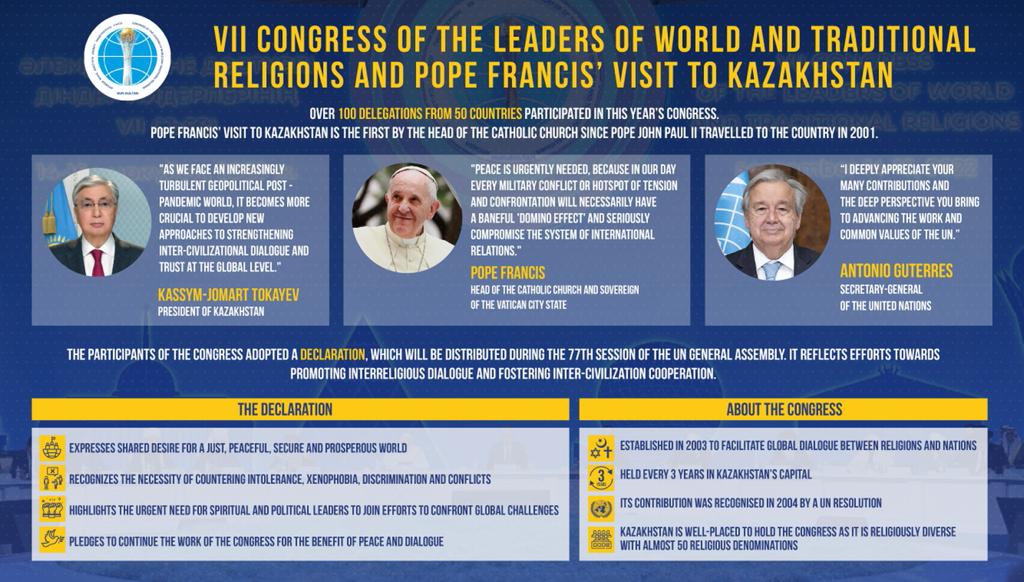
guided by our shared desire for a just, peaceful, secure and prosperous world,
affirming the importance of shared values in the spiritual and social development of humankind,
recognizing the necessity of countering and overcoming intolerance and hate speech, xenophobia, discrimination and conflicts based on ethnic, religious and cultural differences,
respecting the richness of religious and cultural diversity,
realizing that acts of charity, compassion, mercy, justice and solidarity contribute to the rapprochement of peoples and societies,
recognizing the value of education and spirituality for personal and interreligious development
affirming the importance of the role and rights of women in society,
stating that material inequality leads to discontent, social tension, conflict and crisis in our world,
recognizing the importance of addressing global challenges in our post-pandemic world, including climate change, poverty and hunger; organized crime, terrorism, and drugs,
condemning in the strongest terms the extremism, radicalism and terrorism which lead to religious persecution and the undermining of human life and dignity,
condemning the creation of hotspots of interstate and international tension in the world,
expressing serious concern about the global increase in the number of migrants and refugees in need of humanitarian assistance and protection,
expressing a firm desire to contribute to the creation of conditions for dialogue and reconciliation between conflicting parties,
realizing the urgent necessity for spiritual and political leaders to work together in addressing the challenges of our world,
welcoming all international, regional, national and local initiatives, especially the efforts of religious leaders to promote interreligious, intercultural and intercivilizational dialogue,
expressing the intention to intensify cooperation between religious communities, international, national and public institutions, and non-governmental organizations in the post-pandemic period,
reaffirming the work of the Congress of the Leaders of World and Traditional Religions as an international interreligious dialogue platform for representatives of many religions, confessions and creeds,
pointing out the opportunity of the Congress of the Leaders of World and Traditional Religions for taking further specific steps to expand interreligious intercultural and intercivilizational dialogue,
- HAVE COME TO A COMMON POSITION AND DECLARE THE FOLLOWING:
- We will make every effort to ensure that the Congress of the Leaders of World and Traditional Religions continues its regular activities for the benefit of peace and dialogue between religions, cultures and civilizations.
- We declare that in the conditions of post-pandemic world development and the globalization of processes and security threats, the Congress of the Leaders of World and Traditional Religions plays an important role in the implementation of joint efforts to strengthen dialogue in the name of peace and cooperation, as well as the promotion of spiritual and moral values.
- We recognize that the negative consequences of pandemic disease can be overcome only through joint effort, working together and helping each other.
- We are convinced that the unleashing of any military conflict, creating hotspots of tension and confrontation, causes chain reactions which impair international relations.
- We believe that extremism, radicalism, terrorism and all other forms of violence and wars, whatever their motivations and goals, have nothing to do with authentic religion and must be rejected in the strongest possible terms.
- We strongly urge national governments and authorized international organizations to provide comprehensive assistance to all religious groups and ethnic communities that have been subjected to infringement of rights and violence by extremists and terrorists and as a result of wars and military conflicts.
- We call upon world leaders to abandon all aggressive and destructive rhetoric which leads to destabilization of the world, and to cease from conflict and bloodshed in all corners of our world.
- We call upon religious leaders and prominent political figures from different parts of the world tirelessly to develop dialogue in the name of friendship, solidarity and peaceful coexistence.
- We advocate the active involvement of the leaders of world and traditional religions and prominent political figures in the process of conflict resolution for achieving long-term stability.
- We note that pluralism in terms of differences in skin color, gender, race, language and culture are expressions of the wisdom of God in creation. Religious diversity is permitted by God and, therefore, any coercion to a particular religion and religious doctrine is unacceptable.
- We call for the support of practical initiatives to implement interreligious and interdenominational dialogue, for the sake of building social justice and solidarity for all peoples.
- We stand in solidarity with the efforts of the United Nations and all other international, governmental and regional institutions and organizations, promoting dialogue among civilizations and religions, states and nations.
- We recognize the importance and value of the Document on Human Fraternity for World Peace and Living Together between the Holy See and Al-Azhar Al-Sharif (adopted by the UN General Assembly in resolution A/RES/75/200 of December 21, 2020), and the Makkah Declaration (adopted in Mecca in May 2019), which call for peace, dialogue, mutual understanding and mutual respect among believers for the common good.
- We welcome the progress made by the global community in the fields of science, technology, medicine, industry and other areas yet note the importance of their harmonization with spiritual, social and human values.
- We realize that social problems often push people to extreme attitudes and actions and call on all states of the world to ensure adequate living conditions for their citizens.
- We note how people and societies which dismiss the importance of spiritual values and moral guidelines are susceptible to lose their humanity and creativity.
- We call on world political and business leaders to focus on overcoming the imbalances in the development of modern societies and to reduce the gap in the well-being of different segments of the population and different countries of the world.
- We note the positive impact of dialogue between leaders of world and traditional religions for socio-political processes in states and societies, contributing to the preservation of peace.
- We proceed from the immutable fact that the Almighty created all people equal, regardless of their racial, religious, ethnic or other affiliation or social status, therefore respect for each other and mutual understanding underpin all religious teaching.
- We call on political and public figures, journalists and bloggers, while recognizing their freedom of speech, to beware religious generalization and not to identify extremism and terrorism with any nation or religion, as well as not to use religions for political purposes.
- We advocate increasing the role of education and religious formation, particularly among youth, in strengthening the respectful coexistence of religions and cultures and debunking dangerous pseudo-religious prejudices.
- We pay special attention to the importance of strengthening the institution of the family.
- We stand for the protection of the dignity and rights of women, the improvement of their social status as equal members in family and society, as well as encourage their inclusion in the peace processes in cultural and religious settings.
- We note the inevitability of global digital development, as well as the importance of the role of religious and spiritual leaders in interacting with politicians in solving the problems of digital inequality.
- While we respect the freedom of expression, we strive to develop a dialogue with the media and other institutions of society to clarify the significance of religious values for promoting religious knowledge, interreligious harmony and civil peace, as well as to develop general tolerance towards religions.
- We appeal to all people of faith and goodwill to unite in this difficult time and contribute to ensuring security and harmony in our common home – planet Earth.
- We turn to pray in support of all people of goodwill on the planet who make a significant contribution to the expansion of inter-civilizational, interreligious and international dialogue for the sake of a more prosperous world.
- We call for supporting acts of mercy and compassion in regions affected by military conflict, and by both natural and man-made disasters.
- We call for solidarity in the support of international organizations and national governments in their efforts to overcome the consequences of the Covid pandemic.
- We affirm that the purposes of the Congress and this Declaration is to guide contemporary and future generations of humankind in promoting a culture of mutual respect and peacefulness; available for use in public administration of any country in the world, as well as by international organizations, including UN institutions.
- We instruct the Secretariat of the Congress to develop a Concept for the development of the Congress of the Leaders of World and Traditional Religions as a global interreligious dialogue platform for 2023-2033.
- We affirm the role of the Republic of Kazakhstan as an authoritative and global center of intercivilizational, interreligious and interfaith dialogue.
- We thank the Republic of Kazakhstan and President Kassym-Jomart Tokayev for convening the VII Congress of the Leaders of World and Traditional Religions, for their humanitarian initiatives, and for their contribution to renewal and progress, peace and harmony.
- We thank the Republic of Kazakhstan for the excellent organization of the Congress, and to the Kazakh people for their cordiality and hospitality.
- We confirm our collective interest in continuing the activities of the Congress of the Leaders of World and Traditional Religions and our intention to convene the next VIII Congress in 2025 in the capital of the Republic of Kazakhstan, Nur-Sultan.
* * *
This Declaration was adopted by the majority of delegates of the VII Congress of the Leaders of World and Traditional Religions and is being transmitted to the authorities, political leaders and religious figures around the world, relevant regional and international organizations, civil society organizations, religious associations and leading experts. It will also be distributed as an official document of the 77th session of the UN General Assembly.
The principles contained in the current Declaration can be disseminated at all regional and international levels, for consideration in all political decisions, legislative norms, educational programs, and mass media in all interested countries.
MAY OUR ASPIRATIONS BE BLESSED
AND MAY PEACE AND PROSPERITY
BE GRANTED TO ALL PEOPLES AND COUNTRIES!
THE REPUBLIC OF KAZAKHSTAN
NUR-SULTAN
SEPTEMBER 15, 2022
Imam Yahya Pallavicini’s statement at the Session 3
of the Seventh Congress of Leaders of World and Traditional Religions
“The contribution of religious leaders and politicians to promoting global interfaith dialogue and peace and countering extremism, radicalism and terrorism”
Nur-Sultan
15 September 2022
Interreligious cooperation as the antidote to hatred and violence
Excellency Maulen Ashimbayev,
It is my honour to convey the best wishes and greetings of Peace to You, to the distinguished leaders of the Republic of Kazakhstan and to the blessed people of this beautiful land from Italy and from COREIS, the Italian Religious Islamic Community, as well as from EULEMA the European Council of Muslim Leaders.
Fraternity conjures up a familiarity, an intimacy, a union between two or more human beings by virtue of a common origin that both precedes and determines the existence of brothers and sisters, an origin that can be represented by the love of the same parents, or by certain people belonging to the same religious community or by obedience to a contemplative “confraternity”, by virtue of a call or vocation that follows a specific authorized rule.
People can be brothers because they are children of the same family as Cain and Abel or Ishmael and Isaac or Moses and Aaron and interpret this fraternity through fratricide or through noble lineage working to complement each other on a mission to give testimony to and adore the One God.
Pope Francis’ encyclical letter entitled “Fratelli tutti” (“All brothers”), alongside the Document on Human Fraternity for World Peace and Living Together (Abu Dhabi, 2019) clearly condemns all fratricide and violence, hatred and social injustice, especially in the name of the pretext of a religious reason or justification.
The two sons of the patriarch of Abraham’s monotheism, Ishmael and Isaak, have two almost parallel paths that never seem to meet: each is the son of Hagar and Sarah respectively and of the father and prophet Abraham, who seems to be the only thing the two brothers have in common. Yet both, upon the death of their father and after having buried him together, inherit his duty to pass on sincere worship to the One God and both will generate a blessed lineage of believers faithful to the teaching of the prophets despite episodes of fratricidal violence, civil disorder and political corruption occurring over the centuries. These are sacrilegious disorders precisely because they ignore the sacred nature of human life but also of prophetic fidelity.
Islamic doctrine describes both Moses and Aaron as prophets i.e. as elected to the service of guiding the people to react to the forgetfulness of God’s order and identity. Moses is also given the task of passing on a message, a Revelation, a sacred Law, to his people. His brother Aaron does not have this duty, but has the gift of supporting his brother’s mission with the quality of communication, language, speech, towards both Pharaoh and his own people, both to mediate against the arrogance of the King of Egypt and to calm the impatient minds of the Jews before reaching the Promised Land. The new cycle for this religious community will begin thanks to the asymmetrical competition of the two brother prophets.
This fraternity in prophecy, interpreted in an enlightened way by Moses and Aaron, is a teaching for the Muslim faithful to recognize the unity of prophecy and fraternity in the complex articulation and differences in roles to follow.
The history of Islamic civilisation also confirms these complementary elements between the two brothers of the al-Ghazali family, Abu Hamid Muhammad and Ahmad: the first becomes a spiritual teacher after a journey as a scholar, philosopher and theologian, while the other brother remains concentrated and solitary as an ascetic and mystic. While the first brother Abu Hamid Muhammad al-Ghazali is given the role of orthodox clarification and doctrinal renewal, both juridical and ensuring spiritual orientation for the entire Muslim community, we cannot fail to respect the great religious devotion and inner concentration of the second brother.
Yet how can we deny the combination of the qualities of both brothers for common enlightenment? Be careful not to fall into the trap of exalting one brother by virtue of his fame or of idealizing the other brother out of a presumed elective affinity.
Respecting fraternity does not, in fact, mean defending Cain no matter what, or justifying the envy of the brothers of the prophet Joseph who stage his death, turning his father, the prophet Jacob, blind with pain, or exalting Aaron’s qualities of understanding and communication, or acting as rivals over the primacy of promise and sacrifice, to be associated with Ishmael or Isaac.
Fraternity can never be respected if the defence of a weakness is flaunted and, due to incorrect compensation, there is a tendency to scale down and relativize the strength of faith of another brother. If this were the case, this “compensation” would in actual fact undermine the fraternity, to the detriment of its sacral identity and the Order of God, to promote a “fraternal” communion devoid of reference to the tradition of prophecy, without love for the father and for the nature and purpose of religion.
The Revelation of the Quran contains various passages in which the believer is called upon to react to the negative potential of man, who has the ability to corrupt the nature of Creation and of humanity and to spread blood, hatred and violence, miserably betraying the primordial pact with his Lord. According to some Muslim exegetes, this is the “reason” that would justify Iblis, Satan, in his disobedience to prostrate himself before the first man, Adam: how can a being of “light” bow down before a being of “mud”? Does God really propose such a contradiction? Since then humanity has been tempted into pride in mastering the world by forgetting or associating individually with the Lord of the Worlds. To convert believers back to the “True Religion”, God cyclically sends His prophets and messengers and heirs.
On one hand, therefore, traditional sources remind us of the virtue of the elect who overcome the mystification of doctrine and, on the other hand, remind us of the awareness of the dark and perverse sides of the soul in the decadence of times. It is paradoxical that some worshippers of sacred texts seem to be radically disinterested in these two operational aspects, election and purification, manipulating religion into a game of power or juridical moralism.
In the inspired awareness of this profound intellectual crisis, Pope Francis meets, talks and testifies with other spiritual authorities, the Israeli rabbis, Patriarch Bartholomew and Patriarch Kirill, Imam al-Tayyeb and Ayatollah al-Sistani. He presents an integral fraternity without claiming to represent it in an absolute let alone relative way, but he is open to recognizing a sacred dignity that his colleagues interpret as authoritative servants of the Spirit and teachers of a blessed religious expression of the same Christian family or of the same family of Abraham.
Alternatively, there is respect for doctrinal and theological jurisdictions and the relative temporal, national and cultural declinations. These “stations of fraternity” experienced in the course of his eight years of pontificate and travels are accompanied by the three encyclical letters Lumen Fidei, Laudato sì and Fratelli tutti.
Pope Francis’ intuition to suggest as a rule in one of his sermons that “no one is saved alone”, citing the image of a boat in which we are all forced together has, perhaps, the value of a test of humility for the Christian people, but also of a common fraternity among “all” believers in the call to eschatology, to the meaning of faith and of life, before death. Is this image not perhaps also a common religious perspective in all doctrines? And so, in light of the signs of the times, this fraternity cannot fail to be a religious and spiritual alliance in which every believer needs to purify himself of the weights and superstructures that risk sinking the boat or excluding him from the Ark of Seeds of the Seven Laws of Noah.
The Pact between God and man is the fulcrum of this Ark of the Covenant which must be inhabited by custodians of Tradition who are loyal to the sacred, sensitive to the action of Metaphysics, to the transcendence and immanence of God.
It is certainly a sacred, interreligious fraternity because it assumes, at the end of time, a character that truly embodies migration, liberation, illumination, elevation and extinction in satisfying a taste for the presence of God.
This is why the search for an election and purification can only be found among observant believers who share an affinity for humble service and sincere contemplation. These last words, contemplation and service, play the role of supporting and protecting the path to stations unveiling fraternity in traditional life, in the community and in the world, awaiting the return to the beginning.
Even in the history of Islamic civilisation, contemplative orders have helped to preserve and retransmit the intellectual renewal of a rule of spiritual support and protection to cultivate the Way to Know God. And this election will not be able to be fulfilled if no barrier is placed, even at external level, to the rampant madness of polytheism and idolatries where everyone invokes and believes in their own mental and emotional construction of divinity, without any tolerance but with hatred and violence against the other believer and citizen.
We too are convinced, as Pope Francis writes in his encyclical letter that “Truth in fact, is an inseparable companion of justice and mercy.
God is one and the same for everyone, but religions are different. If we truly make of God “the highest possible conception” by avoiding confining Him in one particular idea, we can accept that His revelation is inexhaustible. Thus, Muslims find the Quran the teaching the God’s message to humanity is always the same, but it takes on different forms to adapt to the characteristics of the peoples to whom it is addressed.
These differences are therefore providential since they enable us to grasp a universal metaphysical message in specific and adapted doctrinal and ritual forms. The origin of this diversity escapes us and can only be resolved in God. There can be no “rational solution” to the apparent inconsistencies between the dogmas and rites belonging to Christianity and Islam. While waiting (to return to God) we are invited to compete with one another in doing good!
Prophet Muhammad said: “I am the closest of the people to Jesus in this life and in the Hereafter. There is no prophet between me and him. The prophets are paternal brothers. Their mothers are different, but their religion is one.
Imam Yahya Pallavicini
President of the Italian Islamic Religious Community (COREIS)