MAIN INITIATIVES OF THE PRESIDENT OF KAZAKHSTAN KASSYM-JOMART TOKAYEV AT THE FIFTH MEETING OF THE NATIONAL COUNCIL OF PUBLIC TRUST HELD 25 FEBRUARY 2021
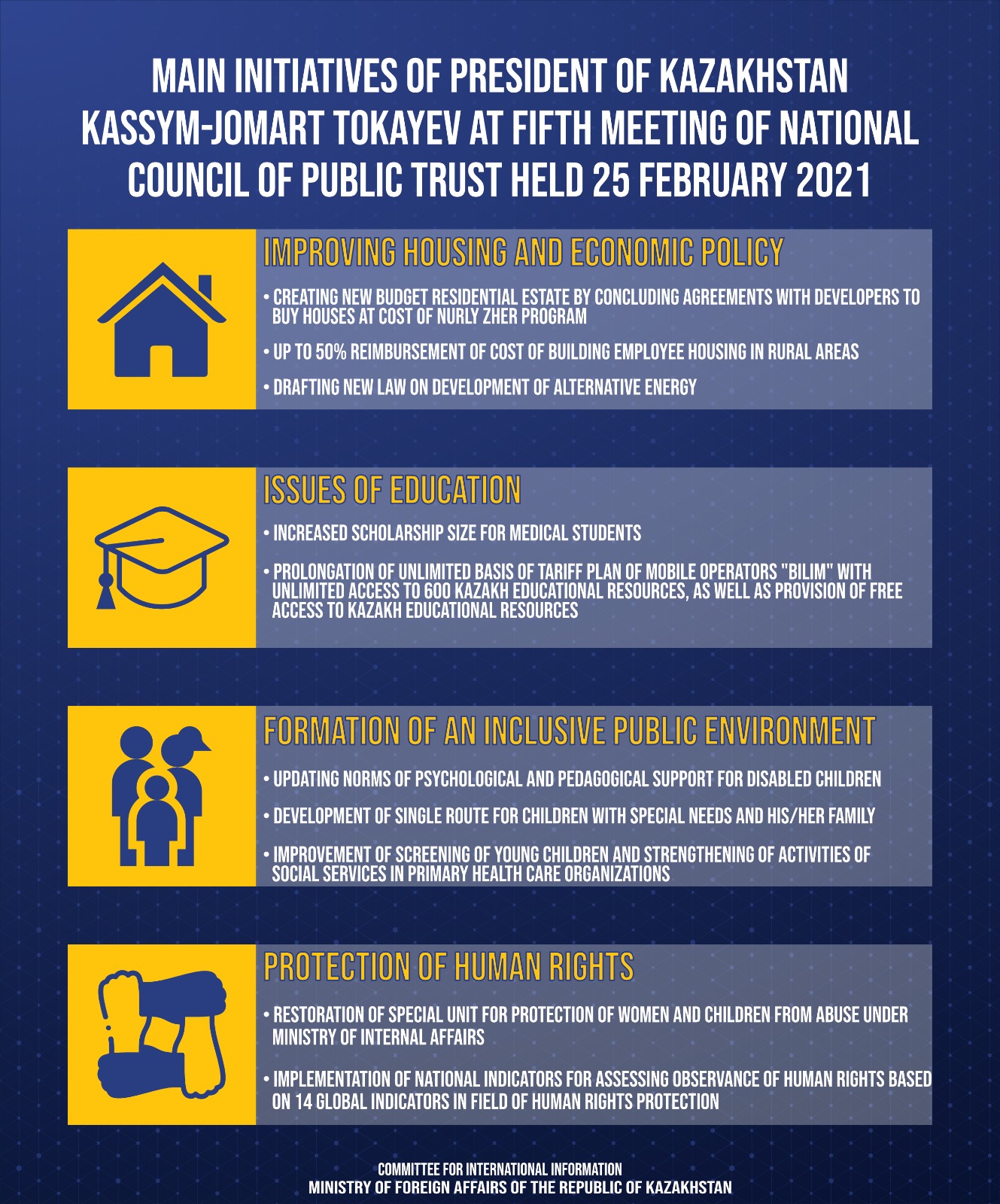
MAIN INITIATIVES OF THE PRESIDENT OF KAZAKHSTAN
KASSYM-JOMART TOKAYEV AT THE FIFTH MEETING OF THE NATIONAL COUNCIL OF PUBLIC TRUST HELD 25 FEBRUARY 2021
|
Blocks of initiatives
|
Details of initiatives |
|
1. Improving housing and economic policy |
· Creation of a new budget residential estate by concluding offtake agreements with developers for the subsequent purchase of housing at the prices of the Nurly Zher programme · Solving the issue of housing construction in rural areas through state reimbursement of up to 50% of employers' expenses for the construction of housing for their employees · Monitoring the activities of social and entrepreneurial corporations (SECs) and strengthening the competence of the Ministry of National Economy in coordinating SECs · Drafting a new Law on the development of alternative energy |
|
2. Issues of education |
· Prolongation on an unlimited basis of the tariff plan of mobile operators "Bilim" with unlimited access to 600 Kazakh educational resources, as well as provision of free access to Kazakh educational resources · Increased scholarship size for medical students |
|
3. Formation of an inclusive public environment |
· Update of the norms regarding special psychological and pedagogical support for children with disabilities · Improvement of screening of young children and strengthening of the activities of social services in primary health care organizations · Development of a single route for a child with special needs and his/her family · Simplification of the procedure for establishing disability, by contacting only a medical institution, by accelerating the integration of information systems of all interested state bodies (in pilot mode from July 1, 2021, full-scale from January 1, 2022) · Adoption of effective regulatory legal acts to ensure barrier-free access for persons with disabilities and other people with limited mobility. Development of the List or Map of in-demand objects |
|
4. Protection of human rights |
· Development of an Action Plan on ensuring safe work in Kazakhstan until 2025 · Implementation of national indicators for assessing observance of human rights based on 14 Global Indicators in the field of human rights protection · Introduction of administrative liability of legal entities, up to the suspension of their license, for involving or admitting minors to gambling · Restoration of the special unit for the protection of women and children from abuse under the Ministry of Internal Affairs · Introduction of the specialisation of female investigators in investigative units to investigate violent crimes against women and children · Development of a concrete action plan for the implementation of a video surveillance system in penitentiary institutions and police offices, which would cover "invisible" zones · Consideration of the exclusion of the norm of a lifetime suspension of a lawyer's license · Increasing the adversarial nature of the parties, ensuring equality of the prosecutor and lawyer in the trial |
Factsheet on peaceful assemblies and rallies in Kazakhstan
Overview
Following the election of President Kassym-Jomart Tokayev in 2019, the government of Kazakhstan recognised the need to update its legislation regarding peaceful rallies. In this regard, on May 25, 2020, the Head of State signed into law a conceptually new legislation on organising and conducting peaceful assemblies (the Law on the Procedure for Organizing and Holding Peaceful Assemblies). It entails the following new elements:
- Notification procedure: For the first time ever in Kazakhstan, the legislation introduced a notification procedure for holding peaceful assemblies, including pickets and rallies. The notification by the organisers of the assemblies does not require any response from the local executive bodies and authorities, and is considered agreed upon by default.
- Designated protest zones: Kazakhstan has adopted the British principle of selecting designated venues for rallies. Special protest zones are set up in Nur-Sultan, major cities, and each of the districts.
- Eased regulations for rallies: The time needed for the public to notify authorities of their intent to hold a political rally has been reduced to only five days.
The notification procedure complies with all the basic principles of a peaceful assembly, which are accepted by the international community. They include:
- Non-aggression
- Legality
- Ensuring state security, public order, safety, and protection of the rights and freedoms of others
The new law in practice
A number of large peaceful assemblies have been organised recently in line with the new legislation by notifying the authorities. They were held by civil activists throughout Kazakhstan. For example:
- On October 31, 2020, civil activists Bakhytzhan Toregozhina and Galym Ageleuov notified the Almaty city Mayor’s Office about holding a rally regarding civil and political rights. Though not necessary, the Mayor’s Office provided a written confirmation of authorisation to hold the rally.
- Journalist Lukpan Akhmedyarov organised a rally on February 28, 2021, in the Uralsk city. After receiving the notification regarding the rally, the local authorities prepared designated places for holding the event, to ensure safety and security for the participants and other residents of the city.
The use of “kettling”
Kettling (also known as containment or corralling) is a police tactic for controlling large crowds during demonstrations or protests. It involves the formation of large cordons of police officers who then move to contain a crowd within a limited area. Protesters either leave through an exit controlled by the police or are contained.
Though rarely used in Kazakhstan, it was utilised as a forced measure on rare occasions to maintain law and order.
Kettling tactics are widely used in developed democratic countries, including the United States, the United Kingdom, Germany, and other European and Western countries.
In March 2012, kettling was ruled lawful by the European Court of Human Rights.