“Green” cooperation between Kazakhstan and the European Union discussed in Brussels
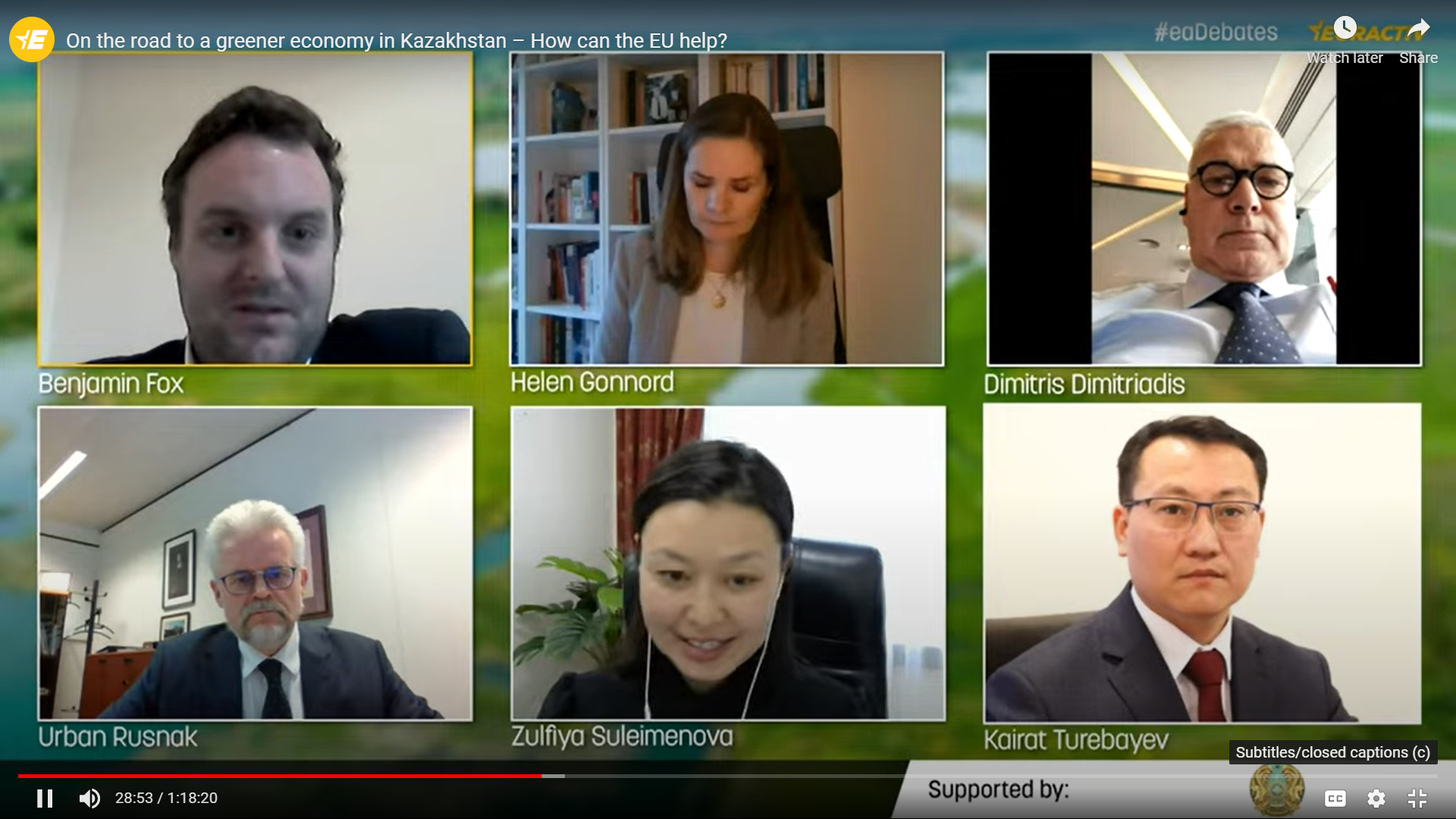
Following the participation of Kazakhstan's High-Level Delegation at the COP26 Global Summit on Climate Change, one of the leading news platforms of Europe, “EURACTIV” in cooperation with the Embassy of Kazakhstan in Brussels, hosted an online roundtable discussion “On the road to a greener economy in Kazakhstan – How can the EU help?”.
The speakers of the online discussion were Deputy of the Mazhilis of the Parliament of the Republic of Kazakhstan Zulfiya Suleimenova, Secretary-General of the European Energy Charter, Urban Rusnak, Vice Minister of Trade and Integration of the Republic of Kazakhstan, Kairat Torebaev, President of the European Economic and Social Committee, Dmitrius Dimitriadis, and the Representative of the European External Action Service, Helen Gonnord.
In his welcoming speech, Ambassador of the Republic of Kazakhstan in Belgium, Margulan Baimukhan underlined that Kazakhstan is taking systemic measures to transition to a green and sustainable economy. So, at the Summit on Climate Ambitions in December 2020, the President of the Republic of Kazakhstan Kassym-Jomart Tokayev announced the goal of achieving carbon neutrality by 2060. In November, the delegation of Kazakhstan led by Prime Minister Askar Mamin confirmed that Kazakhstan's carbon neutrality will be achieved by increasing the sustainability of land use and water use, the energy efficiency of the economy, electrification, and widespread use of environmentally friendly, renewable energy sources.
According to U. Rusnak, active digitization, a growing economy and other timely reforms in Kazakhstan meet the country's climatic ambitions, since the transition to sustainable development requires effective systems. D. Dimitriadis believes that cooperation with Kazakhstan responds to the interests of the EU to promote the values of the Union's “Green Deal” in Central Asia.
Deputy Z.Suleimenova highlighted areas of interaction with the EU within the framework of the new Environmental Code of the Republic of Kazakhstan. This includes, in particular, the emissions trading system, the protection of forests, and the adaptation of society to climate change.
According to Vice Minister Torebayev, as a landlocked country with a huge reserve of natural resources and, accordingly, interested in the constant diversification of trade routes, Kazakhstan considers interaction with the EU as a strategic direction of its foreign trade policy. Therefore, the Republic of Kazakhstan is ready to discuss the impact of the carbon border mechanism on a wide range of sectors of mutual trade, he said.
The participants agreed that the climate targets of the Republic of Kazakhstan and the European Green deal to achieve climate neutrality opens up a wide range of opportunities to enhance trade cooperation, support sustainable SMEs and drive innovation.
Additional information: Kazakhstan was one of the first nations to ratify the Paris Agreement in 2016. In the implementation of this document, the Republic of Kazakhstan intends to reduce greenhouse gas emissions by 15% by 2030; it also has updated the Nationally Determined Contribution (NDC) and adopted a new Environmental Code.