Middle Corridor: Kazakhstan and the EU Strengthen Connectivity Between East and West
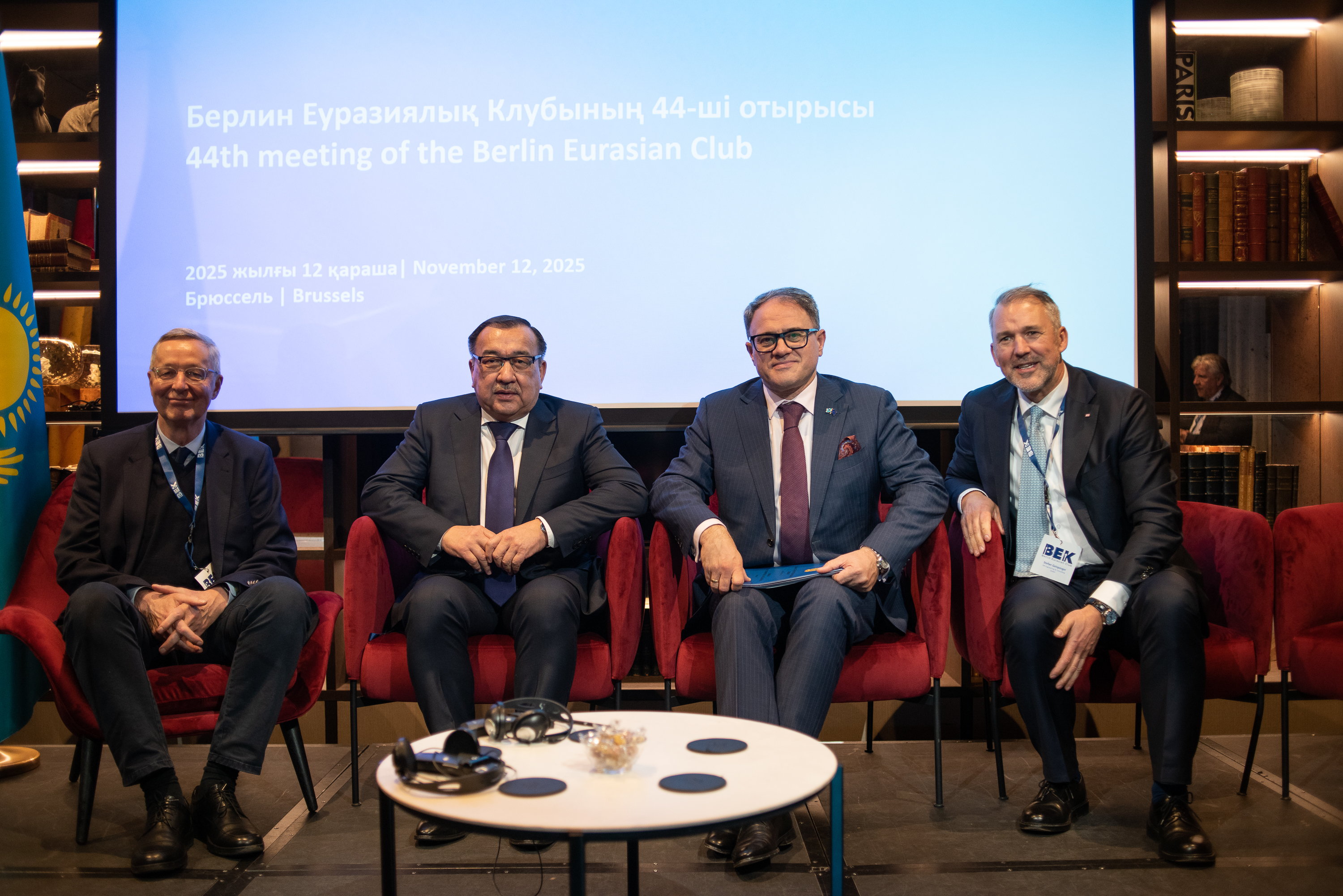
Brussels, 12 November 2025 – The 44th annual meeting of the Berlin Eurasian Club was held in the Belgian capital, focusing on the theme “The Middle Corridor and Global Gateway.” The discussion centered on Kazakhstan’s growing role in shaping a new architecture of transport connectivity between Europe and Asia.
The meeting brought together representatives of government agencies of Kazakhstan and the European Union, business associations, experts and scholars, logistics companies, and financial institutions.
In his welcoming remarks, Kazakhstan’s Ambassador to Germany, Nurlan Onzhanov, emphasized that Kazakhstan is gaining an increasingly prominent position in the EU’s supply chain geography. “This is not a temporary trend but a long-term, objective development based on the dynamic growth of our economic potential and the expansion of infrastructure that connects continents. We are strengthening our partnership with the European Union and Germany, especially in the fields of transport and logistics,” the Ambassador noted.
Kazakhstan’s Permanent Representative to the EU, Roman Vassilenko, highlighted that the event is taking place on the eve of an important milestone in Kazakhstan–EU relations — the 10th anniversary of the signing of the Enhanced Partnership and Cooperation Agreement, which covers 29 areas of bilateral and regional cooperation.
He drew participants’ attention to the dynamic development of Kazakhstan–EU relations, where transport connectivity has become a key factor in further strengthening multifaceted cooperation. Vassilenko underscored the EU’s strong interest in developing the Trans-Caspian International Transport Route, noting the announced allocation of around EUR 20 billion to support it, and called on European institutions to move toward practical implementation of projects aimed at eliminating the Middle Corridor’s so-called “bottlenecks.”
For his part, Michael Harms, Executive Director of the German Eastern Business Association, stressed that Global Gateway is not only about connecting China and Europe. It is also about developing interregional trade and strengthening the EU’s neighborhood policy — linking Central Asia, the Caucasus, and the EU through modern, sustainable transport and digital corridors. “When trade prospers, investment follows. Reliable logistics ensure that goods reach markets on time, creating new value chains and industrial partnerships. Without functioning transport infrastructure, even access to vital raw materials loses its meaning,” Harms emphasized.
Deputy Minister of Transport of Kazakhstan, Zhanibek Tayzhanov, delivered a report on key directions for developing the transport sector.
During the panel discussion, participants examined cooperation prospects in specific sectors, as well as the experience and plans of German and European logistics companies to expand their activities in Kazakhstan.
Participants agreed that developing transport infrastructure, diversifying routes, and transitioning to environmentally sustainable solutions are becoming key priorities of the Kazakhstan–EU partnership.
The meeting of the Berlin Eurasian Club confirmed that Kazakhstan is emerging as a central element of the new system of transport connectivity between East and West, strengthening the region’s role in the global economy.