2023-2033 Development Concept Congress of Leaders of World and Traditional Religions
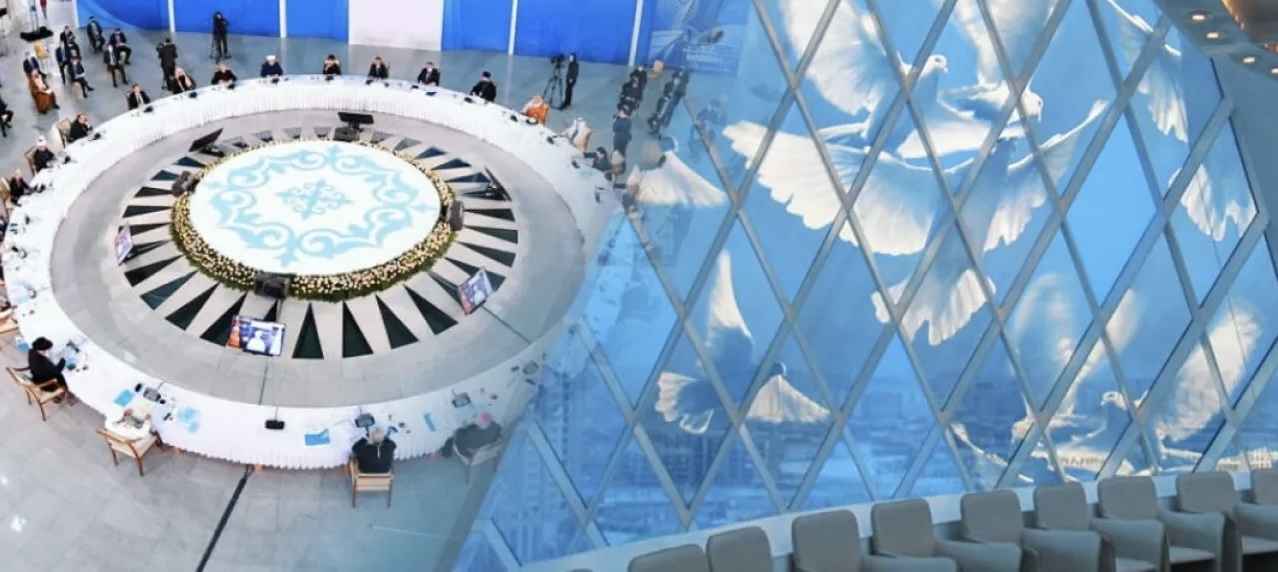
Religious leaders stand for a fair and peaceful world
Table of Content:
I. About the Congress of Leaders of World and Traditional Religions
II. Challenges of the Modern World
III. The Mission and Objectives of the Congress
IV. Priority Areas of Activity and Mechanisms for the Implementation of the Declarations of the Congress
- Preparation for the Congresses
- Systematic Implementation of the Congress Declarations
- Strengthening of the Partnership of the Congress with International Institutions and Platforms, Development of Spiritual Diplomacy
V. Congress Entities
VI. Vision of the Results of the Implementation of the Concept
Draft Development Concept of the Congress of Leaders of World and Traditional Religions for 2023-2033 (hereinafter referred to as the Concept) was drawn up in accordance with paragraph 31 of the Declaration of the Seventh Congress of Leaders of World and Traditional Religions adopted in Astana on September 15, 2022.
The Concept defines a general vision for further development, mission, goals and activities of the Congress of Leaders of World and Traditional Religions until 2033.
I. About The Congress of Leaders of World and Traditional Religions
1.1. Over the 20 years, the Congress of Leaders of World and Traditional Religions has emerged as a unique and well-established platform for global interreligious dialogue.
1.2. The Republic of Kazakhstan initiated the establishment of the Congress of Leaders of World and Traditional Religions. After the unprecedented terrorist attacks of September 11, 2001, when humanity was on the verge of a civilizational and religious split, Kazakhstan proposed to hold a forum that would gather world spiritual leaders at the same table. The idea that emerged only a few weeks after 9/11, during the visit of John Paul II (22-25 September 2001) to Kazakhstan received support from the leaders of most world and traditional religions.
1.3. Kazakhstan's proposal to convene a Congress of Leaders of World and Traditional Religions relies on centuries-old traditions of religious tolerance and hospitality, an integral part of the cultural code of the Kazakh people. Since the dawn of time, different religions, denominations and cultures lived in peace and harmony on the territory of Kazakhstan located in the center of the Silk Road uniting East and West. From the ancient times, Zoroastrian and Buddhist temples, Tengrism symbols, Christian churches and Muslim mosques coexisted in the expanses of the Great Steppe – Uly Dala. In the 21st century, Kazakhstan maintains this tradition of mutual respect and spiritual diversity.
1.4. The first Congress of Leaders of World and Traditional Religions took place in 2003 in Astana, the capital of Kazakhstan. 17 delegations of Buddhism, Christianity, Islam, Hinduism, Judaism, Taoism and Shintoism participated in the Congress. The first Congress was held at challenging times, when the terrorists, covering up their criminal intents with a false religious narrative, sowed fear and distrust in the world. The participants of the Congress unanimously condemned extremism, terrorism and any form of violence as having nothing in common with the true essence of religion. The religious leaders declared: “The diversity of religious beliefs and confessions should not lead to mutual suspicion, discrimination and humiliation, but to mutual perception and harmony, demonstrating the uniqueness of each religion and culture. Religions should strive for greater cooperation, recognizing tolerance and mutual perception as essential tools for peaceful coexistence of all peoples.” The Declaration following the first Congress advocated strengthening and promoting interreligious dialogue as one of the fundamental tools for maintaining peace and harmony between nations and countries.
1.5. Participants of the First Congress of Leaders of World and Traditional Religions decided to hold an interreligious forum regularly, once every three years. The Second Congress of Leaders of World and Traditional Religions was held in the capital of Kazakhstan in 2006. The main outcome was the adoption of universal Principles of Interreligious Dialogue. The Congress participants noted that interreligious dialogue should be based on the principles of openness, tolerance, mutual respect, equality, and also offer a way for peaceful coexistence and fruitful cooperation of all religions, serve as an example for other kinds of dialogues, including political and social ones. The document on the Principles of Interreligious Dialogue became a sort of code of the Congress laying down the foundation for all its further work.
1.6. Over 20 years, the Kazakh capital has hosted seven Congresses of Leaders of World and Traditional Religions. The participants raised the most pressing issues, appealed to religious and political leaders to resolve any conflicts based on mutual respect, considering the interests of each other, advocated the right of every person to freely express their faith and beliefs. The outcome documents of the Congresses touched upon the most urgent humanitarian, spiritual and civilizational issues of the modern world.
1.7. The entities of the Congress of Leaders of World and Traditional Religions have been consistently reinforced. In 2003, the participants of the First Congress of Spiritual Leaders decided to establish the Secretariat of the Congress as a permanent body of interreligious and international dialogue. Since 2012, under the auspices of the Congress, the Council of Religious Leaders has held meetings designed to promote mutual understanding and cooperation between spiritual leaders and international organizations. The participants of the Sixth Congress initiated the establishment of the Nazarbayev Center for Development of Interfaith and Intercivilization Dialogue in 2019. The Center is a working agency of the Secretariat.
1.8. An important feature of the Congress of Leaders of World and Traditional Religions is its diverse representation. The forum is attended by high representatives of all world and traditional religions, established politicians, public figures, heads of international organizations. In 2022, the Seventh Congress brought together about 100 delegations from more than 50 countries, which is a testament to the relevance of this dialogue platform. The working agency of the Secretariat has concluded more than 30 memorandums and agreements with international, religious, educational and other structures, including the United Nations Alliance of Civilizations, the United Nations Educational, Scientific and Cultural Organization (UNESCO), Al-Azhar Al-Sharif, the Dicastery for Interreligious Dialogue of the Holy See, the Department for External Church Relations of the Moscow Patriarchate, Doha International Center for Interfaith Dialogue, Interreligious Council of Russia, the Muslim Council of Elders and others. The contribution of the Congress of Leaders of World and Traditional Religions to the establishment and promotion of the global interreligious dialogue was noted by the resolutions of the UN General Assembly.
1.9. Following the two decades of the Congress, one may note that the initial mission set by its participants has been successfully implemented. At the turn of the 21st century, many doubted even the possibility of a personal meeting between the leaders of world and traditional religions. Today, interreligious dialogue is in great demand and is observing a robust development across the globe. The Congress participants welcome the signing of the Document on “Human Fraternity for World Peace and Living Together” between the Holy See and Al-Azhar Al-Sharif, the Makkah Declaration, the initiatives of the Alliance of Civilizations, “Religions for Peace” organization, UNCIRF, G20 Interfaith Forum, Muslim Council of Elders, the opening of the Abrahamic Family House in the United Arab Emirates and other initiatives aimed at consolidating interreligious dialogue and mutual understanding in the world.
1.10. In the Declaration adopted following the Seventh Congress in September 2022, the spiritual leaders announced their intention to develop a dialogue platform to further strengthen cooperation between religions, cultures, and civilizations. The Congress participants urged religious communities, international and national structures, as well as non-governmental organizations to cooperate in order to cease conflicts and jointly address global issues facing humanity. This Concept presents a vision for the further development of the Congress of Leaders of World and Traditional Religions and its role in promoting and strengthening interreligious dialogue and cooperation in the modern world.
II. Challenges of the Modern World
2.1. The first two decades of the 21st century have been a period of robust economic growth, development of world economic relations, and the expansion of multilateral cooperation in international relations. Various international platforms discussed the outstanding problems of global development. World leaders expressed their readiness to act together and address existing contradictions constructively to achieve common sustainable development goals.
2.2. Meanwhile, the beginning of the third decade of the 21st century is marked by a series of adverse trends. The world has entered a period of serious crises and upheavals triggered by the COVID-19 pandemic. World Health Organization (WHO) reports that the pandemic, directly or indirectly, has claimed the lives of some 20 million people around the world. The spread of COVID-19 has had a devastating impact on global trade and the socio-economic situation of all countries without exception, exacerbating global inequality.
2.3. With this background, geopolitical contradictions have intensified in the world in recent years. Confrontational approaches and military and heavy-handed tactics have returned to political practice. The number of "hot spots" on the planet is increasing. For many regions, the issues of extremism and terrorism remain urgent problems. Currently, approximately a quarter of the world's population lives in conflict-affected countries. The number of refugees is increasing from year to year and has already exceeded 100 million people.
2.4. The system of international law and global security, the relevant international institutions, were unable to face up to the challenge of conflict prevention. Armed clashes in Ukraine have exposed the deeply rooted contradictions of the major powers in the vision of the model of the world order and led to an acute deterioration of the geopolitical situation. Humanity has come close to the dangerous line of nuclear conflict. Under these conditions, the system of international relations needs a complete reset and fundamental transformation. It is necessary to return to the model of peaceful development and cooperation. Dialogue should once again become the main means of solving international problems.
2.5. Under the influence of abovementioned geopolitical factors, the world economy is experiencing serious difficulties. The rate of global economic growth and trade has slowed significantly. Inflation has reached record levels. Many countries are threatened by a debt crisis. For the first time in recent decades, there is an increase in the number of people living in poverty. Approximately every tenth inhabitant of the planet suffers from hunger. At the same time, almost a fifth of the food produced is not consumed and is thrown away.
2.6. The UN notes a "slip" in the implementation of the Sustainable Development Agenda. Developing countries emphasize the impossibility of achieving the Sustainable Development Goals (SDGs) by 2030 without sufficient financial and technological support from developed countries.
2.7. There is insufficient progress in the implementation of measures to combat climate change and environmental degradation. CO2 emissions and global temperatures continue to rise. For two decades of the 21st century, 60% more droughts, floods and storms were recorded than from 1980 to 1999. In many regions, the threat of a shortage of fresh water is becoming more urgent. This increases the risks of further growth of poverty, hunger and instability in the world.
2.8. Social and economic problems, poverty, conflicts in various regions provoke violation of the rights and discrimination of certain groups of the population – religious, ethnic, gender and others. According to the UN, every fifth person in the world faces discrimination on at least one of the grounds provided for by international approaches in the field of human rights.
2.9. Many negative trends in the contemporary world are based on deep shifts of values, the process of devaluation of moral and spiritual values. Years of economic growth have shaped the "consumer society", while the values and culture of humanity are changing dramatically. The cult of "material success" and a consumer attitude towards people and nature is being promoted in society.
2.10. The latest decades have been marked by impressive technological progress. However, along with positive opportunities, it also carries serious risks of further destruction of traditional values. The revolutionary changes associated with the development of digital technologies, the emergence of neural networks and artificial intelligence, discoveries in medicine, bio- and genetic engineering, raise fundamental questions about the nature of the universe, the essence of humanity and the meaning of life in a new way.
2.11. Spiritual experience is central to the human life. Sooner or later, all people turn to the main issues of existence and feel the need for spiritual development. In response to this inquiry, modern society offers a wide range of various new ideologies and subcultures – from theories of self-improvement and simplified pseudo spiritual practices, to radical and extremist ideologies that distort the true nature of faith and rational attitude towards it. In these conditions, the role of world and traditional religions as guardians of fundamental spiritual and moral values is increases significantly. When forming the spiritual culture of new generations, it is important to preserve the continuity of the millennia-long spiritual history of humankind.
2.12. No nation or organization alone is capable of coping with global problems and overcoming the challenges that threaten humanity. People of goodwill – spiritual, political and social leaders all over the planet – should unite to resist the process of disintegration of modern societies, prevent countries from splitting into rival blocs, and promote the values of tolerance, peace and harmony. In order to solve these problems, it is extremely important to use the integrating and creative potential of world and traditional religions.
III. The Mission and Objectives of the Congress
3.1. The Congress of Leaders of World and Traditional Religions has proved itself to be an efficient interreligious dialogue platform that brings together influential religious, political and public figures.
In the first stage of its development (2003-2023), the Congress played an important role in the formation and development of interreligious dialogue.
In the next stage (2023-2033), the key element of the development paradigm of the Congress of Leaders of World and Traditional Religions will be to unite the efforts of religious leaders in facilitating solutions to the most pressing problems of humankind.
The Congress based on the positive experience of the previous two decades of their activities, will continue to work to promote and popularize the global interreligious and intercultural dialogue. At the same time, religious leaders with significant authority and trust in society, as well as moral and ethical strength, are able to make an important contribution to overcoming the most complex challenges and contradictions of the modern world. World and traditional religions play an important role in ensuring stability, unity and harmony at both the national and international levels.
Opening the Seventh Congress of Leaders of World and Traditional Religions, the President of the Republic of Kazakhstan Tokayev encouraged religious figures to contribute to global efforts to mitigate the polarization of international relations and stop the erosion of the world order.
As the President of Kazakhstan noted, spiritual leaders, political and public figures, as well as people of goodwill around the world, should unite in a global peace movement and work together to facilitate the creation of a robust international security system and find effective solutions to the most important political, socio-economic, environmental and other problems facing humanity.
The forum participants supported these initiatives, which was reflected in the outcome Declaration of the Seventh Congress.
3.2. Within the framework of the new development paradigm, in the coming decade, the mission of the Congress of Leaders of World and Traditional Religions is both to further strengthen mutual understanding and respect between communities of world and traditional religions, as well as to realize the potential of spiritual diplomacy to help create a just, safe and prosperous future for all humankind.
3.3. Objectives of the Congress for 2023-2033:
- To further develop the Congress in its capacity to be an effective platform for multilateral dialogue and cooperation, coordination of efforts of leaders of world and traditional religions, international, national, public institutions and people of goodwill supporting the mission of the Congress;
- To promote fundamental spiritual and moral values, which are the unshakable foundation of the development of personality and human society in any era, while respecting those, who do not share such values;
- To unite the efforts of leaders of world and traditional religions, international organizations, state and social institutions, civil societies, academia and all people of goodwill around the world to solve the global problems of the modern world (poverty, inequality, environmental crises, discrimination, pandemics, extremism, terrorism and others);
- To establish mutual respect, peace and harmony as unshakable principles of human existence, the promotion of a culture of dialogue and mutual respect between religions, nations and ethnic groups, and the resolution of contradictions and conflicts on the basis of reconciliation and compromise;
- To prevent the use of people's religious convictions to incite and escalate conflicts and hostilities, and thus to consistently countering radicalism, extremism, terrorism and violence in all of their manifestations;
- To protect and preserve the objects bearing symbols and objects of historical and cultural heritage pertaining to world and traditional religions.
3.4. The participants of the Congress and its entities do not intend to interfere in the affairs of states. At the same time, spiritual leaders are ready for dialogue and joint work with official national institutions in order to create a safer and fairer society.
3.5. The fundamental principles of the Congress activity is reflected in the outcome declarations of the forum, which were developed and adopted by the leaders of world and traditional religions in the period from 2003 to 2022. The participants of the Congress and its entities maintain continuity in their activities and rely on documents adopted following the results of previous interreligious forums.
IV. Priority Areas of Activity and Mechanisms for the Implementation of the Declarations of the Congress
Within the framework of the new development paradigm, in accordance with the designated mission and goals, the activity of the Congress of Leaders of World and Traditional Religions in 2023-2033 will be carried out in three main directions:
First. Preparation and holding of Congresses of Leaders of world and traditional Religions, taking into account current global trends and challenges.
Second. Facilitation of solving the global problems of the modern world on the basis of the systematic implementation of the declarations of the Congresses.
Third. Development of spiritual diplomacy, strengthening the partnership relations of the Congress with international institutions and platforms, other subjects of international relations, and the development of spiritual diplomacy.
4.1. Preparation for the Congresses
4.1.1. The Congress of Leaders of World and Traditional Religions will develop as a global platform for dialogue and cooperation between leaders of world and traditional religions. Such a platform is open to representatives of international organizations, national governments, non-governmental organizations, and research structures.
4.1.2. Congresses of leaders of world and traditional religions will be held every three years. The Congress venue is the Republic of Kazakhstan.
4.1.3. The participants of the Congress will be provided with favorable conditions for discussion, and open and constructive dialogue, in compliance with the principles of mutual acceptance and respect. The Congress will continue the practice of holding public speeches, free exchange of opinions and freedom of expression by spiritual leaders and their representatives. When making decisions by leaders of world and traditional religions and their representatives in the framework of the Congress, the majority principle is maintained.
4.1.4. When jointly working on common documents during the organization and holding of the Congress, differences of doctrines and religious convictions of believers are taken into account with respect and understanding.
4.1.5. Decisions on the agenda of upcoming Congresses are made by the Secretariat, taking into consideration the proposals of the Secretariat Working Group and participants of the Secretariat Session. The most important topics of the Congress will remain the issues of preserving a world free from wars, conflicts, extremism, terrorism and separatism; finding optimal ways to resolve contradictions, overcome disagreements and hostility; promoting spiritual and moral values, mutual acceptance and respect; and sustainable socio-economic development.
4.1.6. The Congress will take into consideration the global agenda of the UN, ECOSOC, UNESCO, SCO, OSCE, CICA, Arab League, Muslim World League, OIC, ICESCO, the World Council of Churches, the Interparliamentary Assembly of Orthodoxy, the World Community of Buddhists, the King Abdullah bin Abdulaziz International Centre for Interreligious and Intercultural Dialogue and other authoritative international organizations, supporting the mission and goals of the Congress.
4.1.7. The main ideas, concept, recommendations and positions of the Congress participants are reflected in the final declaration documents that are identified as the main conceptual documents. The messages contained in declarations may be promoted and popularized by all participants of Congress, who support the outcome declaration.
4.1.8. Based on the outcomes of each Congress, a special document is planned to be adopted - a Road Map to promote and implement the Congress declaration in practice both in Kazakhstan and internationally, jointly with the forum's partners. This will contribute to the practical implementation of ideas, messages, and projects voiced by spiritual leaders at the Congress.
4.1.9. The tradition of submitting the declarations of the Congress to the UN Secretary-General for registration as an official document of the UN General Assembly will continue. If necessary, appeals from religious leaders will be considered to prepare a special UN resolution on tolerance and interreligious cooperation, both independently and jointly with international partners.
4.1.10. The Congress defines in its documents the general directions and priorities of joint actions. It is expected that all stakeholders - participants in the Congress, religious organizations, national governments, civil society institutions, the private sector and other actors - will contribute to achieving the goals of the Congress and implementing its documents. The participants of the Congress are free to choose how to implement its decisions and will assist each other and promote the development of global partnerships at the international level.
4.1.11. The program of the Congresses will include a Forum of Young religious leaders, as well as other events (breakout sessions) with the participation of young spiritual leaders and secular youth. The Congress participants are interested in the continuity of interreligious and intercultural dialogue by involving a wide range of young people – representatives of different faiths, international and public organizations, promising young scientists and politicians in the forum's activities. The involvement of young leaders in the Congress's activities is the key to preserving the traditions of inter-civilizational and interfaith dialogue in the coming years.
4.1.12. Participants of the Congress, following the principle of inclusivity, are interested in the wider involvement of women, people with disabilities, and representatives of other interested social groups in the forum's activities. An important priority of the Congress is to support international efforts aimed at overcoming any form of injustice against people, social groups or communities, and respect for human rights.
4.1.13. The congresses of leaders of world and traditional religions will be open to the media. The work of media representatives will be coordinated in such a way as to ensure transparency of key events of the Congress and at the same time not to interfere with its participants.
4.1.14. Within the framework of the Congress, the Republic of Kazakhstan will continue to present the Astana International Prize for Contribution to Interreligious Dialogue and the Medal of Honor of the Congress of Leaders of World and Traditional Religions, which are awarded to religious leaders, public and political figures, and organizations for outstanding contribution to strengthening interreligious dialogue.
4.2. Systematic Implementation of the Congress Declarations
4.2.1. During the intervals between congresses, the activities of participants and the Congress entities, jointly with the partners involved (religious leaders/communities, international organizations, politicians and public opinion leaders, NGOs, scientists, experts, etc.) are aimed at solving two main tasks. Those tasks are: 1) to implement the provisions of the final declarations of the Congresses, as well as monitoring their achievement; 2) to develop an up-to-date agenda and materials for the next Congress.
4.2.2. The planned activities of the Congress entities during the intervals between congresses are based on the implementation of the Road Map of the Congress Secretariat for the promotion and practical implementation of the provisions of the declaration. The roadmap is coordinated by the Secretariat and approved by the Head of the Secretariat of the Congress of Leaders of World and Traditional Religions.
4.2.3. In the period between Congresses meetings of the Council of Religious Leaders (if necessary), the Congress Secretariat, the Secretariat's Working Group, as well as other events under the auspices of the Congress, are held in coordination with the leaders of world and traditional religions in Kazakhstan and abroad.
4.2.4. The priority of the Congress entities during the intervals between congresses is to ensure interaction and coordination of cooperation between religious leaders participating in the Congress on topical issues of interreligious dialogue and the international agenda.
4.2.5. As part of the implementation of the Road map during intervals between congresses, various events (including online/offline international meetings, round tables, conferences, sermons, lectures, exhibitions, workshops, etc.) will be held in Kazakhstan and other countries during the intervals between congresses, aimed at promoting and implementing the mission, goals and declarations of the Congress. If necessary, urgent events can be organized to help address emerging acute problems of international importance.
4.2.6. In partnership with national governments and international organizations, the Congress entities intend to hold regional interfaith conferences (consultations) during the intervals between congresses. These events will be aimed at promoting the mission, goals and declarations of the Congress, as well as helping to address current regional challenges and issues.
4.2.7. Participants and entities of the Congress of Leaders of World and Traditional Religions, in cooperation with international organizations and national governments, as well as other partners of the Congress, may participate in mediation procedures for the peaceful resolution of disputes and conflicts in various regions of the world.
4.2.8. Religious leaders intend to use the potential of religion to promote return to peaceful life and heal the “wounds of hatred” in post-conflict societies and territories recovering from armed clashes.
4.2.9. The Congress entities will promote the development of international youth dialogue and cooperation to address issues of concern to the modern young generation. The Congress entities will collaborate with both religious and secular youth organizations to promote interreligious and intercultural understanding, including AIESEC, SIFE, Youth for Understanding, Junior Chamber International, the European Law Students Association (ELSA) and other organizations. To this end, various events will be held under the auspices of the Congress with the participation of representatives of youth organizations.
4.2.10. The Congress participants consider it an important task to protect young people from the influence of extremist ideology and will assist the international community and national governments in countering the spread of radicalism among young people.
4.2.11. Meetings of religious leaders and their representatives with the young people of Kazakhstan and other countries will be organized and held to promote the mission, goals and declarations of the Congress.
4.2.12. Participants of the Congress willу support and develop the volunteer movement under the auspices of the forum.
4.2.13. The Congress participants and entities intend to oppose hate speech and incitement to violence on grounds of religion, race or ethnic origin, and to make joint efforts to educate young people on this issue, using mass media and other media platforms.
4.2.14. The Congress participants and entities intend to work together to prevent various provocations in relation to religious symbols, sacred places and convictions of believers.
4.2.15. To raise public awareness of the Congress's activities, and promote the mission, goals and implementation of the Forum's declarations, awareness-raising activities will be carried out on an ongoing basis. An international online centre of spiritual knowledge will be created, including an electronic library of spiritual texts, materials of Congresses of leaders of world and traditional Religions, speeches and works of its participants, as well as representatives of international organizations, governments and public figures, scientists and experts. It is planned to develop documentaries, podcasts, books, albums and other media products that meet the mission and goals of the Congress.
4.2.16. The Congress entities intend to establish cooperation with educational institutions, research centers, scientists and experts, including within the United Nations Academic Impact (UNAI). The participants and entities of the Congress will support research in the field of interreligious and inter-ethnic relations, strengthening interreligious dialogue and interaction, the role of religions in modern society. In partnership with scientific and educational structures, the Congress entities intend to initiate the Fellowship Program on Interreligious Cooperation for religious dialogue researches, as well as to support other projects and research in this field.
4.3. Development of Spiritual Diplomacy, Strengthening of the Partnership of the Congress with International Institutions and Platforms
4.3.1. The Congress entities cooperate with reputable international organizations and structures on interfaith and intercivilizational dialogue. Taking into account the significant and increasing role of multilateral platforms in addressing the most important issues on the international agenda, the Congress will continue to expand the number of participants and strengthen cooperation with international organizations.
4.3.2. Recognizing the paramount role of the UN Alliance of Civilizations in reducing intercultural tensions and building bridges between communities through interfaith and intercultural dialogue, and in lights of Alliance expanding its agenda, the Congress entities intend to strengthen cooperation with this international organization.
4.3.3. The Congress entities intend to push for the participation of the Congress representatives in UN discussions, as well as deepen cooperation with the ECOSOC, UNESCO, ISESCO, OSCE, CICA, OIC and other influential international organizations.
4.3.4. The Congress entities intend to continue to develop cooperation with multilateral platforms similar in goals and objectives, such as “Religions for Peace”, the Muslim World League, Al-Azhar Al-Sharif, the Muslim Council of Elders, the King Hamad Global Centre for Peaceful Coexistence, the Doha International Center for Interfaith Dialogue, the Secretariat of the Network for Religious and Traditional Peacemakers, the King Abdullah bin Abdulaziz International Centre for Interreligious and Intercultural Dialogue and other organizations and partners.
4.3.5. The Congress entities are aimed at expanding international cooperation with new partners and organizations. The enhancement of partnership and cooperation is important in achieving the goals of the Congress and its declarations, promoting ideas and initiatives voiced at the forum, and increasing the visibility of the Congress.
4.3.6. Leaders of world and traditional religions will promote development of the potential of spiritual diplomacy (faith-based diplomacy) to mitigate the global challenges of the contemporary world. To this end, the participants of the Congress of Leaders of World and Traditional Religions decided to appoint Goodwill Ambassadors of the Congress of Leaders of World and Traditional Religions (Goodwill Ambassadors). The Congress Secretariat proposes and considers the candidacies of Ambassadors.
4.3.7. Goodwill Ambassadors of the Congress of Leaders of World and Traditional Religions are appointed for three years with the possibility of a second term. After their tenure in office, Ambassadors of the Congress may be awarded the status of Honorary Ambassador of the Congress. The Congress may have an unlimited number of Ambassadors.
4.3.8. Prominent and highly reputable religious, political and public figures, representatives of the arts, literature, science, sports or other areas of social life interested in promoting the goals and ideas of the Congress at the international level can be invited as Ambassadors.
4.3.9. Goodwill Ambassadors of the Congress work on a voluntary basis, use their capabilities to promote the mission, goals and declarations of the Congress, as well as participate in its events and projects.
V. Congress Entities
5.1. The Congress entities such as the Council of Religious Leaders, the Congress Secretariat and the Secretariat Working Group, are responsible for organizational matters within the Congress of Leaders of World and Traditional Religions, as well as for the implementation of this Concept.
5.2. The Council of Religious Leaders is a non-permanent agency of the Congress, the meetings of which are convened by the Congress Secretariat. The membership of the Council is determined by the Congress. The meetings of the Council may be held in different countries.
5.3. The Secretariat of the Congress of Leaders of World and Traditional Religions is the permanent collegial executive agency of the Congress.
5.4. The Secretariat includes the members of the Congress or their representatives. The head of the Secretariat of the Congress is the representative of the Republic of Kazakhstan. The Secretariat is located at the headquarters of the Congress in Astana, the capital of the Republic of Kazakhstan. The Secretariat holds meetings annually.
5.5. The Secretariat organizes Congresses and drafts its main documents (agenda, declaration, list of participants, program, etc.), as well as other events. The Congress Secretariat, under the leadership of the Secretariat Chairman, is authorized to represent the Congress when engaging with state, international or regional organizations and forums.
5.6. The Head of the Secretariat can create permanent or temporary agencies, such as working group and commissions, or appoint responsible persons to complete specific tasks assigned to the Secretariat.
5.7. Nazarbayev Center for the Development of Interfaith and Intercivilization Dialogue NJSC is responsible for the organization of the Congress and supporting the activity of its entities. By the decision of the Congress, the Council and the Secretariat, the Nazarbayev Center for the Development of Interfaith and Intercivilization Dialogue NJSC organizes events held under the auspices of the Congress, prepares the necessary materials, carries out awareness-raising and research work, and promotes initiatives to develop interreligious dialogue at the international level.
VI. Vision of the Results of the Implementation of the Concept
6.1. The Congress of Leaders of World and Traditional Religions in 2023-2033 will develop as an effective platform for global interfaith dialogue and cooperation. In cooperation with religious associations, national and international institutions, and public organizations, the Congress participants and entities will contribute to the implementation of initiatives and efforts aimed at tackling urgent global issues.
6.2. At the Congress and in between Congresses, the Congress entities will create conditions for productive meetings and negotiations of spiritual leaders, political and public figures, influential representatives of scientific and creative community, to ensure a safe and prosperous future for humanity. The Roadmap to implement declarations of the Congresses, the activity of the Congress Goodwill Ambassadors, the establishment of the Forum of Young Religious Leaders, assistance to the volunteer movement, the participation of representatives of the Congress in mediation processes and the implementation of research, educational and other projects under the auspices of the Congress will contribute to more substantive follow-up from the Congress activity.
6.3. The geography of activity and the number of participants of the Congress will expand. In accordance with the principle of inclusiveness, representatives of various denominations and religious communities, government and public figures, youth, women, scientific and creative communities, and media will be widely involved in the work of the Congress.
6.4. Through the use of spiritual diplomacy tools, the interaction of the Congress with international institutions and state governments will expand and strengthen. The Congress activity will integrate into the global system of intercultural and intercivilizational cooperation.
6.5. Upon the implementation of this Concept, the Congress of Leaders of World and Traditional Religions is expected to contribute significantly to building a world based on respect, mutual understanding and cooperation between people of different religions, cultures and views, where conflicts and disputes are settled through reconciling and trusting dialogue based on common ideas of morality and justice.
6.6. The approaches outlined in this Concept will galvanize the use of the potential of spiritual diplomacy and promote joint efforts of religious leaders to overcome the most pressing challenges and issues facing humanity.
6.7. The participants and entities of the Congress of Leaders of World and Traditional Religions are interested in cooperation with all those who share similar goals and values, as well as the objectives defined in this Concept.