Scientific cooperation between Kazakhstan and Slovakia to be developed
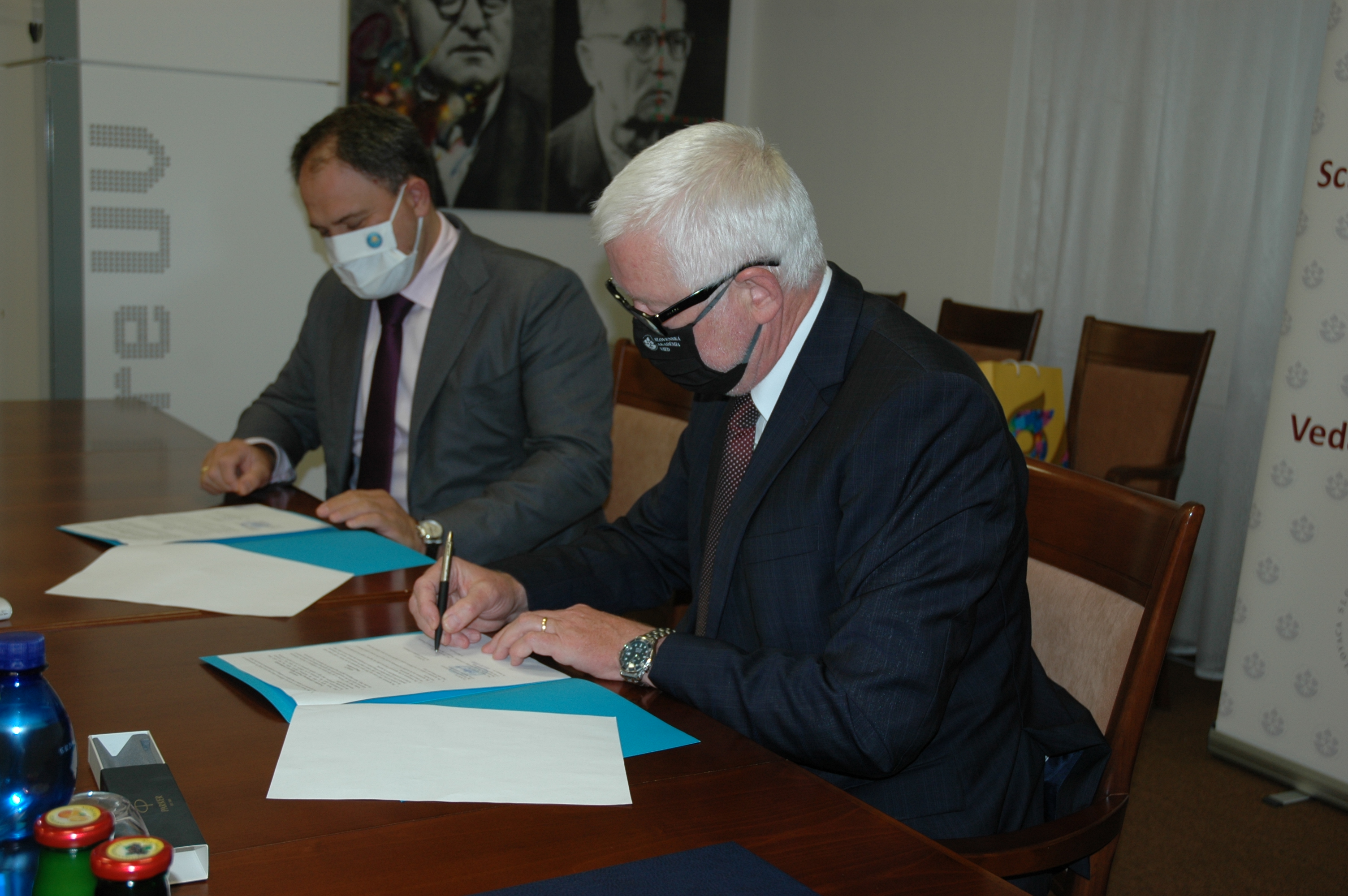
BRATISLAVA, September 11, 2020 – Today in Bratislava, the ceremony of the signing the Agreement on Scientific Cooperation between the National Academy of Sciences of the Republic of Kazakhstan and the Slovak Academy of Sciences took place. Murat Zhurinov, President of the National Academy of Sciences of the Republic of Kazakhstan, signed the document from the Kazakh side (in advance), while Pavol Šajgalík, President of the Slovak Academy of Sciences, signed the document from the Slovak side today.
The conclusion of the Agreement will provide an opportunity to build up cooperation between the scientific societies of Kazakhstan and Slovakia, including in the field of fundamental and applied research, conduct joint researches in various areas, ensure PhD level educational programs and work in postdoctoral studies for representatives of scientific circles from Kazakhstan.
Cooperation activities under the agreement will be implemented in the form of joint mobility projects and will support the exchange of scholars and researchers from the two countries.
The idea to conclude an agreement between two science academies was born and discussed at the meeting between the Ambassador of Kazakhstan to Slovakia Roman Vassilenko and President of the SAS Pavol Šajgalík on May 19 this year.
“We consider the signing of this agreement as the first step on the way for our cooperation, which we believe to be highly promising both due to the scientific and economic potential of Kazakhstan, in the depths of which is hidden the entire periodic Mendeleev’s table,” Mr. Šajgalík noticed today at the ceremony. “We will be happy to arrange our face-to-face meeting, as soon as the restrictive measures, caused by the coronavirus pandemic are lifted and the situation allows us to do so.”
“I would like to sincerely congratulate the presidents of the academies, Mr. Murat Zhurinov and Mr. Pavol Shaigalik, and the scientific communities of two countries on this important step,” Roman Vassilenko noted in turn. “Traditionally, people of science are not known for their speed of action, preferring solidity and gradualness. But the speed of this decision to conclude an agreement and the speed with which it was prepared by the two sides, at the same time thoroughly and qualitatively, debunks this myth, commands the deepest respect and sets a worthy example for us. I would like to believe the cooperation will develop further in exactly this way – quickly, thoroughly and efficiently, and on a mutually beneficial basis.”
The Slovak Academy of Sciences consists of 45 independent research institutes of various profiles, employing about 3,000 employees. The Academy is actively involved in the educational process, about 500 PhD students are studying now, including 35 foreign students.
Currently, under the aegis of the European Union programme Horizon 2020, the Institute of Geotechnics of the Slovak Academy of Sciences and the Institute of Combustion Problems of Nazarbayev University, implement a project in the field of nanoporous and nanostructured materials for medical applications.