Saiga Antelopes – Pride and a Living Legend of the Kazakh Steppe
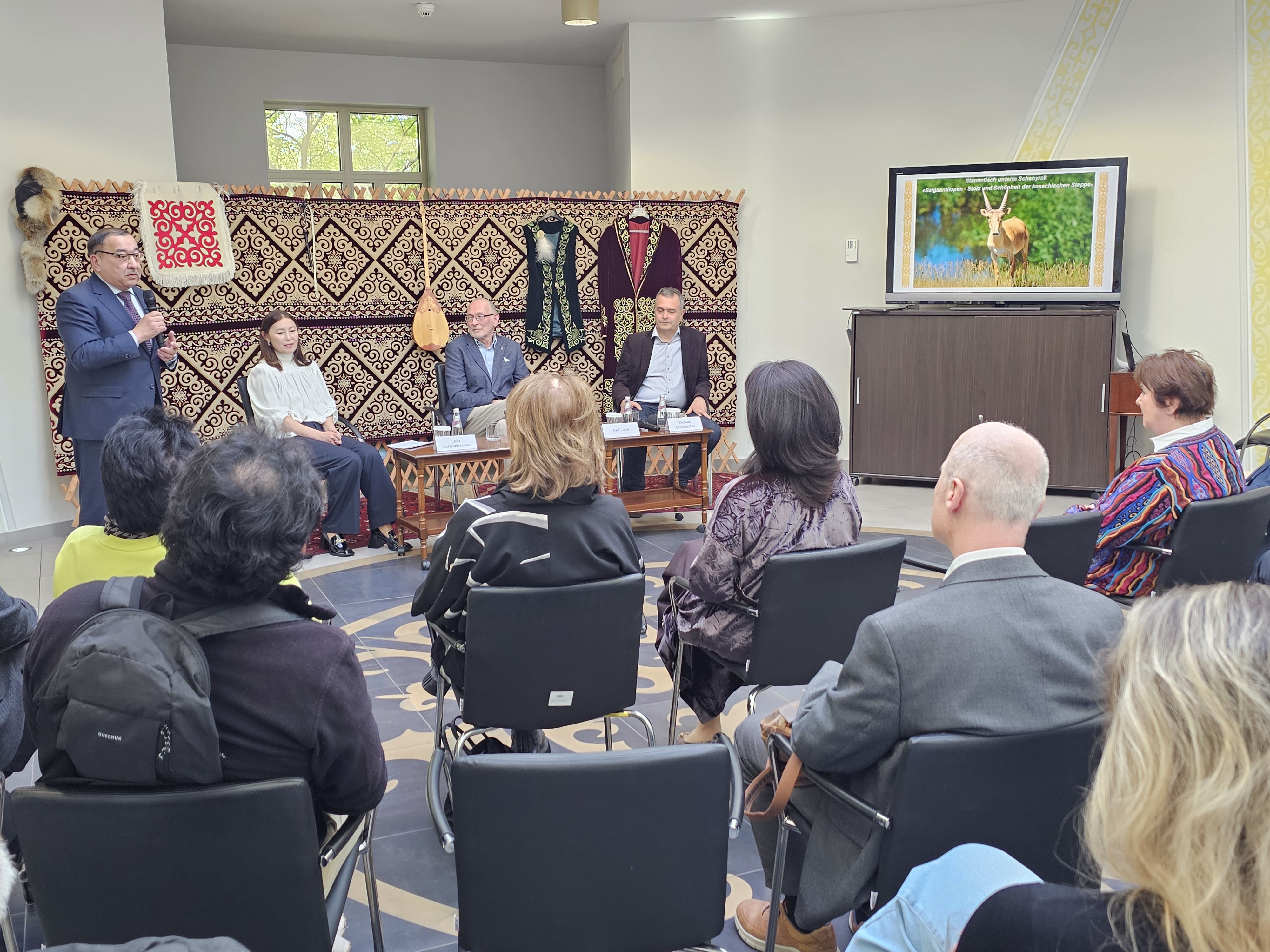
Berlin, 29 April 2026 – Today, as part of the project “Meeting under the Shanyrak,” the sixth meeting on the topic “ Saiga Antelopes – Pride and Beauty of the Kazakh Steppe” took place in the German capital. The event brought together conservation experts, representatives of the scientific community, civil society organizations, and all those interested in Kazakhstan’s natural heritage.
Opening the event, the Ambassador of the Republic of Kazakhstan to Germany, Nurlan Onzhanov, emphasized the special importance of preserving biodiversity in the face of global environmental challenges. He noted that the saiga antelope, one of the oldest inhabitants of the Eurasian steppes, is not only a unique species that has survived the Ice Age epochs but also an important symbol of Kazakhstan’s natural wealth. According to him, the protection of saigas and their habitats is currently a priority at both national and international levels.
Following his remarks, guests were shown a video dedicated to this unique animal species, which vividly illustrated its natural habitat and ongoing conservation efforts.
The substantive part of the program continued with presentations by invited German experts.
Michael Brombacher, Head of the Europe Department of the Frankfurt Zoological Society, presented conservation activities in Central Asia and Kazakhstan, emphasizing the importance of international cooperation in preserving steppe ecosystems. According to the expert, «the recovery of saiga populations, as well as the return of Przewalski’s horses and kulan wild asses to the Kazakh steppe, rank among the most significant achievements of global conservation in recent decades. These successes became possible thanks to the close and trusting cooperation between the Government of Kazakhstan and numerous national and international partners. The achievements of the Altyn Dala Conservation Initiative clearly demonstrate how transboundary cooperation can restore our most important ecosystems and ensure their long-term preservation – for the benefit of present and future generations».
Ralf Lohe, representative of the Nature and Biodiversity Conservation Union (NABU) and expert on Eastern Europe, the Caucasus, and Central Asia, highlighted significant achievements in restoring the saiga population: “The rapid return of the saiga has become one of the most visible and likely one of the greatest conservation success stories of recent decades at the international level. It is not only about saving a species: with the return of large herds, the saiga can once again fulfill its key role in the steppe ecosystem. Today, a significant part of the population lives outside protected areas. This creates not only new challenges but also a unique opportunity to connect with the traditions of the nomadic lifestyle of the Kazakh people and combine them with modern approaches—for the benefit of the saiga, the people sharing this space with it, and the steppe itself.”
The event concluded with a lively discussion and a Q&A session, during which participants exchanged views on current environmental challenges, prospects for saiga conservation, and the importance of international cooperation in nature protection.
For information: Saiga antelopes are unique and rare animals of the Central Asian steppes, easily recognizable by their distinctive nose, which helps them survive in harsh climates. They are an ancient species playing a vital role in steppe ecosystems. After a dramatic population decline in the past, their numbers are now gradually recovering thanks to conservation measures, including anti-poaching efforts, the establishment and expansion of protected areas, and international species conservation programs.