Cultural heritage of Kazakhstan discussed at the international forum in Ethiopia
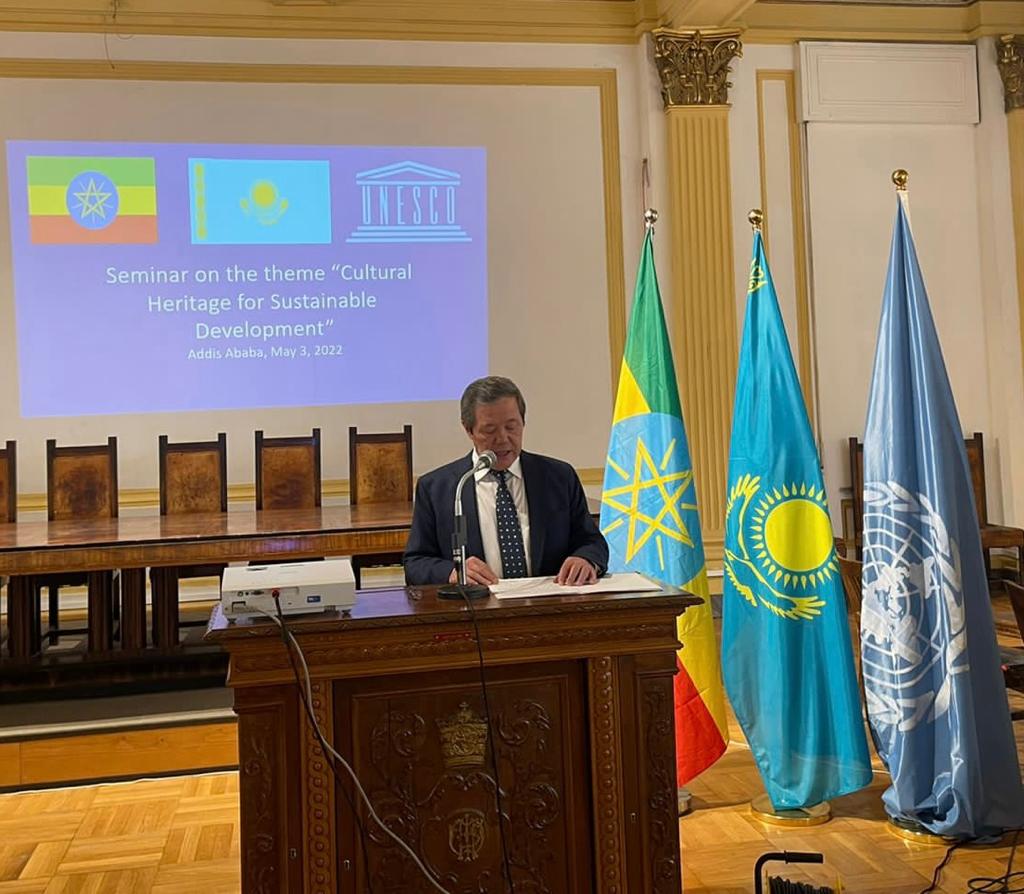
Addis Ababa, May 3, 2022 – The Embassy of the Republic of Kazakhstan in Ethiopia, together with the UNESCO Office in Ethiopia, and the Ethiopian National Commission for UNESCO, organized a forum on the theme «Cultural heritage for sustainable development». The event was held at the Ethnographic Museum of Addis Ababa University and was timed to celebrate the 30th anniversary of Kazakhstan's membership in UNESCO, the anniversaries of famous cultural figures of Kazakhstan A.Baitursynov, R.Baglanova, M.Auezov.
The Forum was attended by State Minister of Culture and Tourism Seleshi Girma, Secretary General of the National Commission of Ethiopia at UNESCO Bezavit Girma, Director of the UNESCO Office in Ethiopia Yumiko Yokozeki, ambassadors of foreign states, representatives of analytical and educational institutions of Ethiopia, students of Addis Ababa University.
In his speech, Ambassador of Kazakhstan Barlybay Sadykov acquainted the forum participants with the cultural heritage of Kazakhstan, the main results of the implementation of the State Program «Rukhani Zhangyru», partnership programs of Kazakhstan with UNESCO for the preservation and strengthening of the tangible and intangible cultural heritage of Kazakhstan.
Within the framework of the Forum, a photo exhibition was organized about the life and creative heritage of outstanding Kazakh figures of culture and art A.Baitursynov, R.Baglanova, M.Auezov, told about their contribution to the development of culture and art of Kazakhstan. The forum participants warmly spoke about the cultural performances performed by the embassy staff on the national instrument Dombra and about Kazakh Folk dances.
During the Forum, participants discussed the contribution of Kazakhstan and Ethiopia, UN and UNESCO programs, funds, as well as regional organizations to the preservation and development of cultural heritage, strengthening intercultural and interreligious dialogue, promoting respect for cultural diversity, mutual understanding at the national, regional and global levels.
It was noted that in September 2015, the UN General Assembly adopted the «Agenda for Sustainable Development for the period up to 2030», in which culture is considered as an important factor of sustainable development for the first time. Cultural heritage has enormous human potential and contributes to economic growth, contributes to reducing inequality, protecting the environment, promoting gender equality, and building peaceful and open societies.
State Minister of Culture and Tourism of Ethiopia Seleshi Girma noted that Kazakhstan makes a great contribution to the UN. According to him, «today Kazakhstan, promoting various global platforms, celebrates its 30th anniversary of membership in UNESCO. This once again shows how Kazakhstan pays attention to the preservation of its cultural heritage. We appreciate how Kazakhstan fulfils its obligations to preserve cultural heritage, and we have a lot to learn from Kazakhstan».
An expert in the field of preservation of urban and architectural heritage, Professor Fazil Georgis noted how much Kazakhstan has done for the rapprochement of cultures, for intercultural and interreligious dialogue. «It was a big surprise for me to learn that you are hosting a Congress of Leaders of World and Traditional Religions and a big event will be held in Kazakhstan this year. I am very happy because at present the world most needs a dialogue between cultures and religions. And I was also impressed by how Kazakhstan promotes its intangible heritage. I dream of visiting your beautiful country with magnificent canyons and lakes in the future. Kazakhstan is a country of great writers, musicians and politicians. Ethiopians should know more about Kazakhstan», - Professor Georgis said.
The participants highlighted the contribution of Ethiopia, which sponsored resolution 2347 (2017), the first UN Security Council resolution devoted exclusively to the problems of preserving cultural heritage.
At the end of the seminar, the participants confirmed the extremely important role of preserving and developing cultural heritage for the socio-economic development of countries and regions, achieving the SDGs, and ensuring a more stable and secure world.
The forum was held in the final year of the UN International Decade for the Rapprochement of Cultures, the author of which in 2012 was Kazakhstan. The International Decade for the Rapprochement of Cultures aims to demonstrate the benefits of simultaneously promoting respect for human rights and cultural diversity and recognizing the importance of intercultural and interreligious dialogue in combating new manifestations of racism, discrimination, intolerance, extremism and radicalism, thereby strengthening ties between countries and peoples.