Key lines from the interview of President of Kazakhstan K.Tokayev to TV channel Khabar
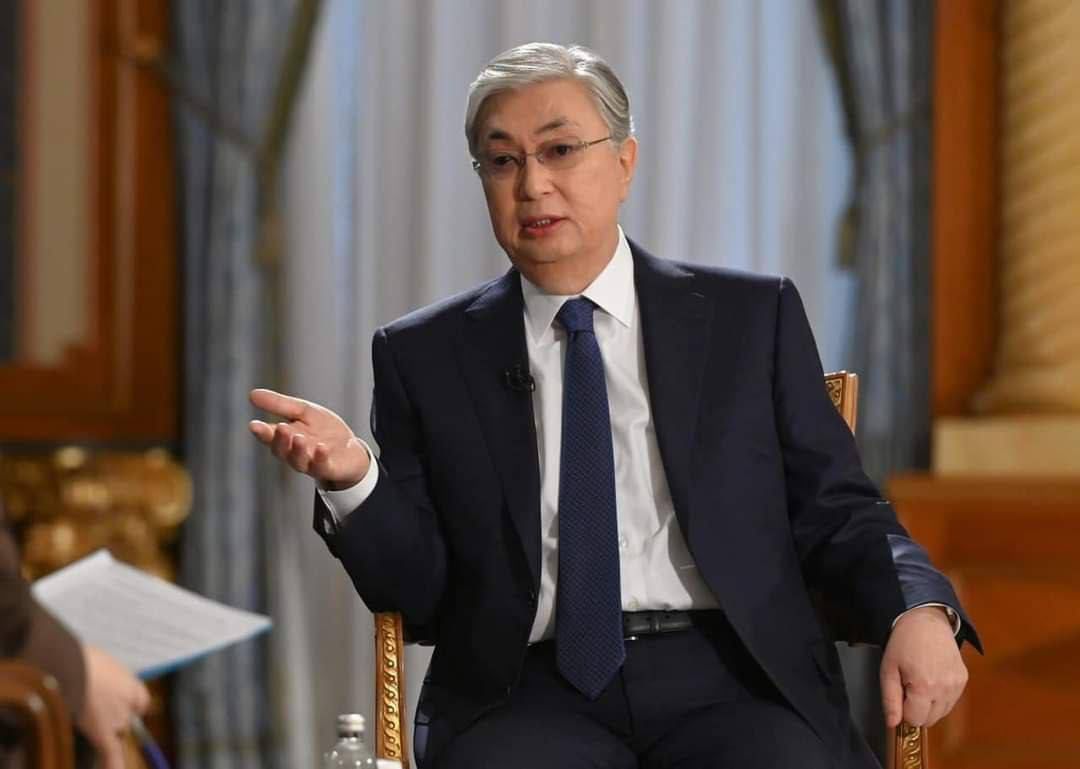
- President Kassym-Jomart Tokayev called the events of “Tragic January” in Kazakhstan a planned operation carried out with the participation of professional militants from abroad. He assured the state would conduct an objective investigation of the events.
- He further promised the law enforcement would thoroughly review allegations of the excessive use of force in restoring security and detaining suspects, and welcomed cooperation with civil society in this matter.
- Tokayev expressed this and other views in the interview with the state TV channel Khabar, his first since the violent riots and terrorist attacks that shook Kazakhstan in early January 2022.
- Commenting on the events of early January, he noted that “it was a planned operation.” All the stages of the operation, from peaceful protests, which certainly took place, to murders and looting, were integrally devised and carried out by professionals, the President stressed.
- According to him, the first wave of events involved genuinely peaceful protesters. The law enforcement agencies did not use force against them.
- In the second wave, young hooligans who attacked police forces played a decisive role in confronting the state.
- The third wave involved “looters, murderers, rapists”. They were, however, led by professional militants who had undergone training They were the ones who led the attacks on buildings of law enforcement agencies. They did not stray away on looting other people’s property. They were primarily interested in the documents of state agencies, particularly the criminal cases against their accomplices and personnel files on law enforcement officers.
- “It was a carefully planned operation, essentially a terrorist operation, involving militants from abroad,” Tokayev emphasized.
- So why was it possible for such events to occur at all? According to the President, “it turned out that there was no clear plan of action of law enforcement agencies in this type of situation.” At the same time, as Tokayev noted, “ we proceed from the fact that weapons should not be used against peaceful demonstrators”. That’s why on January 4-5 the law enforcement bodies in Almaty were armed only with spades, truncheons, flash-bang grenades, tear gas and water cannons (the latter, however, were quickly captured by the militants and were not used). At the same time, some of the captured servicemen were used as human shields by those who attacked the President’s residence.
- According to the President, the investigation will show who exactly was behind the attempted seizure of power.
- After the riots were stopped, many militants tried to hide from the investigation: some managed to flee abroad, some are hiding in Almaty or the countryside; when detained, some were positioning themselves as “random passsers-by”.
- Tokayev reiterated his instruction to the Prosecutor General’s Office to
· investigate every case of a complaint of violation of the rights of the detained individuals.
- The President expressed his approval of the work of the Human Rights Ombudsperson and individual representatives of civil society who are visiting places of temporary detention and assessing complaints about the violations of the rights of these people. “As the head of state, I am personally interested in ensuring that the rights of our citizens are not violated. Each case (of complaints about violations of detainees’ rights) must be investigated,” the President stressed.
- At the same time, he said “we must find those who took part in the banditry against civilians and citizens of Almaty”.
- “I do not condone illegal police actions, if any. We will of course be stopping them. The Minister of Internal Affairs has already received a corresponding reprimand from me,” the President said.
- Due to the lack of a clear plan of action in the first hours of the large-scale unrest in Almaty and several other regions, the leadership of the law enforcement agencies was afraid to take responsibility, the President said.
- “After the Zhanaozen events of 2011 (when 17 people died as a result of the use of firearms by the police against rioters), laws were passed that restrained law enforcement from using weapons in exactly this type of situations that get out of control,” Tokayev noted. “That is why even before the public statement, I told [the leadership of the law enforcement agencies] that shooting should be applied against armed bandits. I took responsibility (for this),” he confirmed. “The president, as the head of state, should take responsibility in such situations.”
- Understanding the likely reaction to this order, the President stressed that “I knew the consequences, I knew that there would be such a reaction. “But the interests of the state, the interests of the security of our citizens, are paramount to me,” he “I was thinking about bringing order to the country.”
- Answering the question about possible additional commitments and a “debt owed to the Russian leadership” in view of the support provided through the Collective Security Treaty Organization (CSTO), Tokayev explained that “the CSTO is our common organization,” noting that Kazakhstan is among its members and co-founders. “When approaching the CSTO, I did not approach outsiders, I, in fact, approached myself and our allies,” he emphasized. The involvement of the CSTO peacekeeping force was secured in accordance with the statutory documents of the organization, therefore it was legal. The CSTO peacekeepers did not fire a single shot while in Kazakhstan, and indeed it was agreed from the very beginning that the CSTO peacekeepers would perform the function of protecting strategic facilities.
- According to Tokayev, “the news of the arrival of the peacekeeping contingent in Kazakhstan played a very important psychological, one
- might say, intimidating role for the bandits. It is important to keep in mind that this was a joint force of the five CSTO member states.”
- Tokayev stressed that no conditions were put forward by Russian President Vladimir Putin for the provision of military assistance to Kazakhstan. Kazakhstan and Russia have allied relations, therefore, there is a mutual commitment to maintain and strengthen such relations.
- The President explained the decision to temporarily restrict Internet access during the unrest by the need to create the necessary conditions for a counterterrorist operation.
- President Tokayev emphasized that there was no “bargaining” with the First President of Kazakhstan, Nursultan Nazarbayev, and no discussion of personal privileges. One key issue was the status of the Chairman of the Security Council and giving Tokayev such powers to make decisions aimed at overcoming the crisis. “This issue was resolved literally on the go,” Tokayev said. Earlier, the voluntary transfer of this status was confirmed first by Nazarbayev’s press secretary, then by Nazarbayev himself. Tokayev reminded that in his speech on January 28 he gave an assessment of the historical role of Nazarbayev and expressed hope that it was shared by the Kazakh society.
- According to Tokayev’s assessment, Kazakhstan’s economy, unfortunately, has prior to this moment developed an oligopoly model, in which a small group of people control its main sectors and influence political decision-making. This situation should be corrected by significantly improving conditions for the development of small and medium-sized businesses, including facilitating their access to credit resources.
- “Reforms are not just about changing the personnel. Reforms are, first and foremost, about changing the system,” the president stressed. “I can say I am seriously thinking about ways to reform the parliamentary system in our country. And, of course, the party system,” he said.
- The ruling party (Nur-Otan) must also be reformed to meet the needs of our society.
- According to President Tokayev, Kazakhstan’s parliament should include several strong parties that honestly compete with each other but are capable of developing a consensus and finding common ground in terms of forming a government.
- The president emphasized the importance of promoting economic and political reforms in parallel. According to him, he sees his task as president as achieving positive results in the transformation of the entire society, its political system and economy.
- “I do not know how long I will be the President of Kazakhstan. But I know for sure that, in accordance with the Constitution, it will not be more than two terms. In this regard, there will be no changes to the laws, let alone the Constitution,” Tokayev emphasized.
- Responding to a question about the Fund “For the People of Kazakhstan,” Tokayev said that according to the recent information it has collected about 50 billion tenge ($116 million). Recalling that its board of trustees consists of independent figures from civil society, he noted, “my job is to encourage the flow of contributions to the fund.” According to the President, contributions to this fund are not a tax, but a charitable activity. At the same time, in his opinion, a regular contribution of 3% of the profits of big businesses would be a fair benchmark.
- President Tokayev commented on the recent critical resolution of the European Parliament regarding the situation in Kazakhstan. Having noted the document is not binding, he called it “biased” and “premature”. The resolution was instigated and dictated by lobbyists, working at the request of people who had left Kazakhstan, having earned serious, big money in our country, and are now spending it to organize demonstrations, pitting people against each other on the principle of “the worse is the better.”
- “As for the international investigation of the events in Kazakhstan, I do not believe it is We can manage ourselves. We have honest, objective people,” the President stressed, mentioning also a number of civil society initiatives in this area.
- Responding to questions about possible personal reputational risks in the context of the difficult decisions he made, President Tokayev emphasized “the recent events have shown that, indeed, the interests of the state are of utmost importance for me.”
- Recalling his order to law enforcement agencies to shoot at the bandits without warning, Tokayev noted he clearly understood that he was acting to the detriment of his reputation, including in the international arena. “It is very bad when you are criticized. But we are talking about the security of the state, this is what we should be thinking about, as well as the safety of our citizens”.
- Answering questions about Kazakhstan’s relations with China, the President reminded that that country was Kazakhstan’s closest neighbor. “China has made tremendous progress in its economic development. China is an advanced country in terms of modern technology, artificial intelligence. We must, of course, cooperate with China,” Tokayev emphasized. Kazakh producers are interested in the Chinese market, including food products. “People who organize anti-Chinese protests naturally pursue their political goals. Perhaps they have absolutely no understanding of the needs of our economy, and generally poorly understand economic realities,” the Kazakh leader added. In his opinion, “perhaps they were paid by specific funds, as there is a geopolitical clash in the global community.” “To this day, China has not done anything bad to us,” Tokayev emphasized. Mentioning a significant trade turnover with China (about $17 billion during the 11 months of 2021), President Tokayev stressed Kazakhstan was interested in “further development of trade, economic and investment cooperation with China.” “We must study China and the Chinese language... we must understand that it is a big, a great country, with which Kazakhstan should have very good relations,” he reminded.
- Regarding relations with the United States, “we have always adhered to the position of developing cooperation in the field of energy and in the non-proliferation of nuclear weapons. Kazakhstan is ready to continue this course,” he stressed.
The video of the interview is available at:
https://www.youtube.com/watch?v=lwzhOH-xcgI