On issues of support and development of civil initiatives
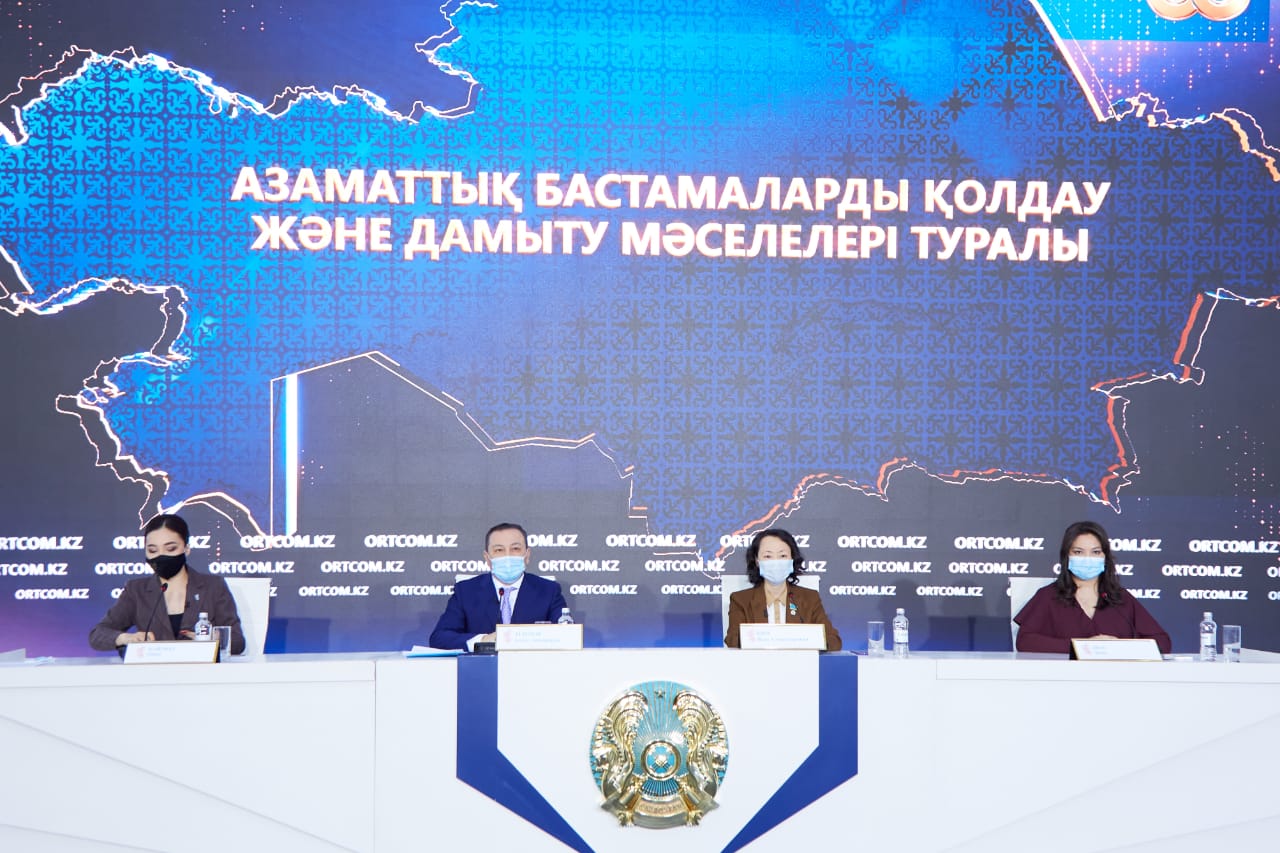
A briefing "On issues of support and development of civil initiatives" was held today at the site of the Central Communications Service. The briefing was attended by Vice Minister of Information and Public Development Bolat Tlepov, Deputy of the Mazhilis of the Parliament of the Republic of Kazakhstan Vera Kim, as well as Chairman of the Board of the Center for Support of Civil Initiatives Lima Diaz.
The speakers talked about measures to support civic initiatives, the development of volunteer and charitable activities, and amendments to the legislation on the formation of state social orders and grant financing.
In his speech, Bolat Tlepov elaborated on the work carried out by the Ministry for the development of interaction between the state and civil society. “In advanced states, raising the level of socio-economic, cultural, spiritual and legal life of the population is not only the concern of the state. This is the goal and interest of the entire civil society. Therefore, the President constantly speaks about the need to involve representatives of the public and the need to continuously increase the level of citizens' trust in the state as part of the implementation of the “Hearing State” concept, the Vice Minister noted. He stressed that over 30 years of independence, the number of NGOs has grown from 100 to 22 thousand, which are ready to be reliable partners of the state in solving socially significant issues. It is worth noting that among all Central Asian countries, most of all NGOs are registered in Kazakhstan.
In addition, B. Tlepov reminded that amendments to the current legislation on public councils came into force this year. "Now at least 70% of members of public councils will be elected and will be represented from among non-governmental organizations." The novelties of the law provide for measures to form a qualitative composition of public councils, expand their powers and rights.
Majilis deputy Vera Kim Lima noted that thanks to systemic measures, including those taken within the framework of the Year of the Volunteer, initiated by the Head of State, in all regions of the country there is a dynamic of growth of both volunteer organizations and volunteers themselves. “The state policy to support volunteer activities is actively developing.
For these purposes, a Working Group was created (under the MIOR) to improve legislation, which included deputies of the Mazhilis of the Parliament, ”the deputy said.
At the same time, during the briefing, the speakers noted that the Ministry, together with representatives of the public, has developed a number of amendments to the current legislation for the further development of volunteer and charitable activities. Bolat Tlepov announced that the number of volunteer organizations has grown 3 times, and that of permanent volunteers - 4 times. Today, there are 600 volunteer organizations in Kazakhstan, in which 200 thousand active citizens are involved. Vera Kim, for her part, assured that, as a deputy of the Mazhilis of the Parliament, she would work to ensure that constructive proposals received from volunteer organizations were reflected in the relevant legislative acts.
Lima Diaz spoke about the initiatives of the Civil Initiatives Support Center. So, she noted that work will be carried out to involve local executive bodies in the allocation of regional grants for NGOs. It is assumed that this initiative will allow local NGOs to be involved in solving urgent problems of the regional level, and will increase the role and potential of rural NGOs in the development of local self-government.
In addition, during the briefing, it was noted that work is underway to improve state mechanisms for supporting NGOs. This applies to the state social order and grant financing. So, they said that work is underway to improve the grant mechanism in terms of its transparency, revise the procedure for the formation of topics, introduce a system of graded grants and assess their effectiveness. Similar work is being carried out to improve the state social order.