Second Meeting of the Artificial Intelligence Development Council Held
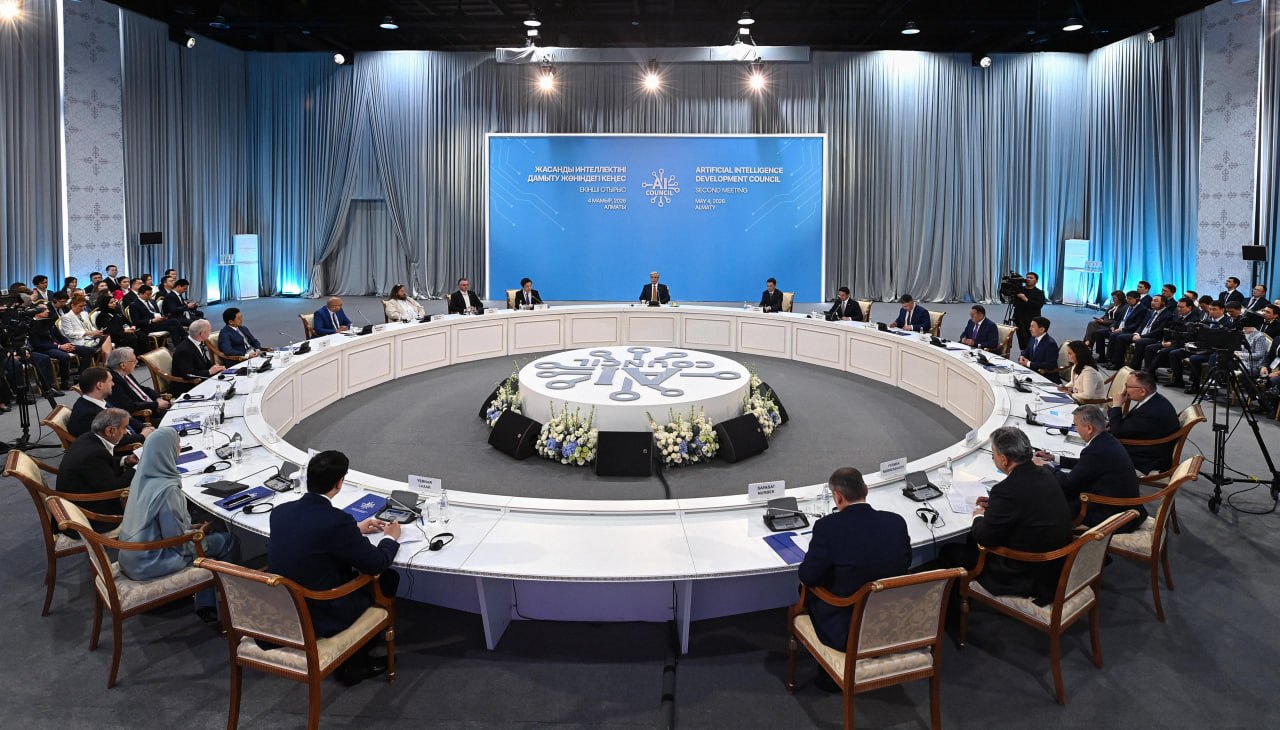
On the sidelines of the major international technology forum GITEX AI Kazakhstan 2026, the second meeting of the Artificial Intelligence Development Council was held under the chairmanship of Head of State Kassym-Jomart Tokayev.
The main theme of the meeting, which brought together 175 leading delegates, was "Artificial Intelligence as a Driver of Digital Economy Growth." The discussion was moderated by Deputy Prime Minister and Minister of Artificial Intelligence and Digital Development Zhaslan Madiyev, who presented a comprehensive report on the implementation of the national AI strategy.
Discussions involved leading global experts, including Kai-Fu Lee (Sinovation Ventures), Omar Al-Olama (UAE), Turing Award laureate John Hopcroft, Olaf J. Groth (Cambrian Futures), and Ebtesam Al-Marzouqi (UN).
Head of State Kassym-Jomart Tokayev emphasised that the world has entered a qualitatively new stage of technological transformation. In his view, the changes now underway bear no comparison to the industrial revolutions of the 19th and 20th centuries in terms of their speed and depth, erasing the boundaries between physical reality and digital space, and the transition to a new technological paradigm based on artificial intelligence requires an objective assessment of the current situation.
In his address, Zhaslan Madiyev stressed that Kazakhstan is moving from concepts to the industrial deployment of AI across all spheres of life. One indicator of success has been the emergence of the country's first AI unicorn and growth in IT service exports, which has already exceeded $1.1 billion. To further scale technology entrepreneurship, the Data Center Valley project has been launched in Ekibastuz, offering global players some of the most competitive conditions in the world — electricity costs from 2.5 cents per kWh and a special regulatory regime.
The Minister also highlighted the strengthening of Kazakhstan's position as a regional digital hub: national supercomputers have entered the global TOP500 ranking, and the Digital Nomad Visa and Altyn Visa programmes have already attracted talent from more than 30 countries through the QazETA platform.
In addition, the launch of pilot autonomous taxi projects in Astana and Almaty was announced, along with the development of a "low-altitude economy" (drones) for urban logistics.
On infrastructure development, it was noted that by 2027, 92% of rural settlements will have fibre optic connectivity, and 5G coverage will reach 75%. Kazakhstan is actively developing its role as a "digital bridge" between Asia and Europe via the Trans-Caspian route, with plans to increase its share of international data transit to 5%. The institutional foundation for these reforms has been laid by the new Digital Code and AI law.
Alongside infrastructure projects, human capital development is continuing. In September 2026, the Qazaq AI Research University will begin operations at the exponential cluster in Astana. Advanced tools are also being integrated into the educational environment: in partnership with OpenAI, 200,000 teachers have been given access to ChatGPT Edu, and personal AI assistants for personalised learning are being piloted in Keleshek Mektepteri schools.
The Head of State and international experts, including Kai-Fu Lee and John Hopcroft, supported the proposed course, noting the high pace of implementation.
International experts who participated in the meeting gave a high assessment of Kazakhstan's digital maturity and proposed specific directions for further growth. They drew attention to the need for fundamental education reform through independent teaching quality assessment and called for a shift from fragmented pilot projects to large-scale flagship industrial deployments.
In summing up the discussion, international speakers described Kazakhstan's eGov and AlemAI solutions as a sought-after export product capable of becoming a benchmark model for other states in the region.
It should be noted that following the meeting, the experts' proposals will be integrated into the National AI Development Strategy to 2030.
The Artificial Intelligence Development Council under the President of Kazakhstan was established in May 2025 by a special presidential decree. Its primary tasks are to develop proposals on state policy, improve legislation, provide expert review of international projects, and monitor the level of AI adoptio