Kazakhstan's Digitalisation: 20 Years of the eGov.kz e-Government Portal
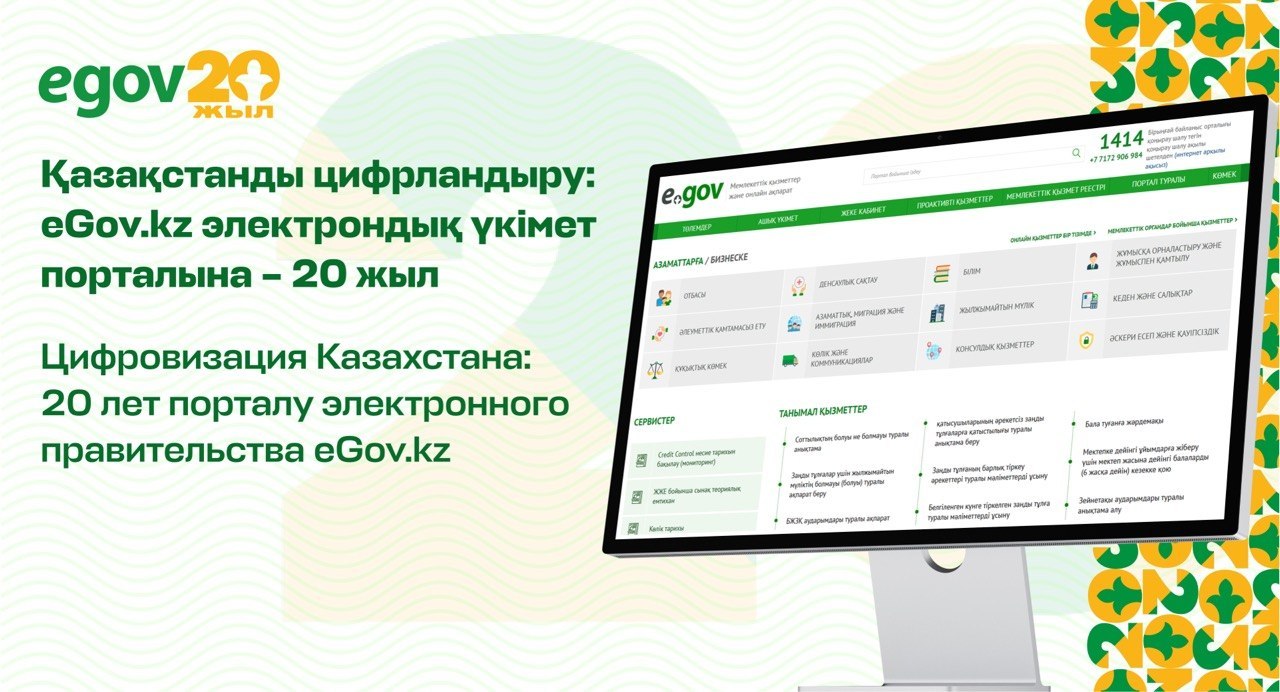
On 12 April, the eGov.kz e-government portal marked its 20th anniversary. Over two decades, eGov.kz has evolved from an information showcase into a fully-fledged digital ecosystem, becoming an indispensable part of every Kazakhstani's life and a symbol of the country's technological transformation.
The history of eGov.kz is one of steady evolution that began in 2006. The foundation for its creation was laid by a Presidential Decree of 10 November 2004, No. 1471, "On the State Programme for the Formation of Electronic Government in Kazakhstan for 2005–2007." Initially, the portal served as an information resource, providing citizens with access to details about government services and agencies.
In its early years, the basic e-government infrastructure was established, enabling access to services online. Development proceeded step by step: from the introduction of the first electronic services to transactional services with online payment, and subsequently to comprehensive services combining multiple provisions within a single life situation.
Key elements of the digital infrastructure were introduced: state databases, departmental information systems, the eLicense.kz portal, the National Certification Authority of the Republic of Kazakhstan, and the e-government gateway. This significantly simplified access to the most in-demand services and reduced the need for citizens to visit government offices in person.
Digital services transformed the user experience entirely. For example, it became possible to register a legal entity in just 15 minutes, or to register a birth online while simultaneously applying for benefits and a place in a childcare queue.
In 2019, the e-government mobile application was relaunched in an updated format and began to develop as eGov Mobile. The pandemic period proved to be both a serious test and a turning point. Under restrictions, eGov.kz effectively became the primary channel of interaction between the state and citizens, ensuring uninterrupted access to essential services remotely. In 2020, biometric identification was introduced, substantially lowering barriers to accessing services. During this period, the number of users and online services grew significantly, digital documents developed rapidly, and the Smart Bridge, Smart Data Ukimet, and eGov Business projects were launched.
Today, e-government has become a familiar tool of everyday life. The portal has more than 15 million registered users, and the total number of services rendered has exceeded 508 million. Over the lifetime of the eGov Mobile application, more than 111 million services have been delivered through it, reflecting a sustained shift towards mobile usage patterns. Of the more than 1,300 government services currently available, around 90% are accessible online, and users also have access to 39 digital documents.
"The 20 years of eGov represent a journey from an information portal to a large-scale digital ecosystem that has become part of the daily lives of millions of Kazakhstanis. Today, more than 90% of government services are available online, and interaction with the state is becoming faster and more convenient. We are moving to the next stage — eGov 3.0 — where proactive services and AI-based solutions play a central role. I would like to thank everyone who was there at the beginning and continues to drive the digitalisation of the country, shaping a modern and effective state," noted Deputy Prime Minister and Minister of Artificial Intelligence and Digital Development of the Republic of Kazakhstan Zhaslan Madiyev.
The current stage of development of eGov.kz and its components is focused on the active deployment of AI solutions, including tools such as eGov AI and the AlemGPT platform, which enable a simpler, more intuitive, and more human-centred format of interaction with the state — including through natural dialogue. The multi-agent AlemGPT platform is currently being actively tested; it will enable the delivery of government services through a complete cycle — from initial request to final outcome — and will in due course become a fully-fledged AI assistant for all types of government services.
Kazakhstan's high level of e-government development has been recognised in the UN Global E-Government Development Index. In 2024, Kazakhstan ranked 24th out of 193 countries and 10th in the Online Services Index (OSI), alongside global leaders such as South Korea, Denmark, and Estonia. UN experts gave a high assessment of the effectiveness of Kazakhstan's e-government and its components, operated by NIT JSC, and of the use of digital solutions in the delivery of government services to improve the quality of life of the population.
At the same time, information security remains an unconditional priority. The protection of personal data is enshrined at the constitutional level and is regarded as the foundation of public trust in government services, alongside ensuring the resilience of the digital infrastructure.
Behind these figures and technologies lies what matters most — millions of hours and journeys saved for Kazakhstanis, and a significant reduction in bureaucratic burden. eGov has evolved from a convenient tool into a genuine digital partner for both the state and society.
Today we are taking the next step — towards a smarter, more attentive, and truly citizen-centred state. Twenty years ago, few could have imagined that one day it would be possible to register a birth, update a residence registration, or receive a benefit in just a few minutes, without leaving home. Today, this is simply our ordinary life.