Kazakhstan’s Constitutional Reforms Presented at the 5th AACC SRD Conference in Seoul
Теlegram CС - https://t.me/consot_kz
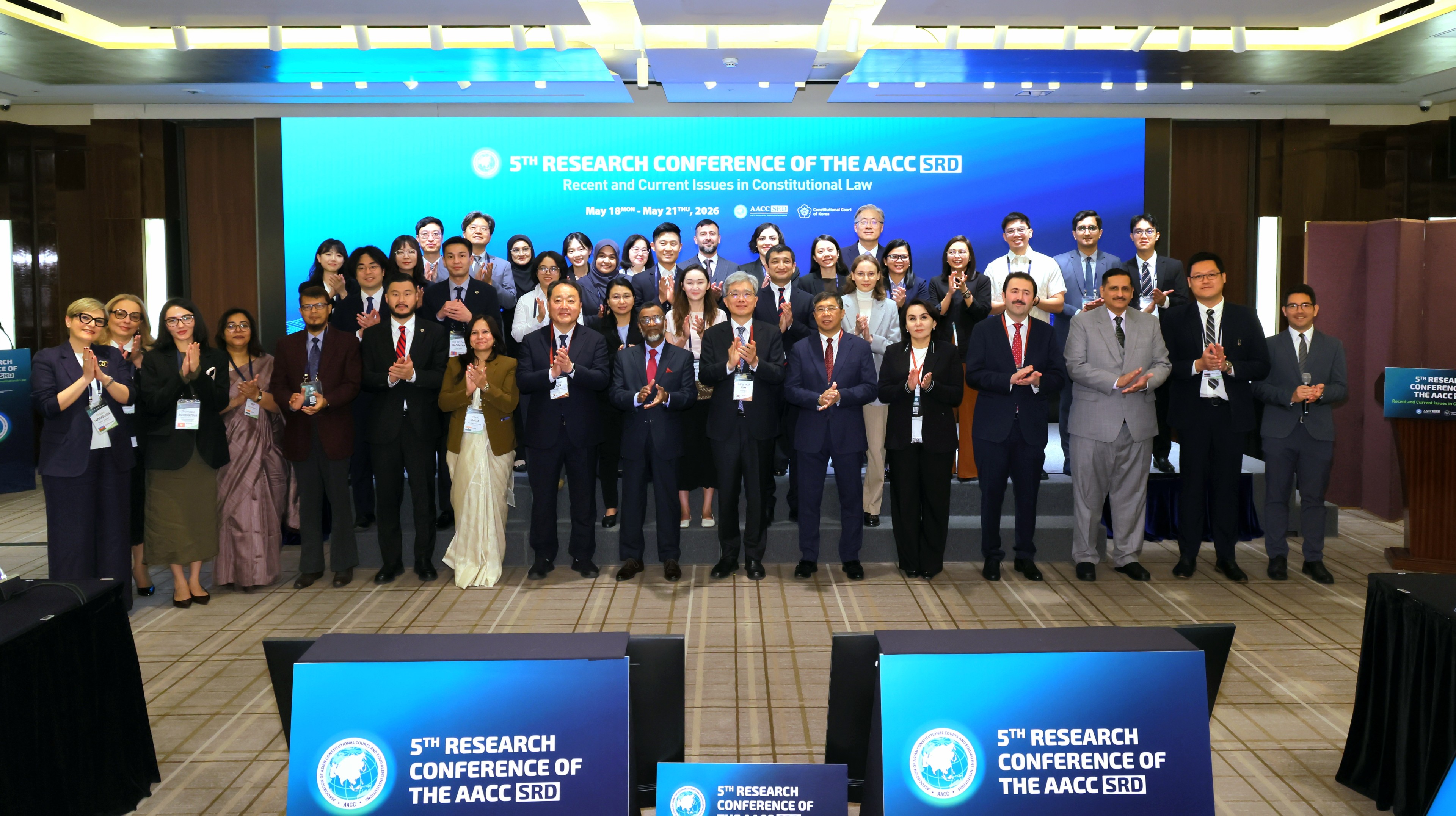
A scientific and research conference was held in the Republic of Korea under the auspices of the Association of Asian Constitutional Courts and Equivalent Institutions (AACC) on the topic “Recent Trends and Current Issues in Constitutional Law.”
The large-scale event brought together approximately 50 representatives and researchers from 15 constitutional review bodies of Asian countries, including Kazakhstan, India, Malaysia, South Korea, Pakistan, the Russian Federation, Thailand, Türkiye, Uzbekistan, and Azerbaijan, as well as leading legal scholars. The Constitutional Court of the Republic of Kazakhstan was represented at the forum by Elmira Kaliyeva, Head of the Department for Preliminary Examination of Applications and Legal Support, and Amir Umarov, Head of the Analytics and Constitutional Proceedings Department.
The forum traditionally serves as a platform for regular international exchange of advanced legal experience, the protection of democratic principles, the strengthening of the rule of law, and the development of effective mechanisms for safeguarding fundamental rights in a changing global environment.
During the conference, Elmira Kaliyeva presented a report on the chronology of Kazakhstan’s constitutional development, elaborating on the innovations of the country’s new Basic Law. She emphasized that the ongoing reforms are aimed at implementing the principle of “Law and Order” and building a Just Kazakhstan. Among the key achievements of modernization presented to international colleagues were progressive measures such as the introduction of the “Miranda rule,” the strengthening of the presumption of innocence, and constitutional guarantees of citizens’ rights in the digital environment, as well as a renewed model of constitutional review that firmly establishes the Constitutional Court as an independent body ensuring the supremacy of the Basic Law.
Background: The Association was established in 2010 as a regional forum of constitutional justice bodies in Asia. Its functions include holding regular meetings of members, organizing symposia, seminars, and study visits, facilitating the exchange of constitutional case-law experience, sharing information on working methods, and exchanging views and ideas on institutional, structural, and procedural issues related to public law and constitutional jurisdiction.
Currently, the Association includes 21 member states: Azerbaijan, Afghanistan, Bangladesh, India, Indonesia, Jordan, Kazakhstan, the Republic of Korea, the Kyrgyz Republic, Malaysia, Maldives, Mongolia, Myanmar, Pakistan, Palestine, Russia, the Philippines, Tajikistan, Thailand, Türkiye, and Uzbekistan.