In Turkestan, the Influence of the Philosophy of the Great Steppe on Modern Legal Culture Was Discussed
Теlegram CС - https://t.me/consot_kz
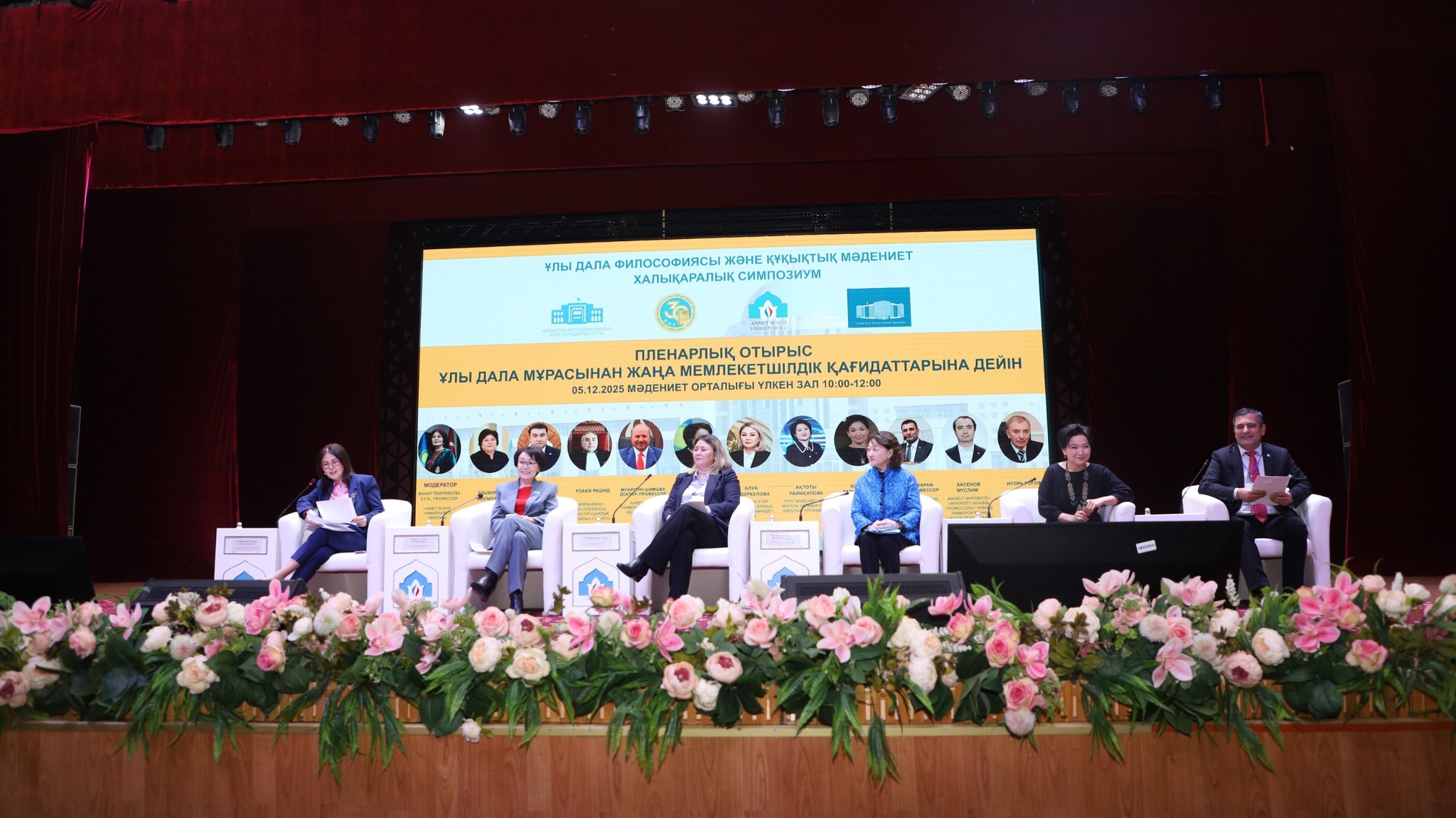
An international symposium titled “The Philosophy of the Great Steppe and Legal Culture” was held in Turkestan. The event was organized at the initiative of the Constitutional Court of the Republic of Kazakhstan and the Khoja Ahmed Yasawi International Kazakh-Turkish University, with the support of the Akimat of Turkestan Region.
The symposium brought together over 300 participants, including philosophers, legal practitioners and scholars, educators, representatives of civil society, and youth from the Central Asian states and Turkey.
A congratulatory message to the participants was delivered by the Deputy Prime Minister and Minister of Culture and Information of the Republic of Kazakhstan, Aida Galymovna Balayeva.
“It is well known that the foundations of steppe civilization rest upon values such as morality, justice, solidarity, and responsibility. Introducing these values into modern academic discourse and directing them toward the development of legal thought is the main mission of today’s symposium,” Balayeva noted in her address.
In his congratulatory message, the Akim of Turkestan Region, Nuralkhan Oralbayuly Kusherov, emphasized that the special status of Turkestan as the spiritual, historical-cultural, and tourist center, as well as an architectural heritage site of the country, underscores the importance of the event’s agenda and the continuity of humanistic values in contemporary conditions.
“On November 5, 2025, President Kassym-Jomart Kemeluly Tokayev signed a decree ‘On Approving the Fundamental Principles, Values, and Directions of the Domestic Policy of the Republic of Kazakhstan.’
The principles of domestic policy now include ‘Law and Order,’ the ‘Listening State,’ ‘A Strong President – an Influential Parliament – an Accountable Government,’ Adal Azamat, and ‘Clean Kazakhstan.’
The Kazakh people have a rich history in state governance, lawmaking, and judicial practice.
In the country’s statehood, as well as in the legal knowledge and consciousness of the Kazakh people, these principles hold significant cultural, social, political, and legal importance,” Kusherov stressed.
In her welcoming remarks, the Chairperson of the Constitutional Court of the Republic of Kazakhstan, Elvira Azimova, reminded participants that the event was initiated in the year marking the 30th anniversary of the country’s Constitution.
“The legacy of steppe legal culture is a philosophy and culture of honor and responsibility. Today, it helps strengthen legal awareness and respect for the law.
Law functions effectively when it is rooted in human values and aligned with the cultural code of the people,” Azimova noted.
At the conclusion of the symposium, participants expressed their wish that the event be held annually in the “Central Asia+” format.