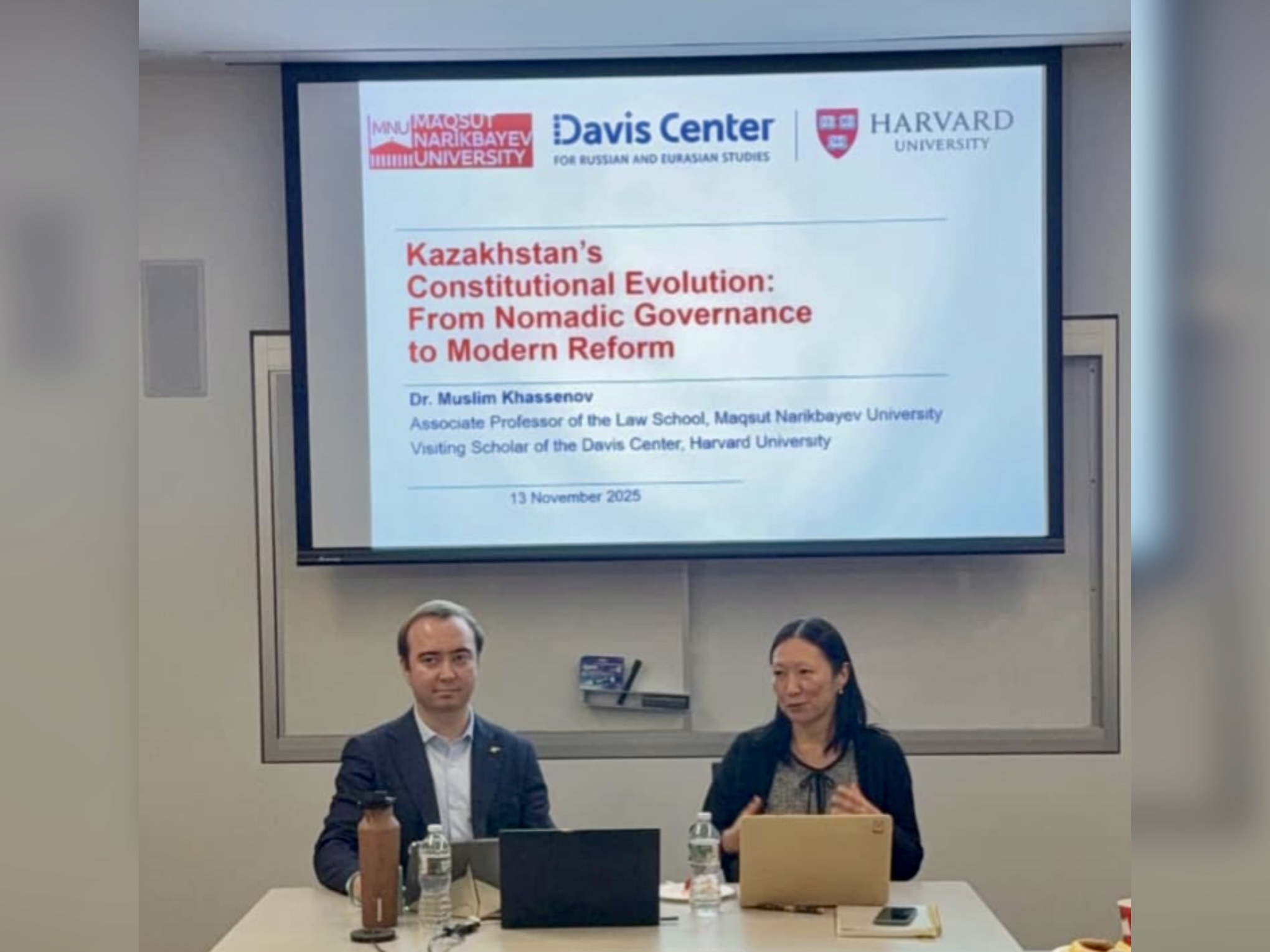
A lecture on the evolution of constitutional law in Kazakhstan was held at Harvard University
Теlegram CС - https://t.me/consot_kz
On November 13, Harvard University hosted a public lecture by Muslim Khassenov, member of the Scientific Advisory Council of the Constitutional Court and associate professor at Maqsut Narikbayev University. The topic was: Constitutional Evolution of Kazakhstan: From Nomadic Governance to Modern Reforms. The lecture was held in English and brought together professors and students from Harvard and other leading universities in Boston.
The presentation covered 560 years of constitutional development in Kazakhstan, from the steppe constitutions (the customary law codes of Kasym, Esim, and Tauke Khans) to the modern transformations of the “New Kazakhstan” era. The lecture revealed the key milestones in the formation of Kazakh statehood, the role of khans and sultans, biys and the national intelligentsia, thanks to whom the Kazakh people managed to preserve their statehood and go through the most difficult trials. Five historical stages were identified and 12 key documentary pillars of Kazakh constitutionalism were presented. Particular attention was paid to the constitutional reform of 2022, which marked a new stage in the constitutional modernization of Kazakhstan, including the revival of the Constitutional Court, which, according to the lecturer, became the main legal achievement of the modern period.
Muslim Khassanov is a visiting scholar at Harvard's Davis Center for the 2025-2026 academic year, conducting research on legal reforms and the rule of law in Central Asia as part of a research fellowship under the Bolashak program.