The Central Asian Dialogue Platform of Women in Justice held in Astana
Теlegram CС - https://t.me/consot_kz
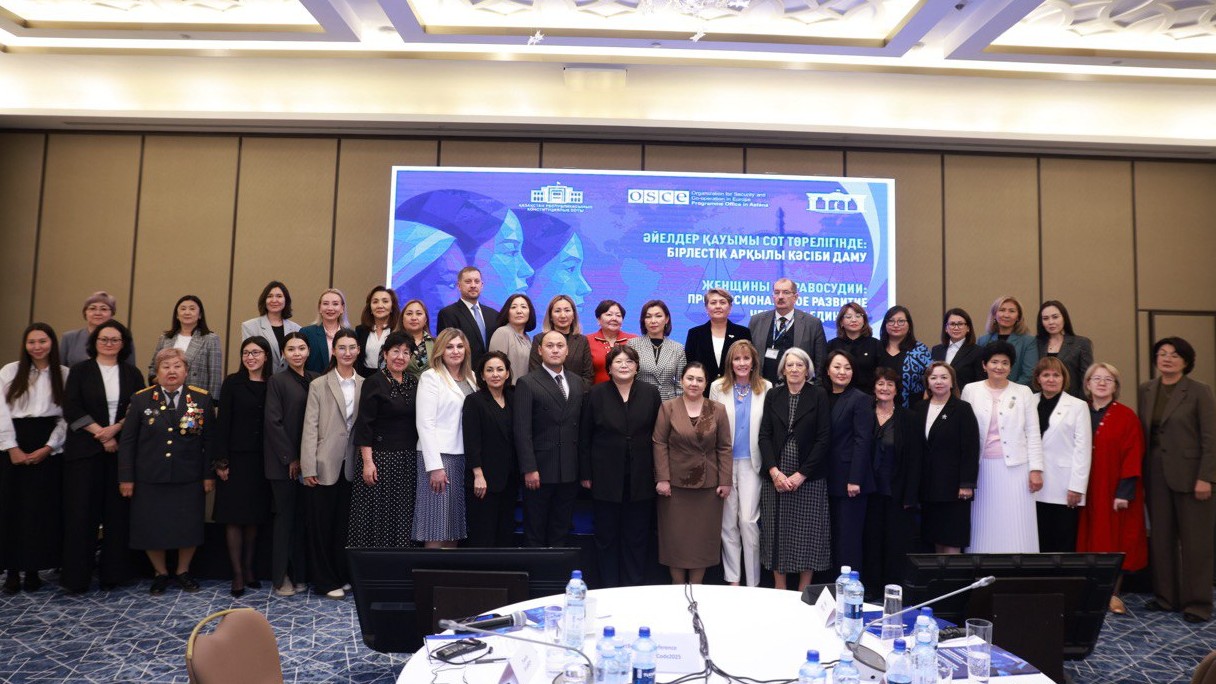
On September 11, 2025, Astana hosted the Central Asian Dialogue Platform ‘Women in Justice: Professional Development Through Association’, organized by the Constitutional Court in cooperation with the Supreme Court and the OSCE Programme Office in Astana.
The Dialogue brought together judges of the Constitutional and Supreme Courts, representatives of judicial and law enforcement authorities, government institutions of Kazakhstan, Central Asian countries, other foreign states, as well as experts from international organizations.
Among the distinguished guests were Ms Claire Bazy Malaurie, President of the European Commission for Democracy through Law (Venice Commission), and Ms. Pamela Harris, President of the International Association for Court Administration (IACA).
The participants discussed a wide range of issues related to the professional development and leadership of women in the judiciary, ensuring gender equality and access to justice, sharing international experiences, and implementing UN Security Council resolutions. Particular attention was given to the role of women in strengthening peace and security, protecting the rights of victims of violence, as well as the challenges of digitalization. During the dialogue, the idea of creating an Association of Women Judges in Central Asia was raised, which could become an effective regional platform for developing new approaches to ensuring stability and protecting the constitutional rights and freedoms of citizens.
In her address, Chairperson of the Constitutional Court of the Republic of Kazakhstan Ms Elvira Azimova emphasized that women in justice today are not only professionals but also a driving force for change. Out of the ten current judges of the Constitutional Court, three are women, including the Chairperson herself.
‘The Constitution of Kazakhstan enshrines the principle of equality of all before the law and the courts, excluding any form of discrimination. By ensuring equal access for women to justice and legal professions, we strengthen public trust in the judiciary and create a space where every woman can realize her potential, contributing to the development of peace and security. True leadership manifests itself in this daily involvement, in every decision and action — it is not limited to the podium,’ she noted.
Chairman of the Supreme Court of the Republic of Kazakhstan Mr Aslambek Mergaliyev emphasised that women currently make up 54% of the judiciary in Kazakhstan. At the level of first instance courts, their share is 56%; in appellate courts — 44%; and in cassation courts — 63%. The Supreme Court has achieved gender balance: out of 46 judges, 23 are women, including the Chairperson of the Criminal Division.
Ambassador Alexey Rogov, Head of the OSCE Programme Office in Astana, noted that ensuring equal and effective participation of women in decision-making at the state level, including in the justice system, is also a priority for Central Asia and the World in line with SDG 5 ‘Achieve gender equality and empower all women and girls.’
‘In this regard, we welcomed Kazakhstan’s update in June 2024 of its National Action Plan on the implementation of UN Security Council resolutions under the Women, Peace, and Security agenda. Particularly encouraging is the inclusion of a separate item on the possible establishment of an association of women in justice and security in Central Asian countries,’ he emphasized.
The dialogue concluded with the adoption of a Joint Statement confirming the commitment to promoting equal and non-discriminatory access to justice, expanding opportunities for women in the judiciary, and strengthening peace and security. Participants expressed readiness to actively cooperate with government agencies, international and civil society organizations to improve legislation and implement gender-oriented approaches.
The event was held within the framework of paragraph 34 of the National Action Plan for the Implementation of UN Security Council Resolutions 1325 (2000), 1820, 1888, 1889, 1960, 2106, 2122, 2242, 2467 on ensuring equal and full participation of women in conflict prevention and resolution, peace and security, prevention of violence against women, raising awareness, and strengthening cooperation with civil society on women’s protection for 2022–2025. Paragraph 34 provides for initiating and discussing the creation of an association (union) of women in justice and security in Central Asian countries as a platform for exchanging experience on implementing Resolution 1325 (2000), legal frameworks, methodologies, research, recommendations, and holding joint events.
It is worth noting that associations uniting women from various fields, including justice, already operate around the world.
For reference: The Association of Women Judges of the United Kingdom, the Association of Women Judges of Bosnia and Herzegovina, the Association of Women Judges of Spain, the Canadian Chapter of the International Association of Women Judges (IAWJ), the Italian Association of Women Judges, the U.S. National Association of Women Judges (NAWJ), the Hungarian Association of Women Judges (HAWJ), the Colombian Association of Women Judges (ACMJ), the Australian Association of Women Judges, the Association of Women Judges of China, the Argentine Association of Women Judges, the Association of Women Lawyers of Zimbabwe, the Kyrgyz Association of Women Judges (the only one in Central Asia), among others.