Results of the year: improving the quality of healthcare and building new medical facilities
This year is a landmark for domestic healthcare: the implementation of the National Project "Modernization of Rural Healthcare" has started, the construction of the National Scientific Oncology Center is being completed in Astana, which will be equipped with unique equipment, medical screenings have been expanded for citizens, etc.
In his Message to the people, Head of State Kassym-Jomart Tokayev instructed the Government to reconsider approaches to financing health and social services in general.
"Special attention should be paid to the comprehensive improvement of medical infrastructure, including through public-private partnerships. Medicine is an investment–attractive industry, it is only necessary to create the right conditions," the President of Kazakhstan said.
Read about the results Kazakhstan has achieved in the field of healthcare this year in this review.
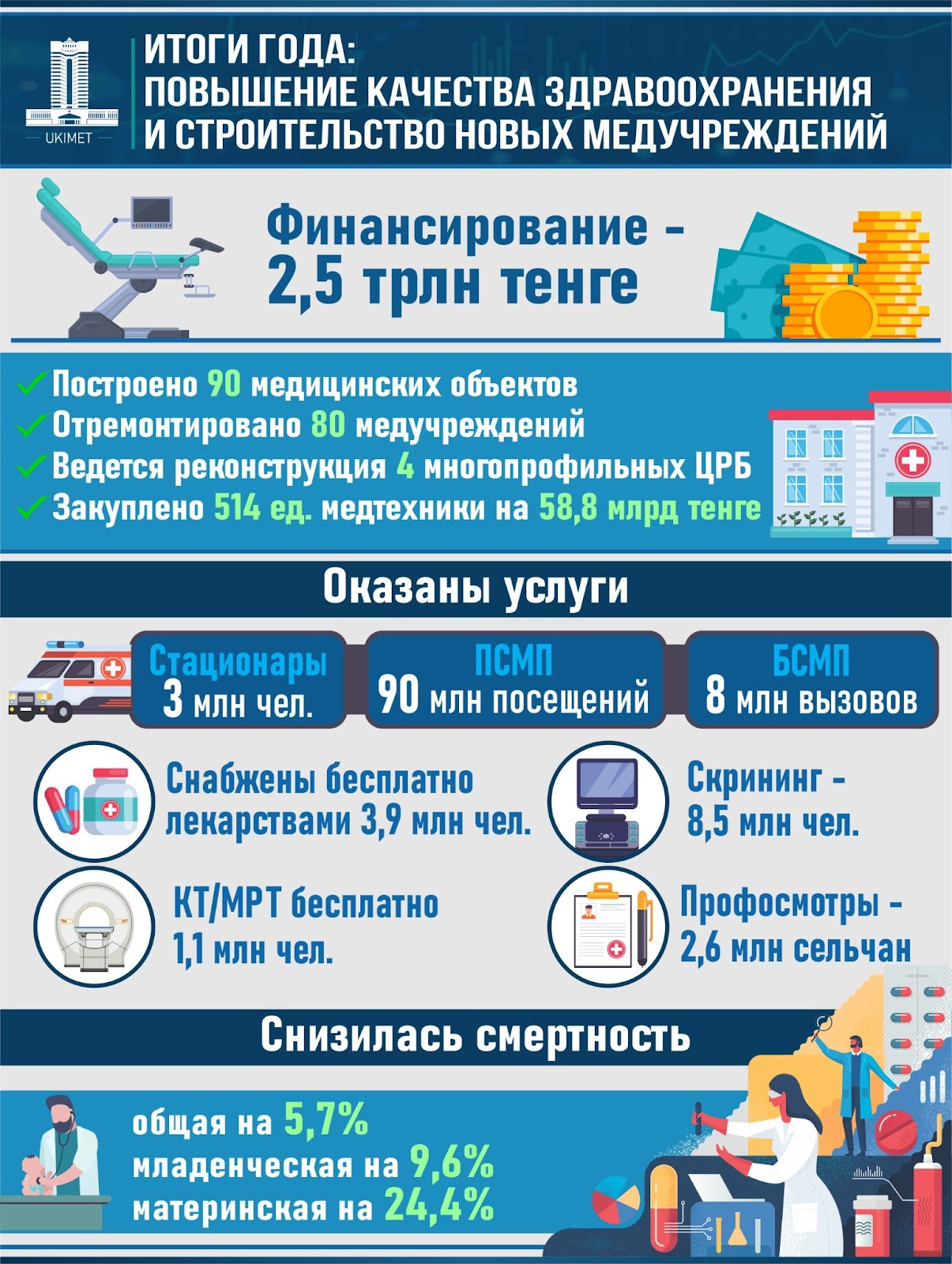
● This year, 90 new healthcare facilities have been built in the regions of the republic, including 59 within the framework of the National Project "Modernization of Rural Healthcare". Along with this, 80 medical institutions have been repaired, and the reconstruction of 4 multidisciplinary central district hospitals has begun.
● About 3 million people received help in hospitals, the primary health care network received more than 90 million visits, more than 360 thousand newborns were born (according to the results of 11 months), emergency medical services provided assistance for 8 million calls.
● In 10 months, compared with the same period last year, there was a decrease in the total mortality rate by 5.7%, mortality from diseases of the circulatory system – by 6.9%, from malignant neoplasms – by 0.6%, from respiratory diseases – by 4.7%, from tuberculosis – by 22.1%. Infant mortality decreased by 9.6% in 11 months, maternal mortality by 24.4%.
● Financing of the healthcare system in the current year amounted to 2.5 trillion tenge. Outpatient expenses were increased, which amounted to 56% of the total. At the same time, the financing of medical rehabilitation increased 13 times – from 6 billion tenge in 2019 to 78.1 billion tenge in 2023. In general, Kazakhstan continues to move confidently towards the goal of bringing the share of medical expenses to 5% of GDP by 2027.
● The volume of outpatient drug provision increased by more than 2 times compared to 2019 and amounted to 237 billion tenge, including 51.8 billion tenge for the treatment of orphan diseases. In total, 3.9 million patients were provided with medicines.
● A full cycle of traceable distribution of medicines to the patient (labeling, coding) has been launched in 20 medical organizations of the republic.
● 514 units of medical equipment worth 58.8 billion tenge were purchased for medical institutions of the Republic of Kazakhstan. The equipment of medical organizations with medical equipment in 2023 increased by 2.5% compared to 2022 to 84.15%.
● The number of advisory and diagnostic services provided increased 2.5 times in 2023 and amounted to over 324 million. 1.1 million residents received expensive diagnostic services (CT/MRI) this year.
● As part of the development of the pharmaceutical and medical industry, the following work has been carried out:
– in the Almaty region, together with the South Korean company SGP, a project for the production of syringes has been implemented;
– In Almaty, the production of ultrasound stationary diagnostic systems of high and expert classes of the South Korean company Samsung Madison has been established;
– The production of hearing aids has been launched in the Mangystau region;
– Production of irradiators and bactericidal air recirculators has been launched in the North Kazakhstan region;
– The production of filter half masks has been launched in Shymkent;
– A line for the production of KN95 medical respirator masks with a valve has been fully prepared in Karaganda;
– Production of disposable sterile syringes with a capacity of up to 250 million units per year has been launched in Zhambyl region.
● This year, best practices centers have been opened in 48 outpatient care organizations, and more than 160 specialists have been trained.
● A screening program for the early detection of 8 diseases (arterial hypertension, coronary heart disease, diabetes mellitus, glaucoma, breast cancer, cervical cancer, colorectal cancer, viral hepatitis) is being implemented for the adult population in the Republic of Kazakhstan. The coverage of screening examinations in 2023 increased by 19.7% compared to 2022 and amounted to 8.5 million people.
Screening for early detection of kidney diseases, gastrointestinal tract, respiratory organs and prostate cancer has been expanded for the rural population. In general, about 2.6 million rural residents are covered by preventive examinations. Medical train services also cover more than 50 thousand residents of remote villages, which is 58% more than coverage in 2022.
● This year, 688 thousand remote medical services were provided, which is 6.7 times more than in 2022.
● As part of the implementation of the instructions of the Head of State, a comprehensive plan to combat cancer in the Republic of Kazakhstan for 2023-2027 was approved.
● 80 new technologies in the field of transplantation, cardiac surgery, oncology, innovative cellular technologies have been introduced in the country, about 20 thousand people have been treated using them.
233 operations were performed at the Gamma Knife center of the National Center of Neurosurgery in Astana, where radiosurgical treatment of diseases of the central nervous system is carried out. A total of 1,037 operations have been performed since its opening in 2021.
● The Nuclear Medicine Center in Semey conducted 776 courses of radionucleide therapy.
● In order to meet the need for doctors, including in acute shortage specialties, about 6 thousand educational grants were allocated from the republican budget in 2023.
● At the expense of the local budget, 16.5 thousand specialists are covered by professional development.
● In 2023, about 7 thousand doctors were graduated by medical universities of the Republic of Kazakhstan. The graduation rate of secondary medical workers amounted to more than 23 thousand people.