A new stage in the development of digitalization in a pandemic
In the past year, when a significant part of the world was in quarantine or self-isolation, digital services have become extremely important.
In the region, in the shortest possible time, a local development team has developed a Unified Information Service for the Delivery of Products and Medical Products BA09.KZ and a service for obtaining electronic passes Propusk.kz without investing budget funds.
One of the most popular types of digital services undoubtedly deserves special attention - home delivery of goods BA09.KZ, which offered citizens a wide range of goods from supermarkets, pharmacies, restaurants and pizzerias without leaving home. Through the service, residents had the opportunity to call a taxi, as well as apply to become a volunteer.
All these developments helped to avoid trips of citizens to crowded places, which was not recommended due to the spread of coronavirus infection.
The operators of the Senim 109 service, which opened more than a year ago, took a big blow.
The service has become a "single front office", which citizens can contact 24/7 from anywhere in our region, from any device or through social networks and get answers to their questions.
It should be noted that from February 25, 2020, the contact center was switched to a round-the-clock operation, and from March 16, 2020, a single number "109" was included in the list of hot lines.
Service "Senim109" is currently the only project of this kind in the republic, which covered the entire territory of the region. These are 18 cities and districts of the region, 329 settlements with a population of more than 1.3 million people.
The service serves and interacts with 279 government agencies and 50 utilities.
Over the course of its work, the service has received more than 150 thousand calls, almost 90% of them were immediately resolved by operators. The record number of applications was received in April 2020, which is almost 40 thousand applications. In total, during the period of the state of emergency (from March 16 to May 11, 2020), the service received 54,503 calls.
On January 1, 2021, the service moved to a new building that meets all the modern requirements of professional call centers. Now the contact center is located in spacious offices equipped with additional technical equipment.
In the near future, the emergency dispatch service - 103 will be moved to the building. In the future, the Center will organize the Unified Emergency Dispatch Service 112, which will unite all emergency services and all streams from video surveillance cameras ensuring the security of the region will be brought together.
Thus, the Center will become the core of the region, capable of concentrating coordination and analytical functions.
One of the important projects in ensuring the safety of our citizens will be the implementation of the Safe City project this year.
More than three thousand video cameras will monitor the safety of residents of the region and will be installed in courtyard areas, public places and aimed not only at improving road safety, but also at preventing crime.
I would like to note that this project is the only project in the republic among similar regions in terms of coverage. A single centralized system will receive signals from 3,223 CCTV cameras in the cities of Karaganda, Temirtau,
Zhezkazgan, Satpayev, Saran and in the village of Osakarovka.
Within the framework of the project, 250 hardware and software systems will be launched, including 80 speed meters, which will automatically record traffic violations in terms of speed violations by vehicles.
The cloud service system used in the project allows you to centrally manage and monitor a distributed video surveillance system through cloud services that allow you to receive various data from distributed video surveillance systems.
Thanks to the implemented digital solutions used in the project, it is possible to eliminate the human factor and eliminate conditions conducive to corruption.
The same tasks have been set for the project "Creation of a regional geo-information portal", the implementation of which we began last year.
The portal will automate public services in the areas of land relations, construction and architecture, such as: obtaining land plots, providing raw materials for the development of construction and reconstruction projects and other services.
Automation of these public services will significantly reduce their delivery time. For example, today the provision of land plots takes from 3 months to 1 year, but with the help of a geoportal, this service can be obtained without leaving your home for 15-20 days. This will avoid direct contact between the service provider and the service recipient, as mentioned above.
A pilot project for automation of public services will start in March this year in the city of Karaganda.
Digital projects are being implemented in other sectors of the economy. In healthcare, work has begun on the introduction of artificial intelligence, in the field of ecology, the installation of gas analyzers continues, and BIM technologies are used in the design of buildings in construction.
The development of ongoing digital projects is impossible without creating a high-quality communications infrastructure and providing the Internet. And the complexity of its creation and development in the region is associated with special territorial conditions, as well as the inaccessibility of many settlements.
Despite this, over the past three years, 55 rural settlements of the region have been provided with high-speed Internet.
Along with this, work is being completed on providing mobile broadband access to the Internet of the third and fourth generation in 85 rural settlements of the region with a population of 250 or more people.
After the completion of all works, the coverage of rural settlements with broadband Internet access services will be about 94%.
Civil initiatives in the IT sphere are being actively implemented, among them I would especially like to mention the project "Waste Valley", which is aimed at creating a comfortable and progressive environment for the development of the IT sphere in the regional center.
The founder of the project is the city patriot, one of the initiators of the Belsendi Azamat projects, the Urban Center Alexander Doroshenko.
It is planned to create a Regional IT Hub at the site of the Terrikonovaya Valley project by the mechanism of public-private partnership, the opening of which is planned at the beginning of this year in the city of Karaganda.
Already today, with the support of the Ministry of Digital Development, Innovation and Aerospace Industry of the Republic of Kazakhstan and the Astana Hub International Technopark, an acceleration program for freelancers is being carried out.
In November 2020, 25 IT and digital outsourcing companies went to the accelerator of the Karaganda IT hub "Terrikonovaya Dolina" for training. These are 14 outsourcing software developers and digital agencies and 11 start-up teams.
The accelerator includes a 6-week free training course for IT companies and freelancers who are planning to expand into the international market.
All these activities are aimed at developing the volume of IT products, that is, at the output of our enterprises for export.
The cybersport movement is also actively developing in the region. So, at the beginning of 2020, the first Regional eSports tournament was held in the city of Karaganda as part of the series of games "Alaman Cup", organized with the support of Kazakhtelecom JSC and the republican public association "Qazaq CyberSport Federation" with a total prize fund of 500 thousand tenge.
More than 200 Counter-Strike: Global Offensive teams and 69 FIFA 20 players from across the country participated in the qualifiers.
Our fellow countryman Aknazar Bekseitov became the winner in the FIFA 20 discipline, the title of Counter-Strike: Global Offensive champion went to the team from Almaty.
This tournament was organized without the use of budgetary funds from the state and it is planned to make it traditional.
In the field of public services during the past year, about 6 million public services were provided, of which more than 85% were received in electronic form. This suggests that during the pandemic, e-government services have become essential services.
Today, more than 92% of all services are available online, citizens can receive them independently on the egov.kz portal, through a Telegram bot or a mobile application.
To increase the interest of the population of the region to the electronic form of receiving public services, the region is constantly informing the population through the media, placing visual advertising, organizing self-service corners, holding fairs of public services, distributing booklets.
In the regions of the region, the “Open akimat” projects have been implemented for service recipients, where public services are provided to the population in open, barrier-free spaces on the principle of a single window using digital technologies.
According to the results of a sociological survey, more than 93% of the region's residents are satisfied with the quality of public services. 12 thousand people took part in the survey.
As a result of the systematic work carried out last year, it was possible to reduce by 3 times violations of the terms of the provision of public services, 11 times - violations of the law.
The pandemic has once again reminded us that we live in a closely connected world and only joint efforts will allow us to find a way out of this situation.
And we can probably say that thanks to digitalization, this will happen a little faster.
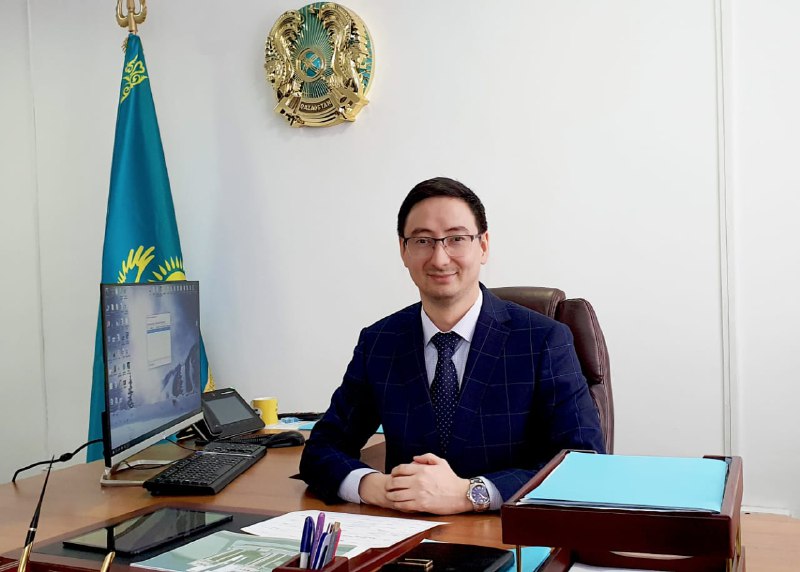
Head of the Department of Informatization, Provision of State Services and Archives of the Karaganda Region - R.O. Bayzhanov