Information on the death of seals in the Mangystau region
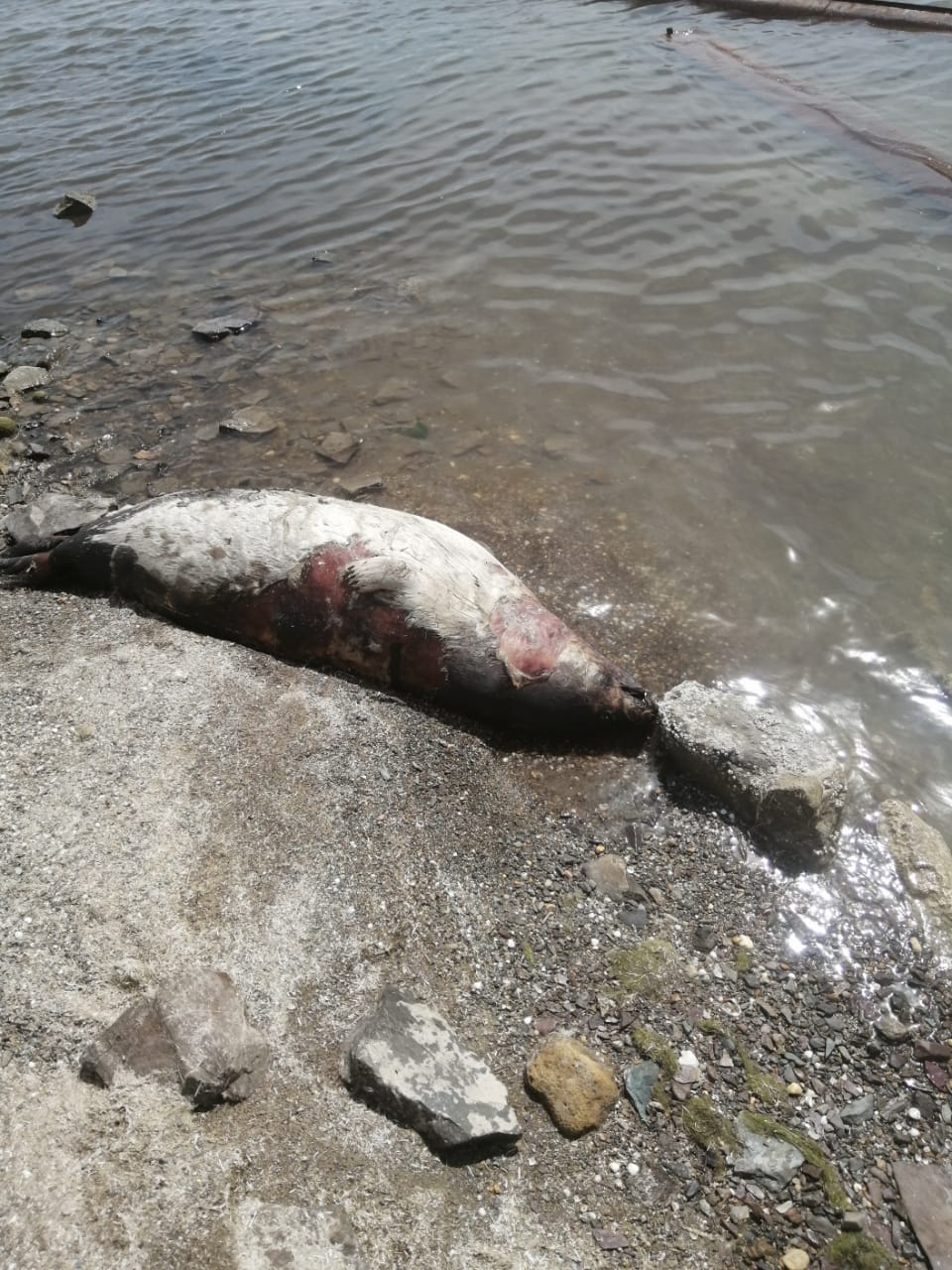
On April 27, 2022, during the continuation of work on the survey of the coast of the Mangystau part of the Caspian Sea, 94 carcasses of dead seals were found. The surveys were conducted with the participation of representatives of the fish inspection for the Mangystau region of the Committee of Fisheries of the MAGPR, the Department of Ecology for the Mangystau region, the veterinary service and local executive bodies.
The Department of Ecology of the Mangystau region selected samples of water and soil for laboratory studies. It should be noted that due to the strong decomposition of seal carcasses, tissue sampling for laboratory studies in order to determine the causes of death was not possible.Currently, disposal activities of dead seal carcasses are being organized. Monitoring of the coast continues, the information will be updated after the preparation of the results of the selected water and soil analysis samples.
We remind you that on the Kazakh coast of the Caspian Sea over the past 5 years, the largest number of dead seals was recorded in 2017 in the area of the city of Fort Shevchenko in the Mangystau region, then 247 carcasses were found, but the cause of the deaths could not be established.
It should be noted that in many cases it is not possible to take samples of samples due to the strong decomposition of carcasses of dead individuals. At the same time, it should be noted the different degree of decomposition, which indicates their death in different periods of time for many reasons, including natural mortality.
Thus, it is impossible to say about the mass death at the same time, since mostly seal carcasses are found in spring on the western coast of the Tubkaragan peninsula, where they are carried from the entire Northern Caspian by blowing winds from the west.
Surveys show that the mortality of a certain part of seals can be attributed to natural, due to unfavorable winter conditions, various diseases, as well as anthropogenic factors, including death in poaching nets. To strengthen its protection, the Caspian seal was included in the List of Rare and Endangered Species of Plants or Animals by the decree of the Government of the Republic of Kazakhstan dated November 9, 2020.
Along with this, two Kazakh-Russian programs of scientific research of the Caspian seal population are currently being implemented:
- Research program on the biology and main demographic parameters of the Caspian seal for 2019-2023;
- Program assessment of the number, distribution and natural reproduction of the Caspian seal in the Kazakh and Russian waters of the Northern Caspian, for 2020-24.
Kazakh and Russian scientific organizations participate in the research:
- All-Union Scientific Research Institute of Fisheries and Oceanography (VNIRO with the Volga-Caspian branch "KaspNIRKh"); Institute of Ecology and Evolution of A.M. Severtsev (IPEE); Research organizations "Vector" and "Typhoon" (Russia);
- "Kazakhstan Agency of Applied Ecology" (KAPE); LLP "Research Institute of Microbiology and Virology of the Republic of Kazakhstan"; LLP "Scientific and Production Center of Fisheries" (NPCRH).
The joint efforts of scientists from the two countries are conducting research and counting of the Caspian seal from sea vessels, as well as from aircraft, using a proven international accounting method based on multispectral remote aerial photography with a lower error.
Studies conducted in the Kazakh and Russian sectors of the northern part of the Caspian Sea indicate that the number of seals in 2020 was 282 thousand, in 2021 - 302 thousand, and in 2022 the total estimated number reaches about 340-360 thousand individuals.
Aerial reconnaissance over the winter ice field of the Northern Caspian Sea within the Kazakh part of the sea showed that the most significant place of accumulation of seals during the breeding season was the territory south of the Ural furrow. In the spring of 2021, 19 seal deposits were found in the northeastern part of the sea, which are concentrated in three areas: the islands of Novye Durneva, Prorva and Repair Shalygi.
Based on the results of joint research, measures will be developed to preserve the Caspian seal, one of which may be the creation of specially protected natural areas.
In support of the efforts of scientific organizations, in September 2021, during the XVII Forum of Interregional Cooperation between Kazakhstan and Russia, the Ministry of Ecology, Geology and Natural Resources of the Republic of Kazakhstan and the Ministry of Ecology and Natural Resources of the Russian Federation signed a Joint action plan for the conservation of the Caspian seal population for 2021-2026.
Following the results of this Forum, the Head of State K.K.Tokayev instructed the Government of the Republic of Kazakhstan to work out the possibility of creating state natural reserves in the Northern Caspian Sea to preserve the population of the Caspian seal, protect their habitat and reproduction territories.
In this regard, purposeful work has begun. In particular, a draft technical specification has been prepared for the development of a natural science justification, on the basis of which the boundaries, area, regime of protection and use of the state natural reserve for the conservation of the Caspian seal population will be determined.