The annual meeting of the Commission for Monitoring the Use of Funds from the National Fund was held at the Supreme Audit Chamber of the Republic of Kazakhstan
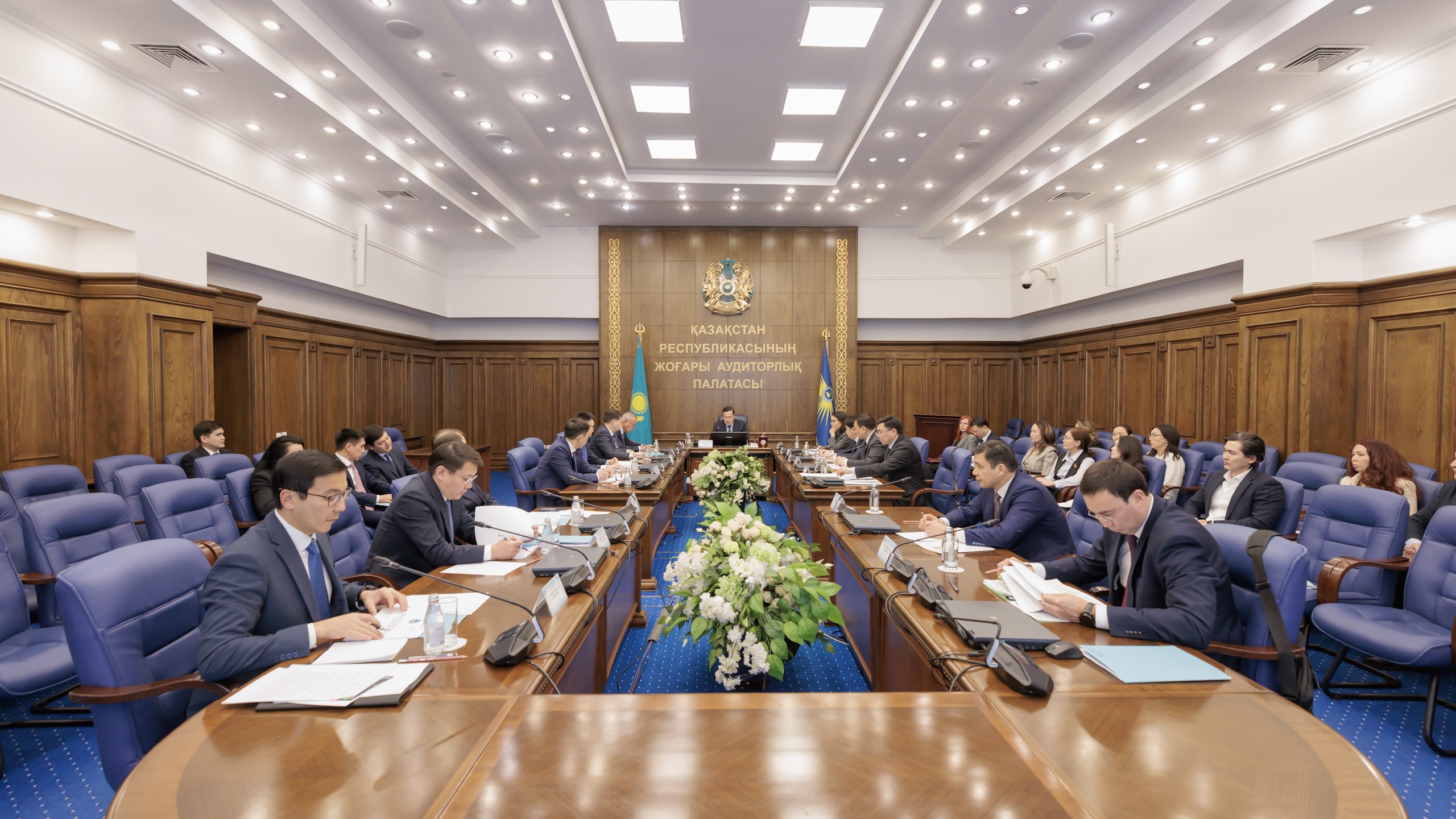
Alikhan Smailov, Chairman of the Supreme Audit Chamber, held a meeting of the Commission for Monitoring the Use of Funds from the National Fund of the Republic of Kazakhstan. The Commission meets in person once a year.
Authorized officials from the Executive Office of the President of the Republic of Kazakhstan, the Senate of the Parliament, the National Bank, the Agency for Strategic Planning and Reforms, the Ministries of National Economy and Finance, law enforcement agencies, as well as representatives of the quasi-public sector, took part in the meeting.
In his Address to the Nation last year, the President, Kassym-Jomart Tokayev, once again emphasized the need to use National Fund resources as efficiently as possible.
“To create additional investment sources, it is necessary to rethink the role of the National Fund as sustainable development instrument. The Fund’s resources should be used thoughtfully to finance promising small-scale projects with high market potential in our country. Most importantly, it is necessary to take a responsible approach to the funds allocation,” the President said.
During the Commission meeting, the audit results of the targeted and effective use of National Fund resources were reviewed.
The audit covered more than 3,000 budget investment projects totaling 3.4 trillion tenge, financed through targeted transfers, as well as bond loans to quasi-public sector entities amounting to 3.8 trillion tenge.
Overall, the implementation of these projects had a positive effect. However, the Commission identified significant opportunities to increase the economic return from National Fund resources. Certain shortcomings and violations were also recorded.
One of the key issues is the absence of a single government body responsible for achieving all the goals and objectives assigned to the National Fund. This prevents the formation of a comprehensive overview and the adoption of economically sound decisions.
Currently, responsibilities are divided among the Ministry of National Economy, the Ministry of Finance, and the National Bank. At the same time, centralized accumulation and analysis of complete information on business processes related to the use of the Fund’s resources, as well as on the final performance of financed projects, are not ensured. The level of transparency in reporting remains insufficient.
The Commission found that some projects were included for financing without basic readiness for implementation: they lacked design and cost documentation, land plots, and other prerequisites. This led to delays in implementation. Additionally, more than 500 projects worth 394 billion tenge were either excluded or replaced during execution.
Targeted transfers from the National Fund are legally intended for priority tasks of strategic and national importance. However, cases were identified where local-level projects were financed that could have been implemented without using National Fund resources, such as rural improvement facilities and small social infrastructure projects.
In some cases, National Fund resources were allocated to already completed projects or in amounts exceeding actual needs.
There were also cases of misuse and inefficient reallocation of funds: financing intended for rural medical infrastructure was redirected to urban facilities, and funds were allocated for equipment that had already been purchased. In certain regions, procurement volumes exceeded plans twofold due to inflated costs.
The Commission also identified shortcomings in bond financing. In particular, an effective system for monitoring the targeted and efficient use of such loans has not yet been established. Cases were recorded of financing problematic projects with low return rates, delays in leasing transactions, and the use of concessional loans as a source of cheap funding without achieving the declared export and production indicators.
Overall, following the use of National Fund resources allocated in 2023–2024, a number of criminal cases have been registered.
Relevant recommendations have been sent to responsible government bodies and quasi-public sector entities.
The working group that conducted the audit also submitted proposals for the Commission’s consideration:
- to exclude the allocation of targeted transfers to projects that have not undergone a full cycle of preliminary assessment and alignment with strategic priorities;
- to ensure full traceability of National Fund resources to the final recipient;
- to recover 64 billion tenge used for unstated purposes;
- to consider early repayment of bond loans issued in previous years by quasi-public sector entities.
According to the working group members, the implementation of these measures will strengthen financial discipline and ensure targeted and efficient use of National Fund resources.