Identify violations, issue instructions, monitor compliance: what the Supreme Audit Chamber did in 2025
Head of State Kassym-Jomart Tokayev gives priority attention to issues of effective use of budget funds and resources.
To this end, Kazakhstan is consistently reforming and strengthening its state audit system, implementing digital monitoring technologies, and analyzing and applying proven international experience.
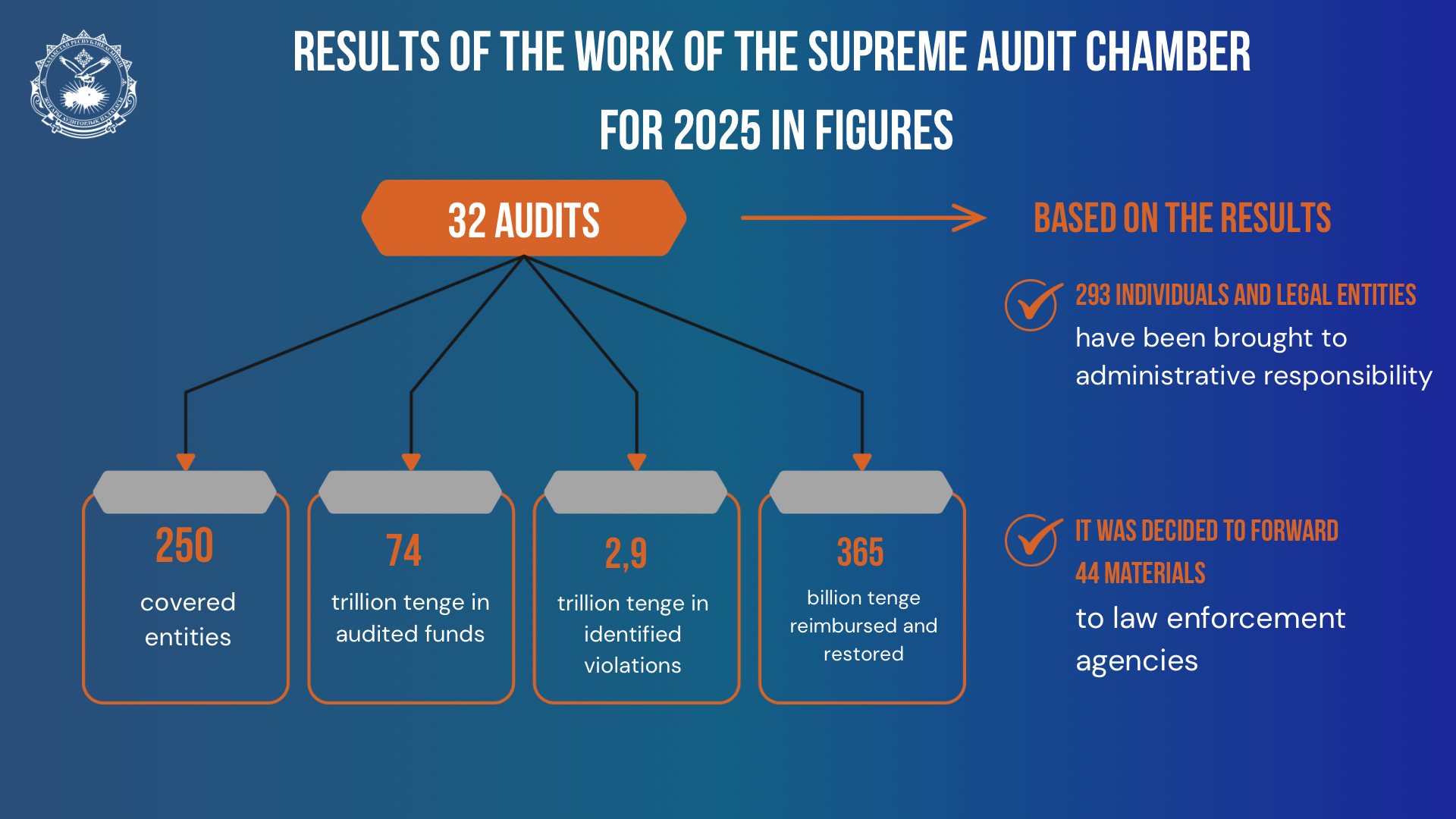
In 2025, SAС auditors conducted dozens of comprehensive and targeted audits covering key areas of public policy, the economy and public life. In total, there were 32 major audits covering 250 entities and 74 trillion tenge.
As a result, various violations amounting to more than 2.9 trillion tenge were identified. More than 365 billion tenge of them, has already been reimbursed and refunded to the state.
293 individuals and legal entities have been brought to administrative responsibility. It was decided to refer 44 audit reports to law enforcement agencies. To eliminate systemic shortcomings and violations, 132 recommendations and 1,400 specific instructions, which are mandatory for execution, were sent to the Government of the Republic of Kazakhstan and the audited entities.
The work carried out by the SAC in 2025 made a significant contribution to improving the efficiency of public administration and the use of budget resources in Kazakhstan.
Audits
In 2025, there were many audits that attracted the attention of the media and the public. One such audit was that of Samruk-Kazyna JSC and 18 companies in the group.
The fund had impressive figures for 2024: revenue of 16.5 trillion tenge and net profit of 2.4 trillion tenge. 2.37 trillion tenge was transferred to the state, plus another 673 billion tenge on the instructions of the President and the Government. At the same time, the SAC audit revealed violations amounting to 351.8 million tenge.
The audit of the drug supply system proved to be no less sensational. It turned out that there were shortcomings at all stages: from research and production to procurement and dispensing to patients. The result of the two audits (the first was in 2024) was financial violations amounting to 741 million tenge.
The following audits were also noteworthy:
– in secondary education – shortcomings in strategic planning, gaps in the training and employment of teachers;
– in the field of food security – inconsistencies in development documents, lack of an automated system for accounting and control of food stocks;
– in the activities of social and entrepreneurial corporations – chronic unprofitability, lack of transparency, ineffective management of stabilisation funds. Only some of the audits are presented here. In general, the results of the Supreme Audit Institution's audits were regularly published in the media throughout the year.
Supreme Audit Chamber's recommendations
The preparation and monitoring of the recommendations implementation are among the most important elements of audit work.
Here are some of the measures implemented on the instructions or recommendations of the Supreme Audit Chamber in 2025:
– State control over retail prices for commercial gas has been strengthened. Regulation now applies to all market participants, including gas distribution companies. Intermediaries are no longer able to resell fuel purchased from Qazaq Gaz JSC at inflated prices.
–Recipients of agricultural subsidies have reciprocal obligations to the state. Farmers and agricultural companies are now required to demonstrate the effectiveness of budget funds invested in them through increased production, job creation or higher yields.
– Incentive-based reciprocal obligations have also been established for recipients of state support in the manufacturing industry. Enterprises are now required to maintain export volumes at a level no lower than the previous year, so it will be beneficial for them to increase exports.
– Legislation on public-private partnerships has been revised to protect the budget from sharp increases in project costs and reduce the financial burden. The amendments also affect mechanisms for compensating partners for currency risks.
– Control over budgetary investment projects for road reconstruction has been strengthened. They are now subject to registration with the territorial treasury authorities with treasury support (reducing the risks of fraud, corruption and misuse of funds);
– Increased control over the circulation of medicines and medical devices. The form of the authorisation document for the import of unregistered drugs has been revised, and the obligation to verify the authenticity of documents has been established. In addition, measures have been taken against unjustified mark-ups;
– Non-mandatory budget expenditures for the modernisation of heating, water supply and wastewater disposal systems have been curtailed. In 2023-2024, more than 207 million tenge was paid from the budget for analytical services that are part of the direct functions of the relevant committee and JSC Kazakhstan Centre for Modernisation and Development of Housing and Utilities. From 2025, funding for such services will be excluded, and the budget adjustment will result in additional savings of 84.4 million tenge, which will be returned to the state treasury.
– Major changes have been made to the methods used to identify the shadow economy.
They will enable the state to identify hidden income more accurately and take into account new forms of illegal business;
– Nazarbayev Intellectual Schools JSC has improved its rules for the procurement of goods, works and services, reducing the possibility of making purchases from a single source. The National Education Database has been integrated with the unified information system of NIS;
– Separate measures to improve efficiency have also been taken at Baiterek Holding, the Development Bank of Kazakhstan, the Industry Development Fund and other quasi-state companies.
Many of the SAC's recommendations were included in the new Budget Code, which was signed by the Head of State in March. In particular, these include improving tax forecasting, updating the rules for working with the National Fund, changing the financing mechanism for Nazarbayev University, the FMSS and the IFCA, improving the efficiency of the use of state funds at the local budget level, and returning unused funds from national companies to the budget.
The SAC's recommendations were also taken into account in the new Tax Code, which came into force in 2026. Namely, extending the statute of limitations for tax audits, eliminating conditions for delaying tax procedures, etc. It is practically impossible to cover all the completed items of the instructions in one review. Here, it is much more important to understand the essence: this area of work is clearly and systematically structured in the SAC and is under constant control.
Responsibility for violations
Based on the results of audits, the SAC often requires authorized state bodies and organisations to hold officials accountable for violations of budgetary or other legislation of the Republic of Kazakhstan. As a rule, these are the direct supervisors of specific areas, their deputies or actual executors.
Based on the SAC's audits, 198 officials were subject to various disciplinary measures in 2025. Among them are employees of the ministries of education, health, agriculture, energy, tourism and sport, as well as Samruk-Energy JSC, JSC NC Food Contract Corporation, national medical centers and social entrepreneurship corporations, rectors of a number of leading universities, specialists from sports educational institutions, as well as authorized officials from the North Kazakhstan region.
Development of the state audit system
In 2025, along with audits, prescriptions and monitoring of the elimination of violations, the Supreme Audit Chamber paid attention to issues of further development of the state audit system.
A major step forward was the official consolidation of the new procedure for implementing the recommendations of the Supreme Audit Chamber based on the results of the assessment of the implementation of the republican budget.
The conclusions and recommendations of the Supreme Audit Chamber on the Government's report will now be formalized in a single Roadmap with specific measures, responsible state bodies and deadlines for implementation. Its implementation will be monitored on a quarterly basis under the joint control of the Supreme Audit Chamber and the Government Office, which will strengthen control over the republican budget, reduce inefficiencies and increase the accountability of all participants in the budget process.
Other innovations include: in accordance with the instructions of the Head of State, under the leadership of the Chairman of the Supreme Audit Chamber, a meeting of the Commission for Control over Expenditure of Resources Allocated from the National Fund was held: its composition was updated, its regulations and rules of procedure were approved, and an operational working group was created with the participation of the Supreme Audit Chamber, the Ministry of National Economy, Ministry of Finance, National Bank, Samruk-Kazyna and Baiterek. A plan was also approved to audit funds allocated to budget investment projects in 2023-2024, and a pool of projects to be audited and reporting forms were formed. Now, even more attention is being paid to the rational use of the National Fund's resources.
Digital trends as a key development benchmark
Digital transformation and the introduction of modern technologies, including artificial intelligence, were among the key topics of President Kassym-Jomart Tokayev's Address to the Nation in 2025.
Today, a special information system has been introduced for Kazakhstani state auditors, automating all stages of audit work. Integration with 14 information systems of the ministries of finance and justice, Samruk-Kazyna JSC and other organizations has been completed, covering all recipients of budget funds.
Artificial intelligence elements are being actively incorporated: virtual assistants have been introduced, allowing users to obtain answers on training and certification, as well as providing access to regulatory and methodological documents in the field of auditing.
Development in this area continues. Particular emphasis is placed on big data and AI technologies, which will automate many routine processes and significantly improve the quality of audits.
Currently, the Supreme Audit Chamber is developing AI agents that will assist in the preliminary assessment of the republican budget and the preparation of the annual report for Parliament.
Speaking at the fourth session of the National Kurultai, the Head of State noted that the introduction of AI will significantly improve the efficiency of budget spending, improve tax and customs administration, and optimize public procurement. In this regard, the key objective of the SAC's digital transformation is to maximize the potential of the budget resource control system.
Legislative changes
In 2025, the Supreme Audit Chamber also focused on improving the rules governing the budget system and external state audit.
A key milestone was participation in the preparation and adoption of the new Budget Code. It enshrines important changes: the SAC gained the right to audit extrabudgetary funds, participate in the coordination of personnel decisions on audit commissions, and evaluate draft budgets in advance, including at the local level. In addition, the SAC gained online access to the state planning system, which significantly strengthened control over state funds.
Some of the SAC's proposals were also implemented in other laws. For example, the rules for the certification of state auditors and the work of the relevant commission were clarified, responsibility for the late provision of information for budget assessment was strengthened, and the procedure for settling disputes following an audit was clearly spelled out. The misuse of budget funds is officially classified as a financial violation.
At the same time, the Supreme Audit Institution has updated its procedural standards and audit methodologies, certification rules, and approaches to maintaining a unified database, and has approved a classification of violations. All of this will make state audits more transparent, uniform, and high-quality.
Audit diplomacy
An important part of the work of the Supreme Audit Chamber is the regular exchange of experience and knowledge with foreign colleagues.
In 2025, at a meeting in Istanbul of representatives of the supreme audit institutions of the countries belonging to the OTG, with the participation of Azerbaijan, Kazakhstan, Kyrgyzstan, Turkey and Uzbekistan, a declaration was signed on the establishment of the Organization of Supreme Audit Institutions of Turkic States – TURKSAI.
As part of the XXV Congress of the International Organization of Supreme Audit Institutions (INTOSAI), the SAI signed memoranda on professional cooperation with Egypt and Uzbekistan.
In September, the Young ASOSAI Excellence Programme was launched in China with the participation of a SAC delegation.
SAC was also well represented at the 7th Meeting of the Heads of Supreme Audit Institutions of the Shanghai Cooperation Organization countries in Tajikistan.
In short, the Supreme Audit Chamber of Kazakhstan is now a respected member of the international professional community, building strong partnerships with all key players: from the United States, China and Russia to countries of Europe, the Caucasus, the Middle East and Central Asia.
Plans for 2026
In 2026, the Supreme Audit Chamber will continue its intensive work: 37 audits are planned, which will cover support for domestic pharmaceutical manufacturers, efforts to attract investment, the national projects ‘Comfortable School’ and ‘Modernisation of Rural Healthcare’, the gas industry, the activities of Kazpost JSC and the Committee of the Penitentiary System of the Ministry of Internal Affairs of the Republic of Kazakhstan, state information policy and other relevant areas.
Most important, the SAC will consistently improve and develop its activities in the interests of the state and all Kazakhstani citizens.