About Development of the Microfinance Sector in H1 2025

Microfinance sector continues to demonstrate a steady growth, remaining a key lender to individuals and small businesses. Of the sector is driven by the use of new technologies in microloan issue as well as geographic and industry diversification.
The microfinance market undergoes gradual changes: traditional office sales fade into the background, giving way to remote service channels. Thus, digitalization of the microfinance sector becomes not just a trend, but a factor of competitive advantage.
Meanwhile, digitalization has its downside. Active implementation of IT solutions is accompanied by an increase in fraudulent transactions.
These challenges require timely response from regulators. Tighter controls and oversight, including through improved regulatory frameworks, have not only increased transparency of the sector but also eliminated unscrupulous participants who have failed to adapt to new standards. Thus, as of 1 July 2025, there were 212 microfinance organizations (MFOs). In the first half of 2025, licenses of 6 entities were suspended and those of 13 were revoked.
Along with that, due to their consistent development, two MFOs were successfully transformed and received banking licenses, which confirms maturity and sustainable development of the MFO sector.
Market leaders transform from MFOs to banks.
In the first half of 2025, some of the largest market participants withdrew from the MFO register: on 13 June 2025, MFO BNK Finance Kazakhstan (BNK) JSC received a banking license, on 12 August 2025, MFO KMF (KMF) JSC obtained a similar license.
These MFOs accounted for 18.8% of the sector's loan portfolio, indicating their significant position in the sector. These two organizations provided "classic" microfinance services, covering sectors of the economy, borrowers and regions less attractive to larger second-tier banks.
After their exit, leading positions shifted to MFOs that focus on providing microloans for car purchases.
As of 1 July 2025, portfolio of Toyota Financial Services Kazakhstan LLC MFO totaled 234.4 billion KZT, while that of MyCar Finance LLC MFO made 165.9 billion KZT.
Assets and structure of the loan portfolio of MFOs.
During the first half of 2025, MFO assets increased by 13% – from 1,718 billion KZT to 1,936 billion KZT. This asset growth was driven by an increase in the loan portfolio. Microloans accounted for 78.5% of the total assets.
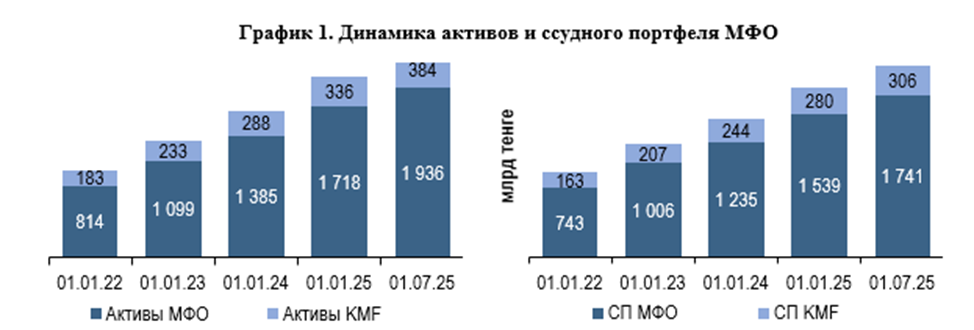
Concentration of sector assets in the top 10 MFOs remains high. Top 10 MFOs account for 74% of the sector's total assets respectively.
High asset concentration in the top 10 MFOs has a dual effect: on the one hand, it ensures sector stability due to dominance of large and stable players capable of investing in technology, risk management, and new product development; on the other hand, it creates risks of reduced competition, market dependence on a limited number of participants, and possible pressure on smaller companies, which in the long term could limit diversification and service availability.
The MFO loan portfolio (principal debt before deducting the reserves) in the first half of 2025 increased by 13.1%, or 202 billion KZT, to 1,741 billion KZT. This indicates continued strong demand for microlending in the current economic conditions.
While the microfinance market was previously perceived primarily as a source of "quick cash" for the population, business lending now gains momentum, both through microloans to legal entities and individuals (both with and without individual entrepreneurship).
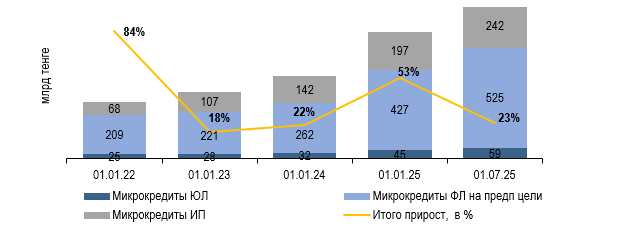
Microloans to legal entities soared by 31.8%, or 14 billion KZT, to 59 billion KZT, to individual entrepreneurs grew by 22.7%, or 45 billion KZT, to 242 billion KZT, and microloans to individuals increased by 11.0%, or 143 billion KZT, to 1,440 billion KZT.
In the structure of the microfinance loan portfolio, microloans to legal entities accounted for 3.4%, loans to sole proprietors – for 13.8%, and loans to individuals – for 82.7%. Share of microloans with overdue debt of over 90 days (NPL 90+) in the MFO loan portfolio made 7.0%, or 117 billion KZT (as of 1 January 2025, it was 6.6%, or 99 billion KZT), of which 2.4% were held by businesses.
Meanwhile, growth in overdue debt is accompanied by an increase in provisions, which as of 1 July 2025 amounted to 297 billion KZT. Despite this increase, this figure is comparable to the rate of loan portfolio growth, which helps maintain the sector's stability.
By industry, retail (37%), services (32%) and crop production (13%) account for the largest shares. It should be noted that the highest loan portfolio concentration is reported in Almaty – 21.1% (403 billion KZT), Astana – 12.8% (244 billion KZT) and Turkestan Region – 11.8% (226 billion KZT).
Business lending by microfinance organizations demonstrates a positive trend, indicating their development in supporting small and medium-sized businesses. Thus, MFO activities make a significant contribution to the country's economy by supporting entrepreneurship, facilitating job creation and stimulating regional development.
However, business lending, unlike retail lending, requires a more thorough assessment of the borrower's solvency. It is more difficult to predict financial flows and the borrower's reliability. This means that MFOs must enhance their risk management and learn to more deeply analyze clients' business models.
Despite the growing role of business lending, consumer microloans continue to account for a significant share of the total loan portfolio. As of 1 July 2025, their volume increased by 5.2%, or 45 billion KZT, to 915 billion KZT, accounting for 53% of the total portfolio.
Meanwhile, significant transformations take place within the retail microlending segment itself. Structural changes in MFO loan portfolios have been reported over the past few years. For example, car microloans have grown by 38 billion KZT since the start of this year.
Successful loan portfolio growth allowed two MFOs that provide car microloans to rise into the top 3 as of the reference date. However, presence of collateral does not reduce the risk of default on raised microloans.
Apart from the growth of car loans, it is also necessary to indicate changes in provision of PDL microloans[1]. This niche has demonstrated growth since 2023, driven by a combination of the following factors:
- high demand from the population for fast and unsecured microloans amid limited access to bank lending;
- simplicity and speed of processing (online application, minimal documentation, instant crediting to a card);
- development of digital channels and remote services, making such products as accessible as possible even in remote regions.
However, in order to minimize lending risks for consumers, in 2024, terms and conditions for PDL microloans were tightened, in particular:
- procedure for calculation of debt burden ratio (DBR);
- reorientation of businesses from PDL to entrepreneurial purposes;
- ban on issuing the microloans with overdue payments exceeding 90 days;
- maximum amount for unsecured consumer microloans has been defined;
- real-time transmission of information about microloan applications to credit bureaus.
Moreover, measures adopted in 2025 to tighten PDL calculation contributed to improved borrower assessment and reduced the risk of their over-indebtedness.
Furthermore, starting from 2026, in order to minimize risks, the Agency plans to implement mandatory requirements for a risk management system (RMS). Market participants already implement certain elements of the RMS, including borrower scoring and establishment of internal limits on microloan amounts and types.
RMS implementation will improve financial stability, protect interests of clients and participants, and enhance competitive advantages of MFOs through effective risk management, timely threat identification, prompt response to changes, and prevention of negative consequences.
At the same time, MFOs are required to implement measures to ensure timely and adequate assessment, monitoring, and management of the most significant risks for MFOs, which include credit risks.
Creation of separate/ independent risk management and compliance functions, forming a second line of defense, will reinforce the internal control system, ensure independence of risk assessmen, and improve quality of risk management.
In conclusion, it should be noted that the microfinance sector demonstrates steady growth and undergoes gradual transformation from a niche of "quick microloans" into a full-fledged source of financing for individuals and businesses. Digitalization becomes a key driver of development, ensuring the availability of services and competitive advantages, but simultaneously increasing the risk of fraud and strengthening risk management requirements.
High concentration of assets in the largest MFOs supports sector stability but limits competition and diversification. At the same time, growth in lending to entrepreneurs confirms strategic importance of MFOs in supporting small and medium-sized businesses, creating jobs, and developing regions.
However, there are still challenges related to the risks of fraud the high concentration of assets among a limited number of participants. Consistent regulatory and supervisory policies ensure market transparency, promptly identify unscrupulous organizations, and create conditions for further transformation of the sector to promote sustainable economic growth.
Therefore, future development of the sector will be determined by a balance between technological advancement, effective regulation, and responsible risk management, which will ensure the sustainability and enhance the contribution of microfinance organizations to the country's economy.
[1] Microloans for purposes not connected with conduct of the entrepreneurial activities with no security for a period of up to 45 days and in the amount of up to 45 MCIs