How does the 14 day return policy work?
Let's consider the problem of returning goods, we will discuss it using one of our customers' stories as an example.
A woman bought a dress in a shopping mall for 47,000 tenge. After she came home, she decided to try on the dress and show it to her husband. And then she found a stain on the dress, since the material is silk, and even a drop of water can leave marks on it. In general, the dress is not worth its price. Then she had it dry cleaned and decided to return it to the store. Now the store manager refuses to take the dress back because she had it dry cleaned.
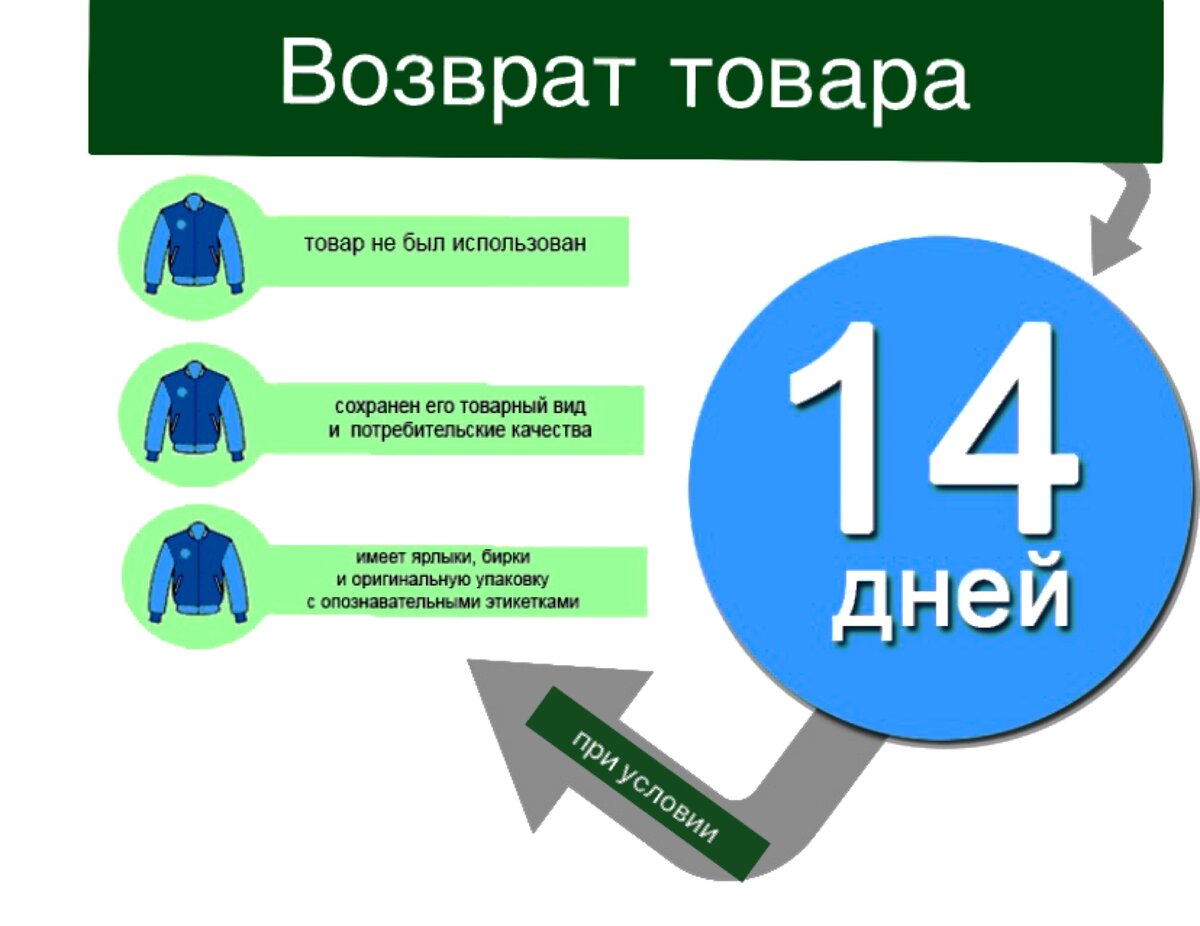
Everyone knows for sure that goods can be returned within 14 calendar days, but they do not know which goods are not subject to return and the conditions for returning goods of proper quality.
Namely, within the framework of the law on the Protection of Consumer Rights, the Exchange and return of goods is carried out in accordance with Article 30 of the Law "On the Protection of Consumer Rights", which states that the seller is obliged to exchange or return goods of proper quality in cases where:
- the goods have not been used;
- the presentation and consumer properties are preserved;
- the labels and seals are preserved;
- and the document confirming the purchase of the goods is also preserved.
The goods can be exchanged or returned after 14 days from the date of purchase, if a longer period is stipulated by the contract.
In our case, the consumer dry-cleaned the goods and, in accordance with Article 14 of the Law, as you understand, they are not subject to exchange or return in accordance with the above article.
Thus, we would like to stipulate the goods that are also not subject to exchange or return in accordance with Article 30 of the Law on the Protection of Consumer Rights:
- medicines and medical devices;
- underwear;
- hosiery;
- animals and plants;
- goods by the meter, namely fabrics made of all types of fibers, knitted and curtain fabric, artificial fur, carpets, non-woven materials, ribbons, lace, braid, wires, cords, cables, linoleum, baguette, film, oilcloth;
- mobile subscriber devices.
Among the most common goods that are not subject to return, but they are trying to return, we can highlight medicines and mobile subscriber devices (mobile phones, smartphones). Due to the high cost of some types of these goods, consumers often face the desire to return the amount paid for the goods, to which they receive a reasoned refusal from sellers. In rare cases, it is possible to meet conscientious sellers who easily exchange or accept these types of goods back when they see that the citizen really did not leave the store or did not open the goods and did not use them in any way. But these are purely human, human and infrequent moments.
If your rights as a consumer are violated, you can contact the Department of Trade and Consumer Protection in the Abay region.
Our address: Semey city, Abay st. 99. 87222 35 34 22.
Department of Trade and Consumer Protection in the Abay region