Меню
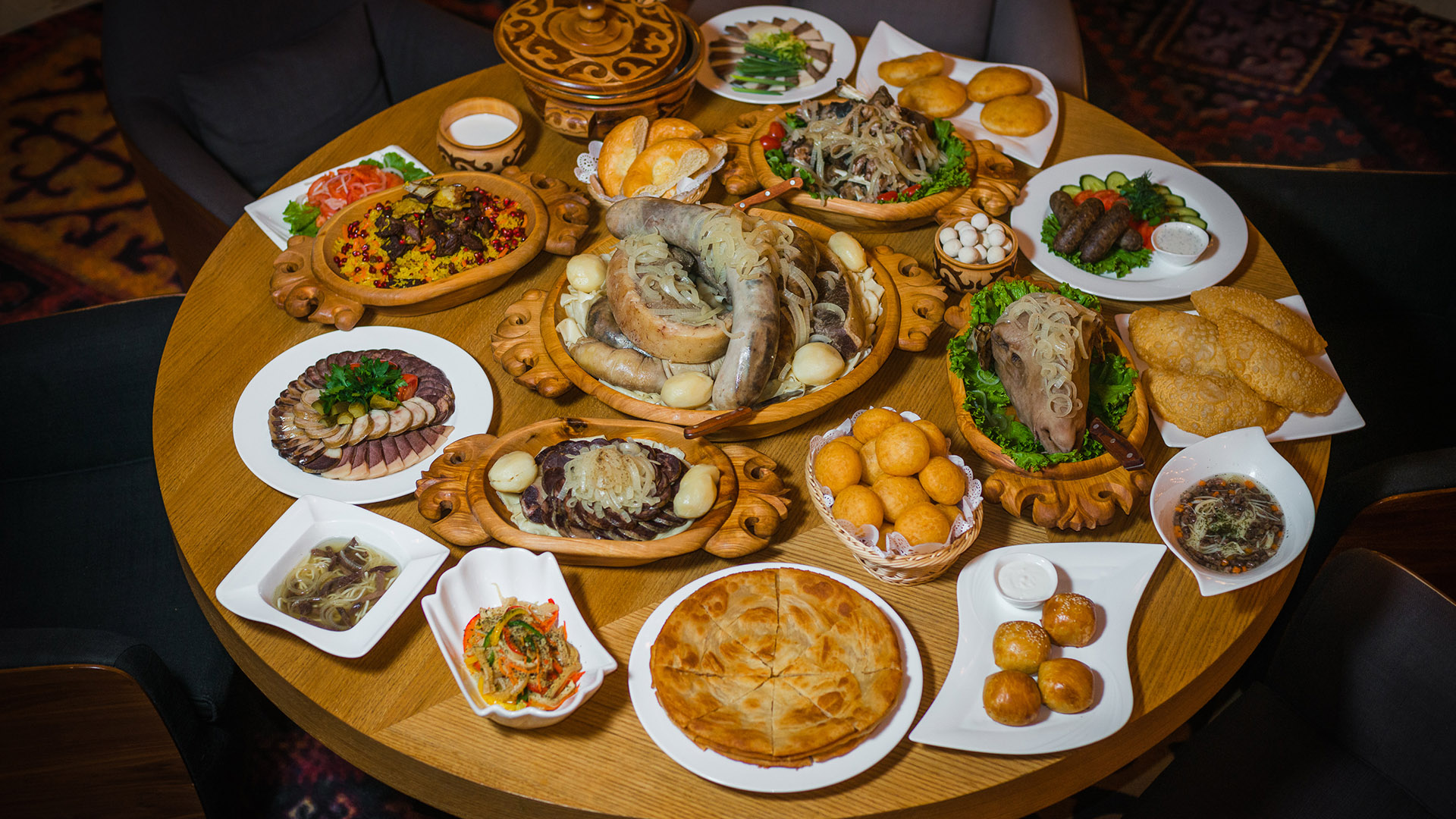
The modern cuisine of Kazakhstan is a peculiar reflection of the ethnic history of the country, which has been developing for the last century and a half. It includes not only traditional dishes that have existed in Kazakh culture since ancient times, but also dishes of Russian, Uzbek, Uigur, Ukrainian, Tatar and Korean cuisines that are beloved by Kazakhs.
Meat and milk are the basis of Kazakh cuisine
Kazakh people for centuries of history have accumulated vast experience in the processing and preparation of meat and dairy products.
The Kazakhs consider not only the preparation of meat to be an art, but also its cutting and distribution at the festive table, elevated to a ritual.
Due to the nomadic way of life, the main method of cooking meat is boiling. Kazakhs have developed original ways of preparation and long-term storage of meat products.
Nomadic lifestyle also influenced the way of preparing dairy products: sour-milk products have become the best option.
Main Kazakh dishes
Kazakh meat - et (also besparmak, which means "five fingers", traditionally this dish is eaten with hands) - a dish usually consisting of boiled meat (often several species - horse meat, mutton, beef, and in the western regions of the country - from camel meat and fish), dough boiled in large circles or cut into rectangles, and a rich broth (sorpa).
Kazakh-style meat (besparmak)
Prepared and washed cuts of meat are put in a cauldron or a pot with cold water, brought to a boil, lower the fire, remove the foam and, at a gentle boil, continue to cook until tender.
30-40 minutes before the end of boiling add salt to taste, a bay leaf, a head of onion, black pepper in the broth.
Knead the dough and let it stand for 30-40 minutes, then roll it with a rolling pin to a 1-1.5 mm thick layer, which can be cut in 7-8 cm squares for convenience.
(In the variants of besparmak, reflecting the influence of Russian and Tatar cuisine, half an hour before the end of cooking the meat, peeled potatoes can be lowered into the broth, boiled until tender and transferred together with the meat to a closed dish).
Put chopped onions, salt, pepper, herbs in a separate bowl, pour the fat taken from the broth, cover tightly and simmer.
Then put it on a flat dish, lay slices of meat on it (many modern housewives prefer to cut it into slices) and put onion rings stewed in grease (tuzdyk). Place boiled potatoes around the edge of the dish.
For 5-7 persons: 750 gr mutton, 1270 gr horse meat, 1200 beef, 1 onion, green onions, salt, spices to taste (quantity and balance of different types of meat vary depending on region).
To prepare the dough: 2 cups of flour, 0.5 cup water, 2 eggs, 1 teaspoon salt.
To prepare the sauce: 1-1.2 cups of broth, 1-2 bulbs.
Kuirdak - stew of meat, liver and other by-products. Onions and often potatoes are added to it.
Kuryrdak can be made of beef, lamb or horsemeat. All by-products (usually included in the liver) are thoroughly washed and after washing the lungs and stomach are slightly boiled. Then all the ingredients of kuirdak are finely chopped: lungs, liver, kidneys, stomach, some meat (to add flavor to the roast).
In red-hot vegetable oil (in the original - the melted internal fat) is carefully fried all that has been finely chopped, except for the liver.
Then finely chopped onions, garlic, and spices are added and the kuirdak is stewed with the addition of a small amount of water over low heat for at least 1 hour.
When the main ingredients are almost ready, add liver and cook for no more than 15-20 minutes, as it hardens while overcooking. At the same time with liver can be added potatoes, chopped into small cubes.
This dish is ready and served at once and garnished with greens.
Ingredients: lung - 200 gr, beef liver - 150 gr, heart - 50 gr, bacon - 100 gr, onions - 50 gr, potatoes - 4-5 pcs. pepper - a pinch greens - teaspoon
Bauersaks - flour products made of yeast dough and fried in hot fat. The bauersaks differ in size and shape from region to region: they can be small balls or cubes resembling doughnuts. The size of bauersaks also varies, mostly depending on the region of the country.
Dissolve 20 grams of yeast in warm water, add 1 tablespoon of sugar, 1 tablespoon of flour and put it in a warm place to make a stew.
When the omelet is ready, add 0.5 kg of flour, 1 liter of warm milk, 1 tablespoon of salt, 1-2 tablespoons of sunflower oil and 3-4 eggs and knead the dough, cover and put in a warm place so that the dough can rise.
The amount of flour can be varied to taste - the less flour, the more delicate the bairnsaki are, but one must remember that it is more difficult to work with liquid dough - it is harder to roll out.
When the dough is ready, it is rolled out 1 cm thick, cut into pieces about 3 cm by 3 cm or more, and then each piece is deep-fried in a deep fryer, a well-hot sunflower oil, until golden brown.
Shelpeks are traditional flatbreads made of sourdough, fried in oil.
To make shelpeks, dough is kneaded like bauersaki, cut into small pieces, rolled into flatbread and fried in grease until golden brown.
Ingredients: wheat flour - 5-6 glasses ayran or raw milk - 1 bowl melted butter - 2 tablespoons sour cream - 2 tablespoons yeast - 20-30 gr water - 0,7 cup sugar - 1 teaspoon vegetable oil - 2,5 glasses.
Horse meat delicacies
Kazy is a traditional sausage made of horse meat. It is made using fatty meat from the ribs (usually with spices and spices). Eaten only in boiled form.
Shuzhuk is similar to kazy, but the meat is not used from the ribs, but harvested. Method of cooking, in general, identical.
Jaya - pre-salted and boiled meat from the hips of horse meat.
Traditional dairy products:
Koumiss - sour milk drink from mare's milk, obtained as a result of lactic and alcoholic fermentation. In terms of strength, koumiss can be high in alcohol, which can be intoxicating, and low in alcohol, which has soothing properties. Koumiss is recognized as a useful restorative. It is used to treat, in particular, some forms of tuberculosis, as well as loss of appetite after severe, debilitating illnesses, anemia, and stomach diseases.
Shubat is a sour milk drink made from camel milk. Shubat has higher fat content (up to 8%) compared with koumiss. Shubat, unlike koumiss, is not shaken and well stirred before serving. It is thicker than koumiss and has a white color. According to some estimates, shubat is useful in treating asthma, tuberculosis, liver diseases, diabetes and psoriasis.
Ayran is a type of sour-milk drink obtained by fermenting milk, which used to be poured into a leather saddlebag strapped with sourdough. In the modern version, the milk is put in a warm place after adding the sourdough starter.
Qurt - dry young cheese made from sheep, goat or mare's milk. It is a white ball (sometimes flattened) the size of an apricot or smaller.
A touching story of human mercy and sympathy in terrible and tragic events is associated with qurt. In Kazakhstan there was the Akmola camp for the wives of traitors to the Fatherland, whose prisoners called it briefly: ALZHIR. In this camp the repressive apparatus of the totalitarian system gathered about eight thousand women whose only fault was that they did not betray their husbands, who were the first to be thrown into the millstones of repression in the 1930s.F
It was under these inhumane conditions that the prisoners of the camp encountered the unusual attitude of the Kazakhs to the blacksmiths. Former prisoner Gertrude Platais recounts: "One winter morning the female prisoners carried bunches of reeds from Lake Zhalanash. After a while some children appeared on the shore of the lake, who, at the command of their elders, began throwing stones at these women. The guards started laughing out loud: "You see, you are not only disliked in Moscow, you are also disliked here in the aul.
The humiliated women thought, "What are you old men teaching your children? But one woman stumbled, and when she fell near the stones she smelled milk and cheese. She took a piece and put it in her mouth - it seemed very tasty to her. She picked up the stones and brought them to the barracks. There were some female Kazakh prisoners there. They said it was qurt, salted curd dried in the sun.
Gertrude Platais' memories were the basis for the poem "Qurt, a Gem".
Oh, Lord, this is not just a stone.
I could smell the scent of milk from them.
And in my heart fluttered the flame of hope,
A lump rose in my throat.
So this is what the elderly invented!
That’s why women were risking children!
They took care of us from disease,
They saved us from unbelief.
They understood that we are not enemies,
And just unfortunate women.
The prisoners of ALZHIR were very grateful to the local Kazakhs, thanks to whom many managed to survive in the millstone of the camp system.