Меню
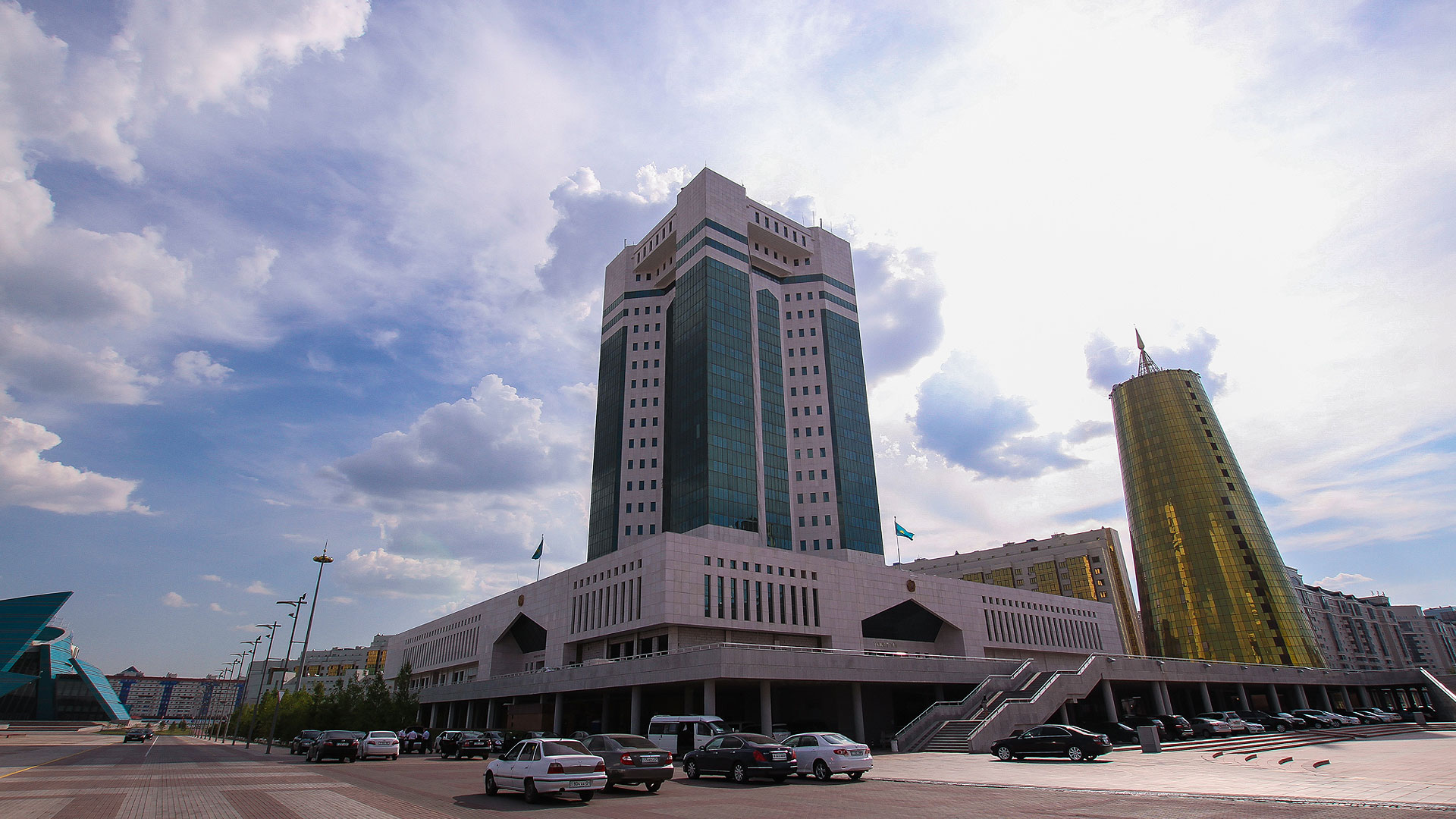
Kazakhstan is a democratic legal unitary state with three independent branches of power: Executive, Legislative and Judicial.
Executive power
The executive power is headed by the President of Kazakhstan and exercised by the Government. The Head of Government is the Prime Minister, whose candidacy has to be approved by the Parliament.
The Government serves during the President's term of office and resigns after the election of the next Head of State.
The main responsibilities of the Government:
- The development of the basic directions of domestic, foreign and social-economic policy of the state, its defense capability, security, maintenance public order;
- The development of the Republican budget, presentation to the Parliament and implementation;
- The development, introduction to the Mazhilis, and law implementation;
- The management of the activities of the ministries, state committees, other central and local executive bodies;
- The appointment and dismissal of the heads of central executive bodies not included in the Government;
- The executions of other functions, assigned to the Government by Constitution, laws and acts of the President.
The representatives of the local executive bodies are akims of regions, districts, cities, auls, villages and settlements. The heads of regions, akims of Astana or Almaty are assigned by the President on the recommendation of the Prime Minister.
Legislative power
Parliament implements the legislative power in Kazakhstan and consists of two Chambers: the Senate and the Mazhilis.
Senate
The Senate of the Parliament of the Republic of Kazakhstan is formed from deputies, elected by two people from each region, city of republican significance and the capital of Kazakhstan.
The overall count of deputies of the Senate of the Parliament is 47 people.
The President of Kazakhstan, considering the need to ensure representation of national-cultural and other significant interests of society in the Senate, appoints fifteen deputies.
Half of elected deputies of the Senate are re-elected every three years. The term of office of the Senate deputies is six years.
The exceptional powers of the Senate of the Parliament of the Republic of Kazakhstan:
- The appointment and dismissal of the Chairman of the Supreme Court and judges of the Supreme Court of the Republic, and acceptance of the oath;
- The coordination on the proposal for the appointment or deprivation the inviolability of the Chairman of the National Bank, the Prosecutor General, and the Chairman of the National Security Committee of the Republic;
- The function implementation of the Parliament of the Republic in accepting of constitutional regulations and laws during the temporary absence of Mazhilis, spurred by the early termination of its powers;
- The carrying out other responsibilities assigned to the Senate of the Parliament by the Constitution.
Mazhilis
The Mazhilis of the Parliament of the Republic of Kazakhstan consists of 107 deputies. 98 of them are elected by party lists based on general, equal and direct suffrage by secret ballot in a single national constituency. There are also nine more deputies elected by the Assembly of the People of Kazakhstan.
The term of office of deputies of the Mazhilis of the Parliament of Kazakhstan is five years.
The exceptional powers of the Mazhilis of the Parliament of the Republic of Kazakhstan:
- The consideration of draft constitutional laws and legislation introduced in Parliament;
- The approval of Prime Minister's candidacy;
- The announcement of the next presidential elections;
- The carrying out other responsibilities assigned to the Mazhilis of the Parliament by the Constitution.
Maslikhats represent the local legislative bodies of regions, districts and cities of republican significance (Astana and Almaty).
Judicial power
The judicial power in Kazakhstan Republic belongs only to courts represented by permanent judges and jurors, involved in criminal proceedings.
The highest bodies of judicial power are the Supreme Court and Constitutional Council.
The judicial system of the Republic consists of three branches:
- The highest branch- Supreme Court of the Republic of Kazakhstan;
- The middle branch - regional and equivalent courts (the city court of the capital, the city court of a city of republican significance, the Military Court of troops of the Republic of Kazakhstan);
- The main branch - district and equivalent courts (city, specialized courts, garrison military court).
The President appoints judges (in regional and local courts - on the proposal of an authorized body, coordinated with the Chairman of the Supreme Court).
At the same time, judges are independent in the administration of justice and comply only with the Constitution and the law.