Меню
Tomyris (6th century BC)
We know about her thanks to the records of the Herodotus. The Greek Father of History described in detail her victory over the founder of the Persian Empire Cyrus the Great. The history of Tomyris and her victory over Cyrus was also mentioned by such ancient authors as Strabo, Polyenus, Cassiodorus and Jordan.
Herodotus reports that Cyrus crossed the Arax River, ventured into the territory of the Massagetai for one day and set a trap for them. The Persians left the camp with a supply of wine, which was defended by a non-combatant unit, while the main troops retreated back to the river. As soon as Massagetai defeated the enemy, began to feast at the camp. Sated with food and wine, they fell asleep. The Persians returned, killed many and captured even more, including Spargalis, the son of Queen Tomiris, who commanded the Massagetai.
In the subsequent battle, Tomyris defeated the Persian army, and according to legend, she plunged the head of Cyrus into a wineskin filled with blood with the words: "You wanted blood, so empty it to the dregs!" The life of Queen Tomyris inspired many literary pieces and theatrical productions. Bulat Dzhandarbekov's Saki dilogy about her is very popular in Kazakhstan. The name Tomiris has become widespread among Kazakhs.
Al-Farabi (870-950)
His full name is Abu Nasr Muhammad ibn Muhammad ibn Tarkhan ibn Uzlag al—Farabi at-Turki. Born in the city of Farab (Otrar) in the Syr Darya, he came from the family of a noble Turkic military commander.
The largest historians of culture and science have noted the greatness and uniqueness of al-Farabi. Astronomy, logic, music theory and mathematics, sociology and ethics, medicine and psychology, philosophy and law — this is an incomplete list of his scientific interests. Apparently, when he was young, al-Farabi left his hometown and visited many cities associated with Islam and the Arab caliphate — Bukhara, Merv, Khorran, Alexandria, Cairo, Damascus, Baghdad. He spent many years in Baghdad, the political and cultural center of the Arab caliphate. Here he thoroughly studied the works of Beit al-Hikma figures, translators of Greek authors, met prominent scientists and after some time he became a leader among them due to moral height and brilliancy. Here he was awarded the title of Muallim Assana — the Second Teacher.
The title of "second" implied the presence of the "first" - Aristotle.
Al-Farabi made an independent contribution to the science of logic, which was first developed by the great Greek predecessor. His unique and bold philosophical views contradicted public opinion, who were incapable of fully understanding Greek philosophy and science. And direct attacks on some of the prejudices of the era made many people suspect him of heresy and rejection of religion. In fact, he showed exceptional independence in his thinking and consistently defended his beliefs.
Khodja Akhmet Yassawi (1103-1167)
Born in Ispidzhab (Sayram). Khodja Akhmet Yassawi devoted his whole life and strength to uniting kindred peoples and creating spiritual unity against the background of numerous religious movements. From the handwritten sources received from the former imam of Yassa (Turkestan) Abd-al-Qadir, it is known that the inhabitants of this city for many years opposed Khoja Akhmet Yassawi, and he had a hard life.
The works of Khodja Akhmet Yassawi — poems, sofas, rizal — were widely popular among local residents. He was not only a spiritual mentor, but also a wise statesman. In his spiritual sermons, poems and treatises, he responded to pressing issues when he felt that he could enlighten people. Khodja Akhmet Yassawi called on the people to be tolerant of people of a different faith.
According to legend, Yassawi was forced to leave the bustle of the world to serve the Almighty. He settled in an underground cell in the city of Iasi, near the mosque, where he spent the rest of his life.
In 1166-1167, Khodja Akhmet Yassawi died and as a saint was buried in the city of Yassy in a mausoleum built for him. At the end of the 14th century, at the behest of Emir Timur, who revered Khodja Akhmet and made many efforts to celebrate the memory of his spiritual patron, a grand mausoleum was erected on the site of a small tomb of Akhmet Yassawi, which later turned into a place of mass pilgrimage and worship of Muslims.
Kerey and Zhanibek Khans (15th century)
Sultans (princes) in the Ulus of Abulkhair Khan were descendants of Genghis Khan in the ninth generation and his eldest son Jochi. In the 50s and 60s of the 15th century, the sultans Kerey and Zhanibek with the tribes supporting them migrated to the territory of Western Zhetysu (Semirechye), which was under the rule the Chagataid dynasty from Mogulistan - the Yesen-Bugi Khan. This migration played a crucial role in the emergence of the Kazakh Khanate and the consolidation of the name of already established ethnic group — the Kazakhs.
In 1462, after the death of Yesen-Buga, the positions of Zhanibek and Kerey were strengthened, since the local Zhetysu clans aknowledged their power and new groups from Eastern Desht-i-Kipchak joined them. All this led to the formation of the Kazakh Khanate in 1465. Kerey Khan and Zhanibek Khan increased the land of the Ak-Horde by including the lands of the Zhetysu clans.
Soon, around 1468-1469, during a campaign against the Kazakh Khanate, Abulkhair Khan died. After that, Kerey Khan and Zhanibek Khan, having significant military forces and a strong rear in Zhetysu, began a war for power over Eastern Desht-i-Kipchak. Kerey Khan and his associates fought for the creation of a strong independent state, developed politically, culturally and economically. During this struggle, Kerey Khan died. His name is last mentioned in historical sources in connection with the events of the winter of 1473-1474. Zhanibek Khan died in one of the battles in 1480. Nevertheless, the state founded by them continued to exist, having significantly strengthened and expanded throughout the 16th century, and remained on the historical arena until the end of the 18th century (the descendants of Kerey and Zhanibek bore the title of khan until the middle of the 19th century).
Aiteke biy Baibekuly (1644-1700)
Ayteke biy played an important role in the Khan's council in solving state affairs related to foreign and domestic policy. He advocated the unity of the Kazakh people and a well-equipped and trained army. He was in the vanguard of the fight against the Dzungars. He spoke Arabic, Persian, Chagatai and Uzbek languages.
He was buried on the territory of present-day Uzbekistan.
Tole biy Alibekuly (1663-1756)
He was a highly educated man of his time, known for poetic eloquence. Numerous sayings, aphorisms and court decisions are associated with the name of Tole biy.
Tole biy is one of the drafters of Zheti Zhargy (Seven Charters), which is a set of Kazakh laws - social and legal norms of Kazakh society. He was buried in Tashkent. A small mausoleum is installed over his grave.
Kazybek biy Keldibekuly (1667-1764)
For a long time Kazybek was one of the influential members of the Khan's council under Tauke. After his death Kazybek took an active part in the political life of the country, remained an adviser on foreign and domestic policy under khans Samek, Abilmambet and Abylai. He was a skilled speaker.
Information about the life and work of Kazybek has been preserved in the works of Levshin, Valikhanov, Marjani, Adambayeva, Torekulova et al. The writer Smataev, in his Elim-Ai novel, vividly described the legendary biy.
Abulkhair (1693-1748)
In military operations against the Dzungars, Abulkhair showed himself to be a talented commander, organizer of a nationwide rebuff to the enemy. He managed to attract strong and influential batyrs of all three zhuzes to his side in a short time.
During the years of the Dzungarian-Kazakh war of 1723-1729 Abulkhair managed to significantly expand his political influence and achieve a leading role in the military and political life of the Kazakh tribes.
In 1726 at the People's Assembly in Ordabasy (South Kazakhstan region) he was elected the leader of the Kazakh militia. Abulkhair's generalship talent is proved by victorious battles with the Dzungars on the banks of the Bulanta River (1728) and on Anirakai (1729).
In 1726 and 1730, Khan Abulkhair, on behalf of the elders of the Younger Zhuz, appealed to the Russian government with a request for citizenship and protectorate for the Kazakhs of the Younger Zhuz. In 1730, he sent embassies for this purpose (the embassy of Kundagulula, the embassy of Kutlymbet) to the city of St. Petersburg to the Russian Empress Anna Ioannovna.
In October 1731, Abulkhair accepted Russian citizenship.
Abulkhair pledged to protect trade caravans, provide military assistance to the Russian government, and pay yasak (tax) with fur and leather. In return, he asked to build a fortress for him at the mouth of the Ori River and protect the lands of the Kazakhs from the raids of their neighbors — Bashkirs, Kalmyks and Yaik Cossacks. Through the planned transformations, Abulkhair proposed to create a state system that could ensure effective governance over the nomadic population by the ruling monarch, and the ability of society to resist efficiently the military aggression of strong neighbors.
In 1748, he died in an internecine struggle with Sultan Barak.
Abylai Khan (1711-1781)
His real name is Abilmansur. Tole biy took part in his upbringing. In his youth, Sultan Abylai became famous as one of the heroes of the battles with the Dzungars. Later he became a key figure in the vanguard of the struggle for the independence of the Kazakh state. He skillfully maintained relations with the rulers of Russia and China. In 1771, he was elected Khan of the Middle Zhuz, in fact, his power and authority ensured that he was recognized as the ruler of the entire Kazakh Khanate.
He was buried in the mausoleum-mosque of Khoja Akhmet Yassavi. In the memory of the Kazakh people, Abylai has been preserved as an outstanding statesman, a talented commander and a far-sighted politician.
Kenesary Kasymuly (Kasymov) (1802-1847)
In 1837-1847, he led the largest uprising of the Kazakh people against the colonial power of the Russian Empire. In 1841, the People's Assembly elected Khan of all Kazakhs. He died in a fight with the Kyrgyz army in the area of Maitobe in the south of modern Kazakhstan.
The historical merit of Kenesara Kasymov is that he managed, in the conditions of his time, to mobilize the Kazakhs to fight against a much stronger opponent for freedom and independence.
Kurmangazy Sagyrbayuly (1823-1896)
He was born in the Bukeevskaya Horde, in the Zhideli tract (now Zhanakala district, West Kazakhstan region), in a poor man's family. From early childhood, he played dombra.
He was an eyewitness to the popular uprising of the Kazakhs of the Bukeev Horde (1836-1838) under the leadership of Isatay Taimanov and Makhambet Utemisov against Khan Dzhangir and the colonial power of the Russian Empire. One of his first kuis, Kishkentai (Small), was dedicated to the participants of this uprising. Having survived the wanderings, humiliation and persecution, Kurmangazy composes Alatau and Sary-Arka kuis, reflecting the love for his land, the aspiration of the people for independence and freedom. Kurmangazy was acquainted with representatives of Russian progressive culture — philologists, historians, ethnographers who collected material about Kazakh music, musicians and folk instruments.
About 60 kuys of Kurmangazy have reached our time. The peak of his work is considered to be the kui Sary-Arka filled with a bright tonality. It is about boundless expanses of the Kazakh steppe.
He was buried in the village of Altynzhar in the present Volodarsky district of the Astrakhan region of Russia.
Shokan Valikhanov (1835-1865)
As a career officer of the Russian Imperial Army, he served as an adjutant to the Governor-General of the West Siberian Province, carried out intelligence assignments. He also conducted scientific research, while traveling to remote areas of Central Asia. He kept in touch with the great Russian writer Dostoevsky during his exile in Semipalatinsk (Semey). He is considered the author of the first recording of excerpts from the Kyrgyz epic Manas.
In 1858-1859, he made a trip to Kashgaria, which allowed him to gain fame as a brave traveler. Having studied the geography, history, political structure, features of culture and life of this country, then almost unknown in Europe, Valikhanov made a significant contribution to the scientific study of East Turkestan.
He left behind an extensive literary legacy. During his short life, he managed to write a number of works devoted to the history, geography and ethnography of the peoples of Central Asia and Kazakhstan, as well as a fairly significant number of works on socio-political topics. Despite his youth, he was a well-formed major scientist with an encyclopedic mindset, who managed to put a number of questions in a new way in modern science.
He died at the age of 29 from tuberculosis.
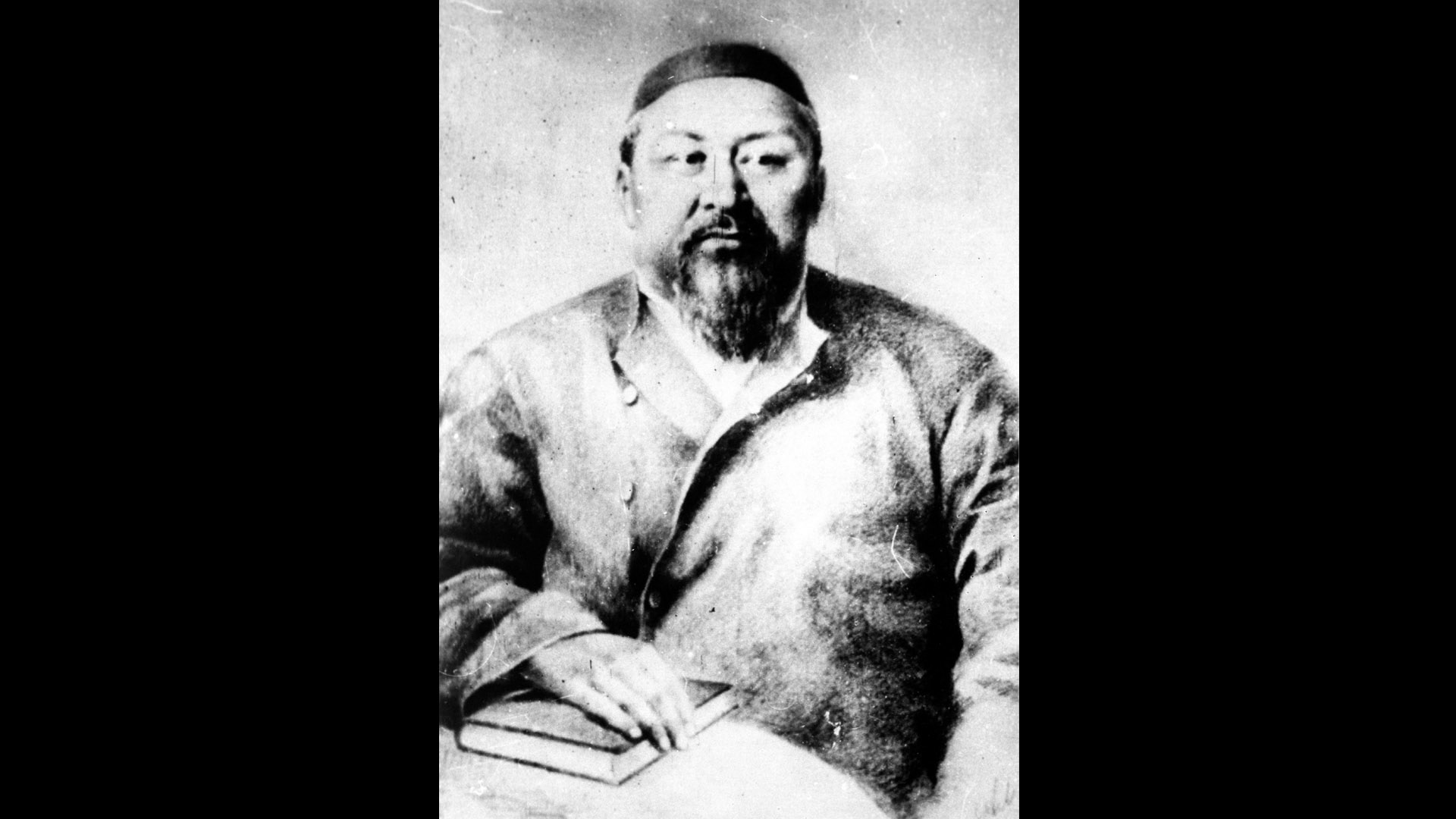
Abay (Ibrahim) Qunanbaiuly (1845-1904)
The founder of the new Kazakh written literature and the Kazakh literary language.
The author of many poems, several songs and poems on lyrical, philosophical, everyday and historical themes and motifs, which have gained wide popularity among the Kazakh people. He also translated a number of poems by great foreign poets such as Pushkin, Lermontov, Krylov, Goethe, Byron, Mickiewicz and a number of others.
Abay's significant contribution to the development of artistic prose and social thought was the Words of Wisdom or Gaklia (1890-1898). Abay's works have been translated into many languages, including Russian, Chinese, English, French, German, Polish, etc.
The Kazakhstan State Prize in Literature was established in memory of Abay. A city, a number of villages, streets, theaters, libraries and other objects in the country bear the name of Abay. The Kazakh State Academic Opera and Ballet Theater, the Kazakh National Pedagogical University in Almaty, the streets in Kazakh cities and several foreign countries, and the peak in the Ile Alataū (Trans-Ili) Range are named after Abay. Monuments and busts of Abay have been erected in dozens of Kazakh cities and villages, as well as in Moscow, Beijing, Tashkent, Vitebsk, Budapest, Tehran and Istanbul.
Events in honor of the 150th anniversary of Abay were held under the auspices of UNESCO in 1995.
Andrey Zenkov (1863-1936)
He was born in Tobolsk. His father was also an architect. In 1867, his family moved to the military fortification of Vernoye (now Almaty), where his father became one of the developers of the first layout plan. He is the originator of earthquake-resistant construction in Almaty. The buildings he constructed, including the Ascension Cathedral, withstood the strongest earthquake of 1911.
In the 1920s, Zenkov was restoring the urban property destroyed by the civil war. He remodelled residential properties into bakeries, anti-epidemic centers, hospitals and children's institutions. In 1925, he was appointed head of the Construction Control Department at the Council of People's Commissars of the Kazakh SSR. He participated in the development of the first housing and construction plan, when the capital was transferred from Kyzylorda to Almaty.
He was buried at the Central Cemetery of Almaty.
Alikhan Bukeikhanov (1866-1937)
He was born in a Chingizid (a Genghis-Khan descendant) family in the Aktogay district of the Karaganda region.
His thirst for knowledge and great diligence allowed him to enroll into and successfully graduate from a technical school in Omsk and the St. Petersburg Imperial Forestry Institute. While studying in Russia, Alikhan became close friends with prominent members of the Russian intelligentsia. Among his friends were such major scientists as Potanin, academicians Shcherbina, Shevtsov, Barthold and Radlov.
He was a member of four scientific expeditions. He produced more than 50 research papers, monographs, essays, and over 1000 articles.
In 1905-1907, he was the initiator and one of the main authors of the Karkaraly Petition containing political demands to the colonial authorities of the Russian Empire. He is one of the organizers and leaders of the Omsk City and Akmola Regional Committees of the Constitutional Democratic Party of Russia (in short - Cadets or the People's Freedom Party), founder of the Kazakh branch of the Cadet Party in Semipalatinsk and Karkaraly, and a member of the Congress of Zemstvo and City Officials of the Russian Empire, held in November 1905 in Moscow. In January-April 1906, he spent 4 months in Pavlodar and Omsk prisons, but was released dur to his election to the electorate.
In March 1917, he was appointed commissioner of the Provisional Government for the Turgay region and a member of the Provisional Government of the Turkestan Region.
In July-December 1917, he initiated the convocation of the 1st and 2nd All—Kazakh Congresses in Orenburg, where he announced the possibility and necessity of creating Alash-Orda, a national autonomy of the Kazakhs within the Russian state. In 1917-1920 he participated in the creation of military units of the Alash-Orda army, negotiated with the self-proclaimed All-Russian governments (Siberian Autonomy, Komuch, Ufa Directory, Omsk Government of Admiral Kolchak). In 1920, he recognized the Soviet government. In 1922-1927, he was engaged in scientific, pedagogical, literary and journalistic activities in academic institutions of Moscow and Leningrad.
From October 1927 to July 1937, he was under house arrest in Moscow. On July 26, 1937, he was detained and imprisoned in Butyrskaya prison. On September 27, 1937, he was sentenced to capital punishment on falsified charges of "organizing and leading a counterrevolutionary organization in Moscow and Kazakhstan" and "Japanophilia", on the same day he was shot and buried at the Don Cemetery in Moscow.
Ivan Panfilov (1893–1941)
Ivan Panfilov was born on January 1, 1893 in Petrovsk (Saratov region). Panfilov was drafted into the army during the First World War. From 1918, he served in the Red Army. On July 14, 1941, he was appointed Commander of the 316th Rifle Division. The division was formed in the shortest time and sent to the battlefield. This division was recruited from the residents of Alma-Ata (now Almaty) and Frunze (now Bishkek, Kyrgyzstan). Panfilov was killed by a shell splinter during the Battle of Moscow on November 18.
By a Decree of the Presidium of the Supreme Council of the USSR, on 12 April 1942 Panfilov was posthumously awarded the title of Hero of the Soviet Union for courage, heroism, initiative and exemplary military performance in the fight against German invaders. He was awarded the Order of Lenin, the Order of the Red Banner, and a medal. Panfilov was buried in Moscow.
Many schools in Central Asia are named after Panfilov himself and his Guardsmen. A street and an avenue in Moscow bear the name of Panfilov. Central Park in Almaty is named after Panfilov's 28 Guardsmen.
Manshuk Mametova (1922–1943)
Her real name was Mansiya Mamytova. On August 13, 1942, she volunteered to be enlisted. She participated in battles as part of the 100th Rifle Brigade and the 21st Guards Rifle Division. She was a senior sergeant and a machinegun leader. On October 15, 1943, in the battle for liberation of Nevel (Pskov region, Russian Federation), while defending a strategic hill, alone and seriously wounded, she destroyed 70 enemy soldiers with a machine gun and died of sustained wounds. After her last stand Mametova was posthumously awarded the title of Hero of the Soviet Union.
Streets in the cities of Nevel, Almaty, Uralsk and others, dozens of schools are named after Manshuk Mametova. Monuments were erected in her homeland and in the city of Nevel, there is a memorial house dedicated to Mametova. A feature film The Song of Manshuk was dedicated to Manshuk Mametova (script by A. Mikhalkov-Konchalovsky, directed by M. Begalin).
Aliya Moldagulova (1925–1944)
A sniper of the 54th Independent Rifle Brigade of the 22nd Army of the 2nd Baltic Front, corporal. She destroyed 78 enemy soldiers and officers. Moldagulova was fatally wounded and died of sustained wounds on January 14, 1944 in the battle north of Novosokolniki (Pskov region, Russian Federation).
Being wounded by a shell splinter, she participated in hand-to-hand combat with German soldiers, was wounded again but managed to kill the enemy. The second wound was fatal. On June 4, 1944, Moldagulova was posthumously awarded the title of Hero of the Soviet Union and the Order of Lenin.
Mukhtar Auezov (1897–1961)
Mukhtar Auezov was born in the Semipalatinsk region in the East Kazakhstan. His family was related to the great Kazakh poet Abay.
Auezov was educated at the Semipalatinsk Teacher's Seminary and Leningrad State University. His early work was Enlik-Kebek, a play about star-crossed lovers against the backdrop of inter-clan strife.
In the 1920s, Auezov actively participated in the political life of Kazakhstan. He was a member of the Communist Party, but also closely communicated with the former supporters of the Alash Orda and was subjected to political repressions in the early 1930s. He engaged in scientific work and teaching, at the same time writing his new works.
From 1942 to 1954, Auezov published a four-volume novel The Path of Abay, dedicated to life of abay, an outstanding figure in the Kazakh history. The novel gained a huge popularity and was soon recognized as the paramount achievement of Kazakh literature. In 1959, he was awarded the highest literary award of the USSR, the Lenin Prize.
He authored several novels, more than 20 plays, many novellas and short stories.
Auezov is one of the founders of the Soviet metallogenic science and the founder of the Kazakh school of metallogeny.
Kanysh Satbayev (1899–1964)
Kanysh Satbayev was born on April 12, 1899 in the village of Tendik, Bayanaul district, Pavlodar region.
In 1926, he successfully graduated from the Tomsk Technological Institute. After graduation, he headed the Geology Department at Atbastsvetmet. There, he was engaged in carrying out the first stationary geological explorations in the Kazakh SSR on the systematic identification of mineral reserves in the Zhezkazgan-Ulytau region.
Largely due to Satbayev’s contribution, by 1937, the explored copper reserves allowed Zhezkazgan to become the largest copper deposit in the world and justify the construction of the Zhezkazgan mining and metallurgical plant.
In 1941, Satbayev was appointed director of the Geological Institute of the Kazakh branch of the Soviet Academy of Sciences. A year later, he headed the Kazakh branch of the Soviet Academy of Sciences - the future Academy of Sciences of Kazakhstan. During these years, he focused on the design and construction of the Kazakhstan Magnitka, Balkhash and Atasu mining plant.
In June 1946, Satbayev was elected the first President of the Academy of Sciences of Kazakhstan. In October 1946, he was elected a full member of the Soviet Academy of Sciences. He personally led the comprehensive study of the natural resources of the Mangyshlak Peninsula, the exploration of new deposits of coal, oil, gas, ferrous metallurgy, actively supported the construction of the Irtysh-Karaganda canal. Satbayev was a great connoisseur of Kazakh history, literature, culture, ethnography, music and folklore. He is also known for his archaeological research in Central Kazakhstan and his works on pedagogy and literature.
In 1958, as the head of a group of Kazakh geologists, he was awarded the Lenin Prize, for the development of methodology and the compilation of predictive metallogenic maps of Central Kazakhstan.
He passed away on January 31, 1964 and was buried in Almaty.
Dinmukhamed Kunaev (1912–1993)
Dinmukhamed Kunaev graduated from Institute of Non-Ferrous and Fine Metallurgy in Moscow (1936), doctor of technical sciences (1969), member of the Academy of Sciences of Kazakhstan.
In 1936–1942, Kunaev held senior positions at the Altai, Ridder, Leninogorsk mines.
In 1942–1952, he was Deputy Chairman of the Council of People's Commissars of the Kazakh SSR and the Council of Ministers of the Kazakh SSR. In April 1952, he was elected President of the Academy of Sciences of Kazakhstan. In 1955–1960 and 1962–1964, Kunaev was a Chairman of the Council of Ministers of the Kazakh SSR.
In 1960–1962 and 1964–1986, he was the first Secretary of the Central Committee of the Communist Party of Kazakhstan. Kunaev is a three times Hero of Socialist Labor (1972, 1976, 1982).
Of 45 years that Kunaev spent working in senior leadership positions, for almost 25 he was the first leader of Kazakhstan. He made a significant contribution to the socio-economic and cultural advancement of the republic. Kunaev’s involvement promoted the constuction of many large industrial enterprises in Kazakhstan and establishment of new higher educational institutions, scientific institutions, healthcare, cultural, and sports facilities. Kunaev also fully endorsed the advancement of the creative potential of many Kazakh scientists, writers, artists, and filmmakers.
His name was given to the Mining Institute, a number of schools and streets of the country, and the university in Almaty. There is a memorial museum in Almaty dedicated to Kunaev. He received eight Orders of Lenin, various orders and medals.
Batyrkhan Shukenov (1962–2015)
Batyrkhan Shukenov was born in Kyzylorda. In 1979, he entered the Leningrad State Institute of Culture named after Krupskaya. At that time, he already knew how to play several musical instruments including saxophone.
In 1981, Shukenov entered the Kurmangazy Almaty State Conservatory receiving a professional music education. In 1983, as part of Arai musical group, he was awarded the title of Laureate of the Seventh All-Union Variety Artists Competition.
In 1987, with Vladimir Mikloshich, Bulat Syzdykov, Najib Vildanov and Baigali Serkebayev, he organized the Alma-Ata group. After releasing their first album Put' Bez Ostanovok (Road Without Stops), the group changed its name to Alma-Ata Studio, and later it was shortened to A-Studio. They gained popularity in 1990 with their hit song Julia. Creative efforts of the band and Shukenov personally were supported by famous Russian singer Alla Pugacheva. In 2000, he decided to go solo under a stage name Batyr. Throughout his career, Shukenov sang in Kazakh and Russian. Shukenov was active and held concerts in Kazakhstan and Russia.
He passed away on April 29, 2015 in Moscow and was buried in Almaty. Tens of thousands of people came to pay their final respects. His fans bid their final farewells with applause and singing his hit song Julia.
Shukenov's songs are played on radio stations in all post-Soviet states and are very popular.