Меню
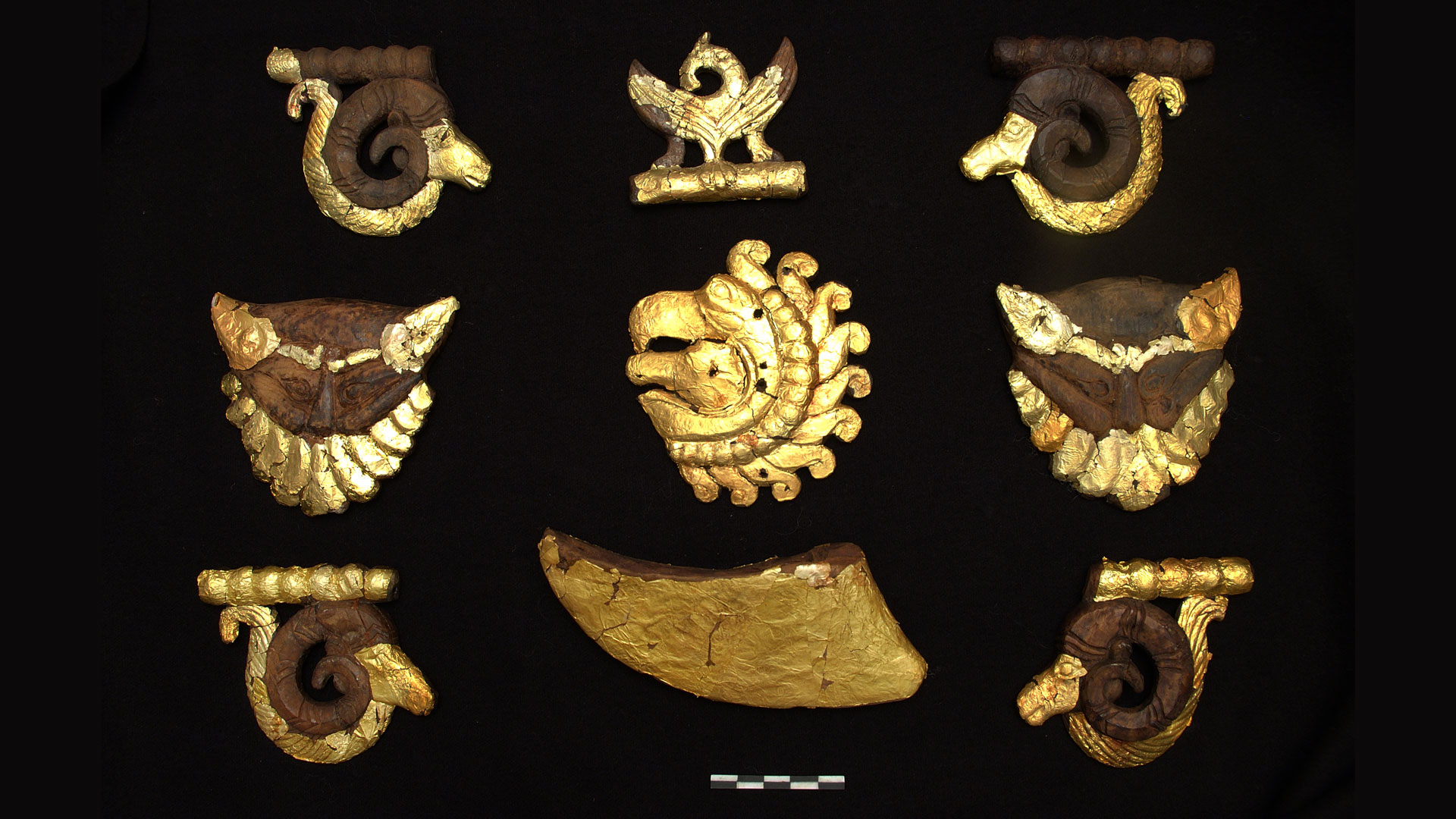
In the first millennium BC, the tribes inhabiting the territory of Kazakhstan were collectively named "Saka", which are also known as "Scythian" in European culture. The Persian sources of that time describe in detail three large groups of Saka tribes: amyrgians , massagetae, paradraya. A lot of information about the Saka tribes was recorded by the "father of history", the Greek chronicler Herodotus. Thus, the tribes of the Massagets, Sauromats, Issedons, Argippeans, Arimaspians, Assians, Pasians, Sakarauks and others are mentioned.
Saka mounds are large ancient structures reaching 20 meters in height, with a diameter at the base up to 120-150 meters. There are also small hills up to 1-1.5 meters high and 5-7 meters in diameter among them. Large mounds are called royal, because representatives of ruling dynasties and the military elite of ancient tribes are buried under them.
In medium—sized mounds — up to 50 meters in diameter and up to 10 meters high — noble warriors, charioteers and priests were buried, and in small ones – 10-15 meters in diameter and 1.5—2 meters high - ordinary people. There are both single mounds and their clusters — from several dozen, or even hundreds. Mounds and burial mounds are found everywhere in Kazakhstan: in the steppes and semi-deserts, intermountain and river valleys, in the mountains and foothills. There are especially many of them in Zhetysu, in the foothills of the Dzungarian, Zailiy and Talas Alatau, in the mountains of the Central Tien Shan.
Written sources are supported by a large number of archaeological finds. It was the Saka tribes who became the creators of huge burial complexes — mounds, in one of which in 1969, on the banks of the Issyk River, 70 kilometers from Almaty, the famous "Golden Man" was found.
The Issyk burial mound, in which the "Golden Warrior" was discovered, is considered to be one of the largest archaeological monuments of the Scythian-Saka period and one of the significant discoveries in the archeology of the XX century. The young man buried in the mound belonged to the circle of Saka-Tigrahaud (Massagetae) rulers. He was dressed in richly decorated armour with gold plaques, a belt, and a ceremonial dress embroidered with gold. In total, about 150 ornaments were placed on the headdress. The Golden Man became the embodiment of the courage of the defenders of the land on which the ancestors of today's Kazakhs lived — Saks, Huns, Uysuni, Kipchaks. Replicas of the "Golden Warrior" are exposed in museums in Almaty and Astana, as well as at the UN headquarters in New York.
A distinctive feature of the Saka civilization was the large-scale use of cavalry in military affairs, which was a novelty for agricultural cultures of that time, who were relying on the power of infantry and chariots. It was the Saka and Sarmatians who created such an advanced type of the armed forces at that time as heavy cavalry. Detachments of armoured riders on solid and hardy horses, which were also often equipped with armor, went into a decisive spear attack. The attack began with archers who shot the enemy from a long distance. The Greeks called them cataphractaries, that is, covered with armour. The new type of troops that proved its effectiveness and the strategy of fighting were borrowed by other states. The historian F. Cardini believes that it was the Saka cataphractaries that became the forerunners of European chivalry.
The worldview and love of creativity of the early nomads were reflected in the creation of a special art in the applied crafts field— "animal style".
The Saka "animal style" began to emerge in the Bronze Age and finally took shape by the VII–VI centuries BC. The creativity of ancient artists was in a lively and diverse interaction with particular images of the animal world. As for the Kazakh fauna, images of argali, tiger and wild boar, moral, camel, and steppe eagle are most often found; less often — saiga, wolf and hare.
The artistic embodiment of animal images was also diverse. Usually, those were shaped in round sculptures of silhouette and linear drawings. Those products were made of such materials as gold, silver, bronze and iron. Bone and horn carvings, applications, and mosaic sewing made of multicoloured felt and leather have also become widespread.
One of the most famous Saka rulers was Queen Tomiris, who defeated the Persian conqueror Cyrus, who intended to conquer the nomads. However, with his death, the invasions of the Saka steppe did not stop. The war with the Persian king Darius and the fight against the invasion of the troops of Alexander the Great became particularly famous.
The invasion of the Greeks in 329-327 BC was met with stiff resistance by the tribes and nationalities of Central Asia. The tribes that inhabited the southern regions of Kazakhstan at that time, in particular, the Massagetaes, actively participated in the struggle against the troops of Alexander the Great. Wounded by Saka arrow, Alexander the Great could not cross the Syr Darya with his troops. The Greeks managed to temporarily subdue the peoples of Central Asia only after almost three years of fierce struggle. The Saka tribes, who lived beyond the Syr Darya, preserved their independence.
It is notwworthy that the Saka tribes have formed a more complex structure of society than in previous periods. Within the framework of the so-called "military democracy", the Saka tribes were headed by kings elected by the warrior class, who also performed the role of high priests.
The dominant form of religious beliefs among the Saks was the cult of ancestors, so they put part of their property in the grave next to the deceased, and embalmed the bodies of the deceased. They also worshipped the sun and fire. Ancient Iranian sources testify to the spread of such religious beliefs as animism and totemism.